
Around the world, governments in different countries are being pressured to adopt emergency measures to contain the effects of soaring oil prices on inflation, supply and economic activity.
The price of a barrel of Brent oil reached US$119 (around R$621) this Thursday morning (19), following attacks by Israel and Iran on energy infrastructure in the Middle East. At the end of the day, the price fell to US$108, but with no stability expected.
In Brazil, the Lula government announced last week exemption from PIS and Cofins charges on diesel and a subsidy for diesel producers and importers, in the amount of R$0.32 per liter. The Palácio do Planalto also promised supervision against “abusive increases” at gas stations and is pressuring state governments to eliminate ICMS on diesel imports, while trying to deal with a threat of a general strike by truck drivers.
Other countries are betting on different responses: while nations like Bangladesh closed universities and placed facilities under military control, others, like Argentina, preferred not to intervene in prices. See below how the reaction is around the world.
Crisis puts pressure on right-wing governments in South America
Already Argentinafuel prices have already risen by around 13%. According to industry executives interviewed by the local press, there are cases in which refiners are selling gasoline and diesel below cost to avoid steeper increases. Until now, however, the Argentine government has avoided directly intervening in fuel prices.
Last week, the president Javier Milei even stated that the international rise in oil prices caused by the war could have positive effects on the country’s economyby increasing the value of the country’s exports of energy and agricultural products.
No Chilethe crisis in the oil sector caused by the war creates a dilemma for the recently installed government of José Antonio Kast. The government is evaluating how to balance the containment of fuel prices with the fiscal cost of the subsidy used to hold the adjustments. The country uses the so-called Fuel Price Stabilization Mechanism (Mepco), in which the State assumes part of the price variations to reduce the immediate impact of rising oil prices at gas stations.
The Kast government is currently discussing adjustments to the system to try to avoid high State spendingwithout passing on abrupt increases in fuel prices to the consumer. According to the local press, without Mepco, the price of fuel in Chile would have already risen by more than 100 pesos per liter (around R$0.60) in a few days.
No Ecuador, The price of gasoline has also risen and reached US$2.89 (R$15) per gallon (3.78 liters), one of the highest recent levels. For some years now, the Ecuadorian government has limited readjustments in the sector: the price can only rise up to 5% per month, even in periods of strong growth, like now. The measure avoids increases all at once, but causes fuel to continue to become more expensive little by little. In the current scenario, the trend is for new gradual increases in the country if oil pressure on the international market continues.
No Peruthe rise in oil prices on the international market is already putting pressure on fuel prices. In the capital Lima, the price of gasoline varies between 18 and 21 Peruvian soles per gallon (around R$27 to R$31), depending on the region. Before the war the price varied between 15 and 16 soles (R$22 and R$24) per gallon. The Peruvian government is monitoring the situation and attributes the increase to the international scenario, with the war in the Middle East. The country has not yet adopted any price containment mechanism.
In Uruguay, although there is still no evident increase in fuel prices following the rise in oil prices, the government claims that it has been monitoring the situation in the Middle East with caution. Gasoline in the country costs around US$2.08 per liter (around R$10.80), one of the highest prices in the region. More than half of this amount corresponds to taxes, which means that any increase in the international market has a direct impact on the economy and increases pressure for readjustments.
Trump considers easing restrictions on Iranian oil
In the United States, which is leading the offensive against Iran in the Middle East, the rise in oil prices has already reached the pumps. The average price of gasoline reached around US$3.88 (R$20.20) per gallon, the highest level since 2022, while diesel reached US$5 (R$26) per gallon, according to data from the American Automobile Association (AAA). The value represents an increase of US$0.25 (R$1.30) in one week and almost US$1 (R$5) in one month.
To try to contain the impact, President Donald Trump’s government began discussing emergency measures, such as the use of strategic oil reserves and even the easing of restrictions involving Iranian oil to increase global supply. Last week, the White House temporarily lifted sanctions on Russian oil already shipped.
No Canadafuel prices also rose rapidly. The liter of gasoline has risen by around 30% since the start of the conflict in the Middle East. Despite being an oil exporter, Canada does not escape global price pressure. In the country, the debate within the government has focused on possible cuts in fuel taxes to alleviate the final price for consumers.
Asia is the most affected region
In Asia, the region that most depends on oil sent from the Middle East, the effects of the war on the energy sector are already beginning to alter the functioning of several economies.
In the Philippines, the government reduced working hours to four days a week and limited energy use in public buildings as a way to save fuel in the face of rising prices.
The communist regime of Chinathe world’s largest oil importer, in an attempt to contain the impact of the crisis on domestic prices, banned the export of refined fuels, reinforced supply in the country and maintains a control system that smoothes price transfers to the consumer.
The country also continues to import Iranian oil, as it is an ally of Tehran, and does not rule out using strategic reserves estimated at around 1.4 billion barrels to maintain prices and avoid shortages in the provinces.
No Japan, the price of gasoline reached a historic record, with an increase of close to 18% in just one week. To contain an even greater impact, the government decided to resume subsidies on the value of a liter of gasoline, with the aim of reducing the price, in addition to starting the release of strategic reserves.
Information from the local press cites that Japan has a reserve of around 80 million barrels. Even with high stocks, authorities warn that, if the oil crisis caused by the war in the Middle East persists, the impact could have an impact on inflation, energy costs and even food in the country.
No Vietnamauthorities encourage remote work and use stabilization funds to contain fuel and energy prices. Already in Thailandthe government temporarily froze the price of diesel and advised the population to reduce the use of air conditioning and even avoid elevators to reduce energy consumption.
Already Indiathe government began to subsidize a significant part of the increase in fuel prices, absorbing more than half of the increase caused by the crisis in the sector to avoid passing it on to the population. Even so, there are still records of rising food costs and concerns about inflation.
No Pakistan, Gasoline prices have already risen around 20% since the start of the conflict in the Middle East. There are also records of queues at gas stations, with the population fearing a lack of fuel due to the uncertainty of supply. As a measure to reduce pressure, the government began cutting the use of fuel used in official vehicles by half and reducing the fleet in circulation.
The country has also encouraged remote work and created restrictions on energy consumption. Pakistan has little fuel reserves, according to international press data, enough for just 28 days, which increases the risk of fuel rationing if the crisis in the Middle East continues.
Em Bangladeshthe government closed universities and placed fuel installations under military control to avoid interruptions in supply, given the risk of protests. Node Sri Lankathe government started fuel rationing, with weekly limits, around 15 liters per car, 5 liters for motorcycles and up to 60 liters for public transport
Already South Koreathe government is considering imposing temporary limits on fuel prices, a measure that has not been adopted since the 1990s, to try to contain the rise. The government is also preparing to use its strategic oil reserves. Furthermore, the country has also discussed subsidies and other ways to contain the impact of the crisis in the sector on consumers and companies, given the heavy dependence on imported oil.
Europe is on alert
In Europe, both the European Union (EU) countries and the United Kingdom are already suffering from the crisis in the oil sector caused by the war. Data from the European Commission, the EU’s executive arm, show that the average price of gasoline in the bloc has risen by around 8% since the start of the conflict, but in some countries the increase has been much stronger. In Germany, for example, a liter jumped from 1.82 to 2.07 euros (R$11 and R$12), an increase of almost 14%, while in Austria the increase was around 13% in the same period.
In Spain, diesel has already increased by 29% and gasoline by 16%. In countries like the Netherlands and Denmark, fuel is already among the most expensive in Europe, with prices above 2.20 euros (R$13) per liter.
No United Kingdomdiesel rose by around 20% since the start of the war, while gasoline rose by around 7% in the period. Local media points out that, if the price of a barrel of oil remains above US$100 (R$521), prices could continue to rise in the coming weeks. To try to contain the increase, the government has put pressure on distributors and launched an investigation into possible price abusedemanding cost and margin data from companies and monitoring posts to avoid unjustified increases. The government also announced more subsidies for needy families.
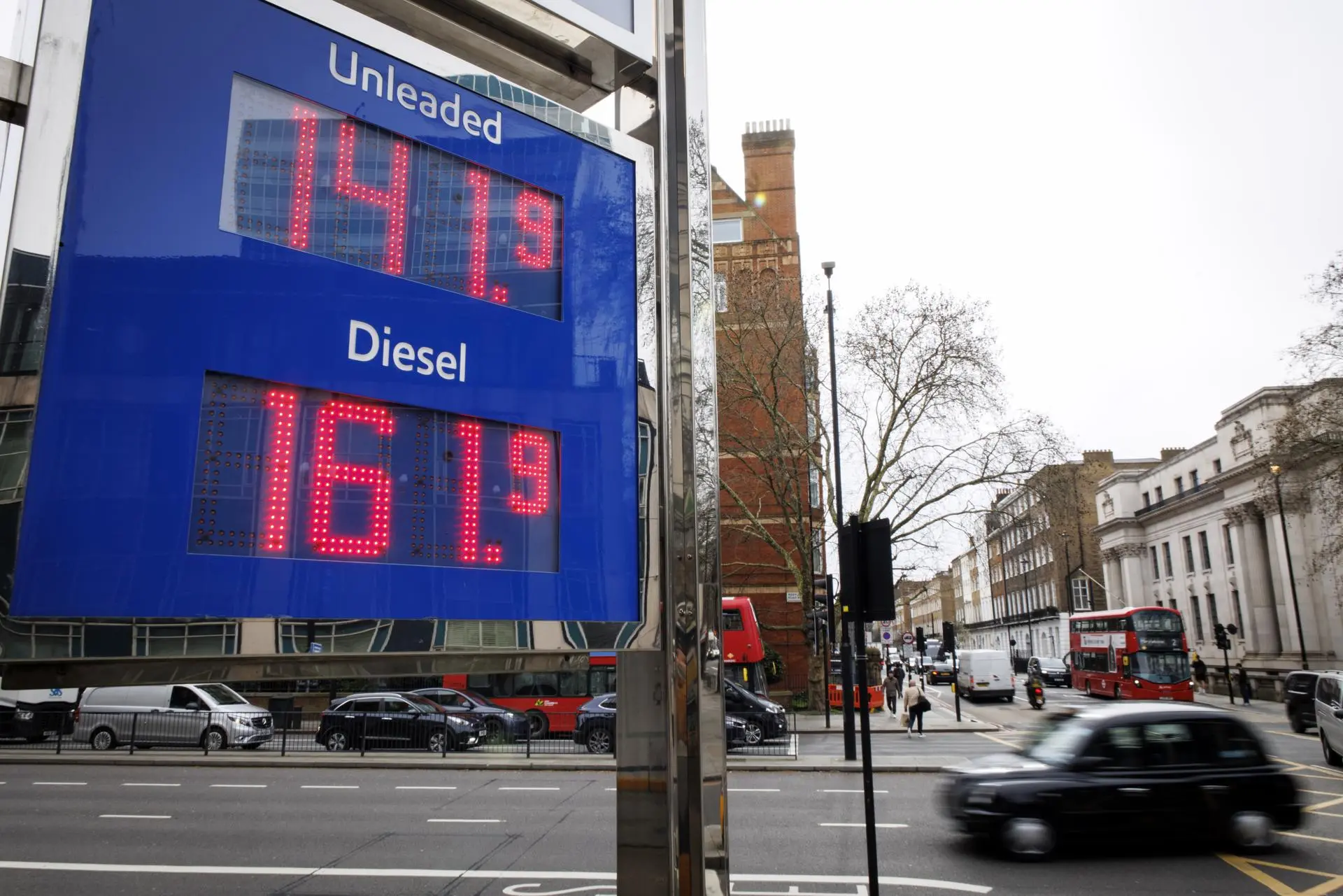 Petrol and diesel prices displayed at a gas station in London, United Kingdom. The country is already feeling the effects of the war in the Middle East, with rising fuel prices. (Photo: TOLGA AKMAN/EFE/EPA)
A Germany discusses limiting job readjustments to once a day, while the Austria has already adopted a stricter rule, allowing increases only three times a week.
A Hungaryin turn, established a ceiling on the price of gasoline for vehicles with local license plates, in an attempt to avoid distortions and an increase in the flow of drivers from neighboring countries in search of cheaper fuel.
Leaders of European Union met this week to discuss emergency measures, including the use of financial instruments, support for families and businesses and possible mechanisms to reduce the cost of energy.
Analysis of think tank Council on Foreign Relationspoints out that the combination of attacks on energy facilities in countries in the Gulf and the restriction of the flow of oil and gas through the Strait of Hormuz has already drastically reduced the global energy supply, which is putting pressure on prices and causing governments to take emergency action to avoid possible economic collapses.
If the conflict continues in the Middle East and the flow through the Strait of Hormuz is not normalized, the energy crisis scenario tends to evolve from a price crisis to an even greater supply crisis in the various regions already affected.
