
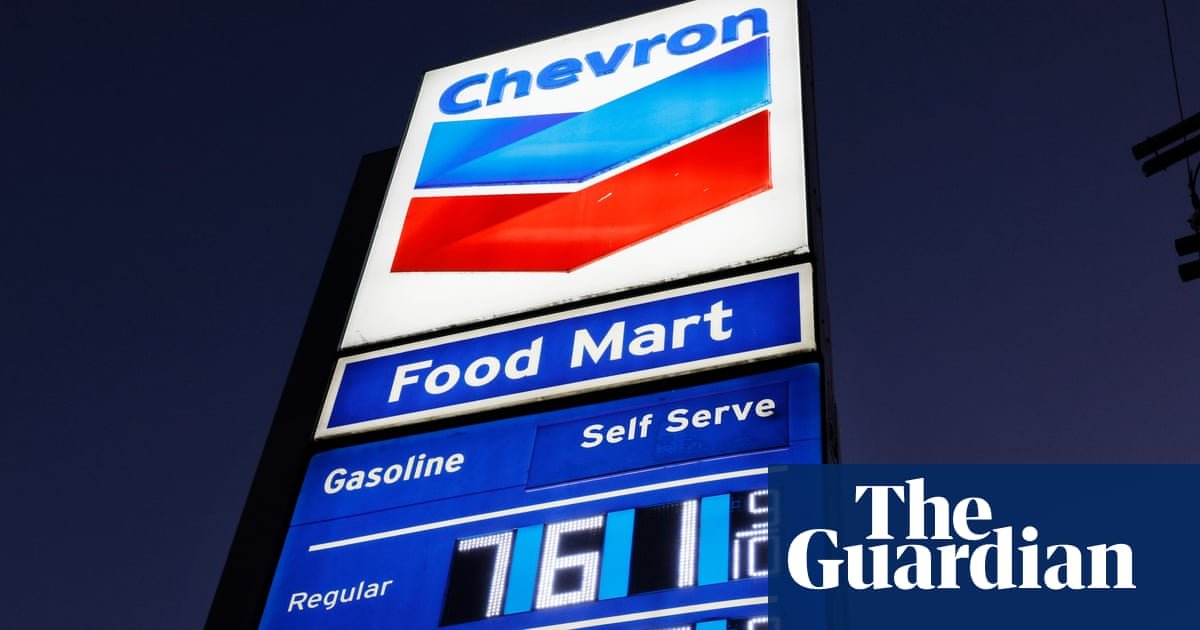
It’s tempting to think that a gas station charging more than $8 a gallon is a glamorous Los Angeles curiosity. Sort of like shopping at Erewhon, the healthy grocery chain that wows with a premium experience – and commands up to $22 a smoothie.
But there’s no glamour at the 901 N Alameda Street station. It’s just a dingy Chevron on the edge of LA’s Chinatown, regularly featured in news stories to illustrate the high cost of fuel in California. Midday on Tuesday, the station charged $8.31 for a gallon of regular gas.
The price of gasoline has spiked since the US and Israel attacked Iran, according to AAA data. But the Alameda Street station is an outlier: in Los Angeles, the average price hovers at about $5.37.
An attendant who did not want to be identified said the station’s outsized prices are because of its downtown location. But when asked why stations barely two miles away sold gas for much less, she demurred.
Unsurprisingly, the station sat largely deserted. An unhoused man bought a bottle of Pepsi. Two cars approached the pumps and drove away. Only a couple of customers bought gas during a 40-minute period. One was a frazzled woman in a black SUV with Nevada plates. She quickly pumped some fuel and peeled off toward Union Station, about two blocks away. The other was Alex Markarian, who works at the LA county assessor’s office near Grand Park.
“Really, I didn’t pay attention to the price when I drove in,” he said. Markarian expressed regret he didn’t wake in time to fill his Prius near his home in Pomona before heading to the office. He ended up pumping 4.1 gallons – plenty to safely get back – and paid $34.56. “Where I live it’s cheaper by at least $3 a gallon,” he said. He calculated he paid a $12 tax “for just being lazy”.
A content creator showed up and started shooting footage. The attendant declined to offer the owner’s contact information and said they were not interested in interviews. “This is private property,” she said.
Soon, a police cruiser appeared with lights on. The content creator adjourned to the public sidewalk.
The Chevron station is owned by Joe Bezerra Jr’s Hawk II Environmental Group. Public records indicate the Bezerra family has long operated independent fuel stations in southern California. Attempts to contact Bezerra and other family members were unsuccessful.
Online reviews indicate Hawk II may have a habit of rubbing customers the wrong way. A mail carrier blasted its Hacienda Heights station for charging him $1 for a small amount of ice. Others complained about exorbitant gas prices in various locales. One reviewer called the Alameda station a scam. Some would-be customers have alleged it’s a grift or price gouging.
High prices may be galling at this station, but they probably aren’t illegal, says LA county department of consumer and business affairs spokesperson Keven Chavez. Businesses can charge high prices, or even substantially raise them, and it is likely not considered a price gouging violation unless those increases are due to a declared federal, state or local emergency.
AAA spokesperson Kandace Redd also said it’s no crime – and no surprise – when gas stations near each other charge varied prices. “[Prices] can depend on factors such as traffic, rent or where the station gets its fuel,” said Redd. “Gas stations in busy areas, such as near highways, airports, tourist destinations or downtown districts, often charge higher prices.”
Indeed, Bezzera’s Chevron is wedged between touristy Olvera Street and Philippe the Original, an LA institution famous for its French dip sandwiches. The higher cost could be because rent and operating costs are more in this location, notes Redd.
Furthermore, come spring, California stations are compelled to switch to a summer blend gas formula, which is more environmentally friendly for warm weather – but also costlier to produce. Naturally, the cost increase is passed along to the consumer. Redd suggests comparison shopping with AAA’s free app, which shows where stations are located and how much they’re charging in real time.
While few have the stomach to empathize with a hawkish proprietor, it is also worth noting that station owners generally realize slim margins on gas, just pennies per gallon. In California, nearly 90 cents on each gallon goes to a combination of local, state and federal taxes. Most of the rest goes to the oil producer, as well as costs associated with refining, distributing and marketing the gasoline, according to the National Association of Convenience Stores – a trade group representing the gas station and convenience store industry. On the other hand, proprietors rake it in on drinks and snack foods. Profit margins can easily exceed 40%.
The downtown Chevron potentially made more on the unhoused man’s Pepsi purchase than it did on Markarian’s fuel. But this doesn’t make Markarian feel any better.
“I won’t be stopping for gas here again, that’s for sure,” he said.
