
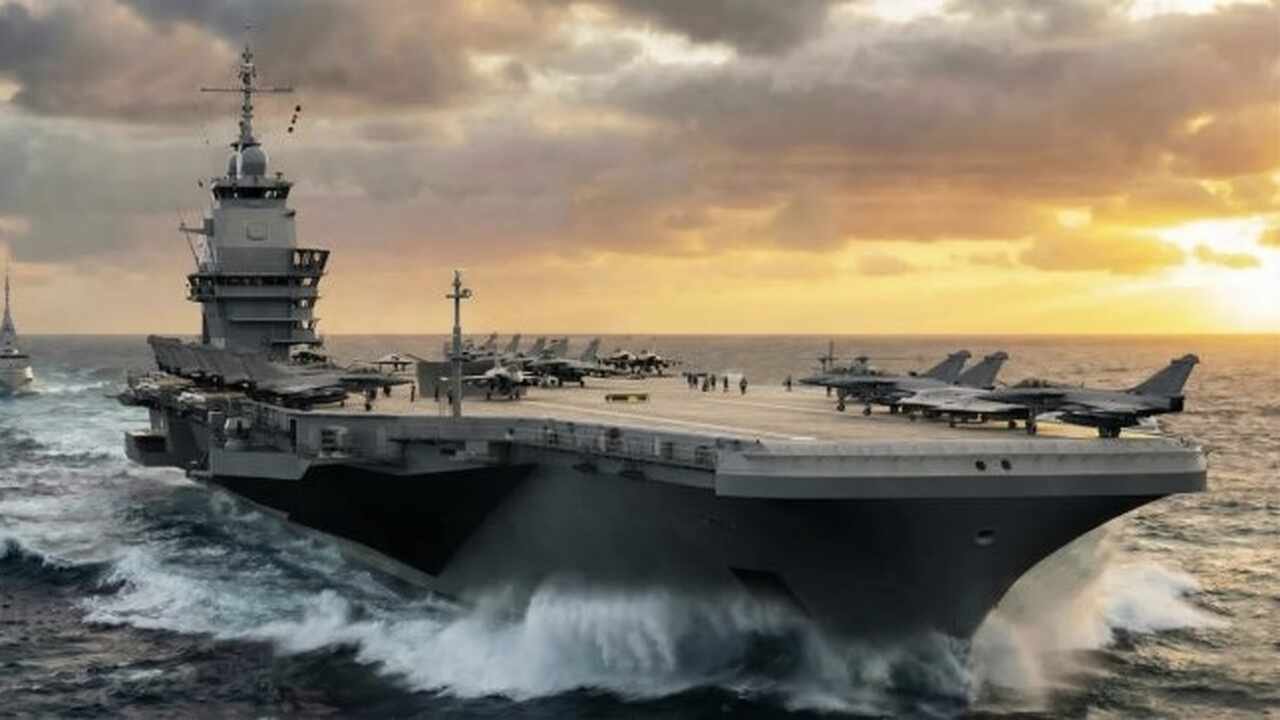
Emmanuel Macron, President of France, announced the official name of the new next-generation nuclear-powered aircraft carrier during a press conference last Wednesday (18).
According to the website’s report The Aviationistthe aircraft carrier will be called Free France (Free France), a name that pays tribute to French citizens who resisted the Nazi government during World War II.
“In this name lives the memory of the women and men who stood up against barbarism, united to save the homeland, determined to defend a certain idea of our nation,” Macron noted.
“This name, therefore, seals a promise for the future: to remain free, we must be feared. To be feared, we must be powerful,” added the French president.
O Free France (R92), previously known as New Generation Aircraft Carriers (PANG), will replace the current French aircraft carrier Charles de Gaulle (R91) from 2038. Weighing 78,000 tons, 310 m long and 90 m wide, she will certainly win the title of Europe’s largest aircraft carrier.
This larger size can allow a greater number of aircraft to be transported, but more importantly it provides a much higher output generation rate and greater safety on deck. This means deck handlers will have more room to maneuver, prepare and arm aircraft before they are taxied to the catapults.
+ Ukrainian pilots warn of aging flight equipment crisis
With the increased length, France Libre will be able to accommodate simultaneous aircraft launch and recovery. Currently, with the Charles de Gaulleonly two steam catapults overlap the angled landing area to give them the length needed to reach launch speed.
Already the Free France will feature three Electromagnetic Aircraft Launch System (EMALS) catapults, as well as the Advanced Arresting Gear (AAG) developed for class ships USS Gerald R. Ford.
The project PANG had initially been planned as a complement to the Charles de Gaulle, but, over the years, the plan turned to transforming the vessel into a complete replacement for France’s current aircraft carrier.
Currently, the Free France it was advertised as a single ship. Unless this changes in the future, the new French aircraft carrier will inherit the biggest flaw of the Charles de Gaulle: When it is not available, there is no alternative.
For a nuclear-powered vessel, this is particularly important, as a substantial period out of service is almost an absolute certainty due to the need to refuel the nuclear reactors.
The timing of this major overhaul would be dictated by the viable fuel remaining in the reactors as well as the state of the vessel’s material, and unlike a regular refit, the process cannot be easily rushed.
O Charles de Gaulle began its first 18-month refueling process in 2007 and completed a second refueling in 2018. If this pattern continues, the aircraft carrier will have to be refueled again in the coming years.
Therefore, despite offering many advantages, a nuclear-powered vessel has some defects, including long maintenance requirements, which are laborious, make the ship unusable for a long time and add significant cost to the construction of an aircraft carrier.
Long live Free France! pic.twitter.com/OydF3TtY2F
— Emmanuel Macron (@EmmanuelMacron) March 18, 2026
Photo and video: Naval Group / X @EmmanuelMacron. This content was created with the help of AI and reviewed by the editorial team.
