
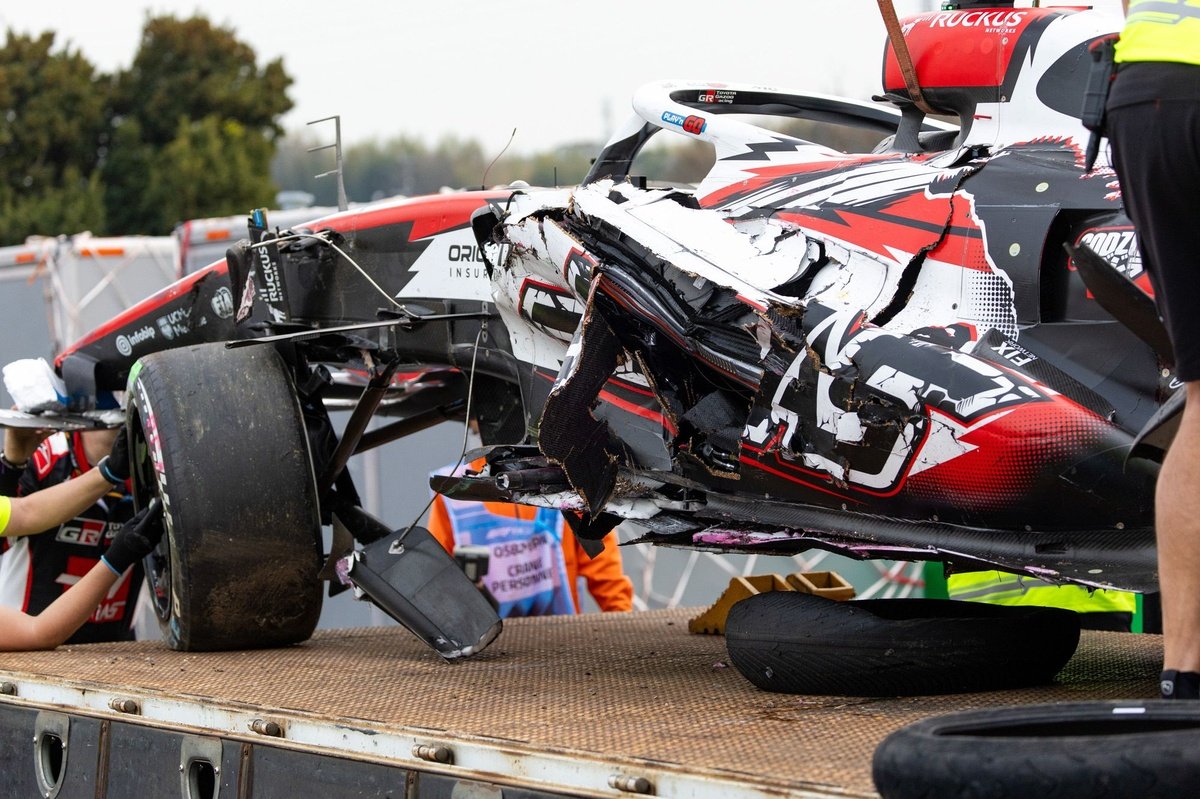
The safety implications of Formula 1’s new technical regulations have rocketed to the top of the agenda after Oliver Bearman’s massive accident in the Japanese Grand Prix. The Haas driver had been a second behind Franco Colapinto on their 21st lap when the gap narrowed suddenly and unexpectedly because of a huge difference in electrical boost as they approached the Spoon corner.
It’s understood that the Alpine was not actively harvesting energy at that point, hence the warning lights on its rear wing were not illuminated in the seconds immediately before the incident. Nevertheless Bearman’s closing speed was 45km/h.
Bearman had to swerve in avoidance while travelling at 308km/h, going sideways over the grass on the inside and skidding back over the track, through the run-off and into the barrier. The impact was measured at 50G.
Afterwards the reaction from the other drivers was a chorus of I-told-you-sos.
“There were a lot of big moments there in the first three laps while we were all sorting out our energies until our systems learned with the closing speeds we have with the boost button,” said Grand Prix Drivers’ Association director Carlos Sainz after the race.
“Even without using the boost button, sometimes your engine gives you a lot more speed than the guy in front, depending on where the other is on the energy. It was only a matter of time, the first big crash was going to happen.”
In a separate interview with Sky F1, Sainz went further, saying, “We’ve been warning them [F1 and the FIA] about this happening.
Carlos Sainz, Williams
Photo by: Simon Galloway / LAT Images via Getty Images
“These kind of closing speeds and these kind of accidents were always going to happen, and I’m not very happy with what we’ve had up until now. Hopefully we come up with a better solution that doesn’t create these massive closing speeds and a safer way of going racing.”
A revision to the energy-management regime has been on the cards since before the start of the season, since a consensus emerged during testing that the data from the first two rounds at least would be reviewed before drawing any firm conclusions about the pathway to improving the formula. Given the cancellation of the Bahrain and Saudi Arabia GPs in April, it was then decided the discussion would take place at an F1 Commission meeting on 9 April.
It’s understood, though, that the focus would be on how to improve the ‘show’ in qualifying, since the commercial rights holder is broadly satisfied with the results of the new technical package in terms of the on-track spectacle.
But the scale of the Bearman incident has provided a timely reminder of the dangers involved when cars deploy electrical energy at different times, or when one car suddenly runs out of energy – something the drivers have been vocal about since before the start of the season.
The FIA has now moved to make its position clear.
“Following the accident involving Oliver Bearman at the Japanese Grand Prix and the contribution of high closing speeds in the accident, the FIA would like to provide the following clarifications,” the governing body said in a statement.
“Since their introduction, the 2026 regulations have been the subject of ongoing discussions between the FIA, Teams, Power Unit Manufacturers, Drivers and FOM. By design, these regulations include a number of adjustable parameters, particularly in relation to energy management, which allow for optimisation based on real-world data.
“It has been the consistent position of all stakeholders that a structured review would take place after the opening phase of the season, to allow for sufficient data to be gathered and analysed. A number of meetings are therefore scheduled in April to assess the operation of the new regulations and to determine whether any refinements are required.
“Any potential adjustments, particularly those related to energy management, require careful simulation and detailed analysis. The FIA will continue to work in close and constructive collaboration with all stakeholders to ensure the best possible outcome for the sport and safety will always remain a core element of the FIA’s mission. At this stage, any speculation regarding the nature of potential changes would be premature. Further updates will be communicated in due course.”
We want to hear from you!
Let us know what you would like to see from us in the future.
– The Autosport.com Team
