
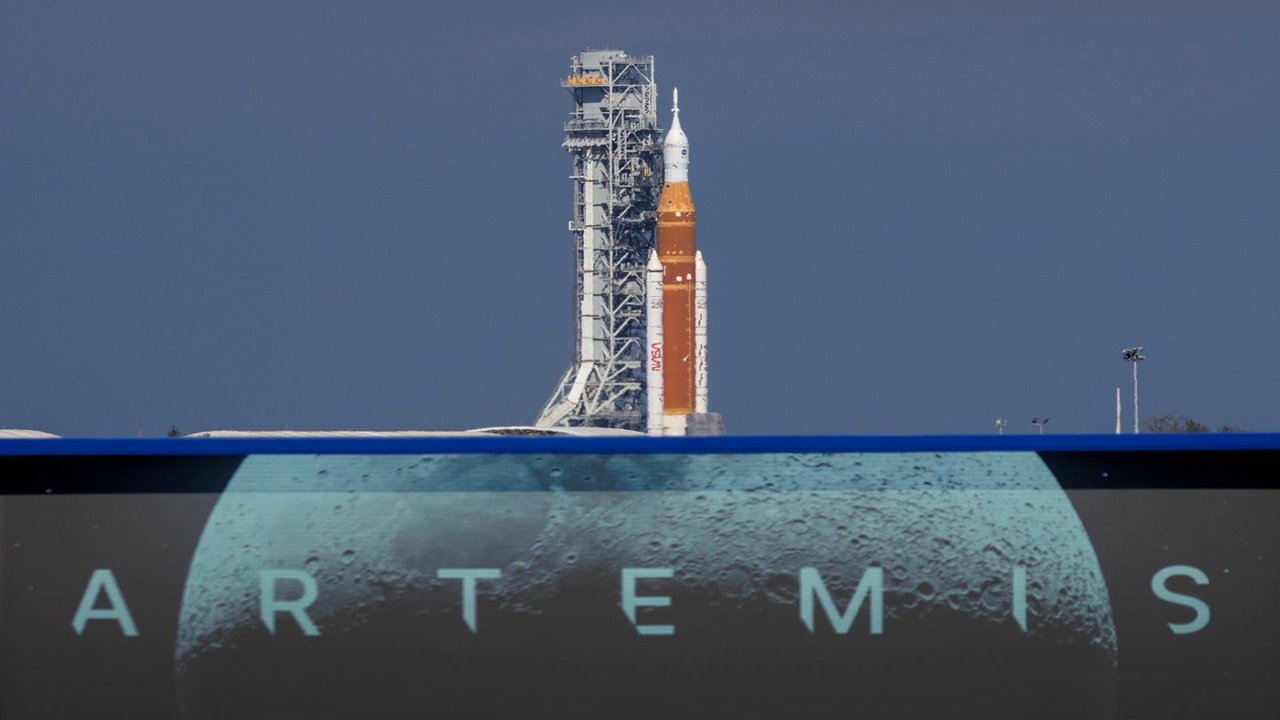
The Artemis II mission should take off this Wednesday (1st), at 7:24 pm Brasília time, marking the return of man to the Moon for the first time in more than 50 years. The mission launch is scheduled to take place from Complex 39B at the Kennedy Space Center in Florida. If weather or technical conditions prevent takeoff at the scheduled initial time, NASA has reservation dates scheduled until April 6th.
According to NASA, weather forecasts for this Wednesday indicate an 80% chance of favorable conditions, with partially open skies and temperatures around 26°C in the Cape Canaveral region, where the space center is located.
How and where to watch
NASA will broadcast the mission’s launch live around the world on its YouTube channel (click here to see). Coverage on YouTube begins at 8:45 am (Brasília time), with live images from the launch pad. The American agency’s social networks, including X and the Facebookwill also display the mission launch in real time.
What is the mission
Artemis II will be the rocket’s first manned flight Space Launch System (SLS) and capsule Orionnamed by the crew of Integrity – “integrity”, in Portuguese. The mission that will be launched this Wednesday does not foresee landing on the lunar surface, as happened last time. On this occasion, the astronauts will simply fly over the Moon and return to Earth on a journey lasting approximately ten days, covering around 1.1 million kilometers. The main objective of this mission is to test the life support systems of the Orion with crew on board for the first time, paving the way for a manned lunar landing planned for the Artemis IV mission in 2028.
According to NASA, Artemis II will take astronauts approximately 8,900 kilometers beyond the Moon – further than any human has ever traveled in space. The previous record belonged to Apollo 13, which in 1970 came within 400,000 kilometers of Earth.
The crew
Four astronauts make up this mission. NASA veteran Reid Wiseman is the commander, responsible for the safety and overall execution of the flight. Victor Glover occupies the position of pilot, in charge of operating the spacecraft. Christina Koch and Jeremy Hansen – the latter representing the Canadian Space Agency (CSA) – act as mission specialists, responsible for scientific experiments and operating specific equipment.
 The crew of the Artemis II mission poses at the Kennedy Space Center in Florida. From left to right: Commander Reid Wiseman, pilot Victor Glover, mission specialist Christina Koch and Canadian Space Agency astronaut Jeremy Hansen. The mission will mark the return of astronauts to the Moon’s orbit after more than half a century. (Photo: Bill Ingalls/NASA/EFE)
Ten days in space
According to NASA’s planning, the first day of the mission will be dedicated to the launch and initial testing of the NASA systems. Orion in Earth orbit. On the second day, the capsule’s main engines will be activated to place the spacecraft on a lunar trajectory. The following days, until the fourth, will be transit towards the Moon, with testing procedures and system checks.
The most anticipated moment will occur on the fifth and sixth days of the mission: the spacecraft will enter lunar space and perform a flyby, passing between 6,400 and 9,600 kilometers from the surface of the Moon. From Orion’s window, according to NASA, Earth’s natural satellite will appear to be the size of a basketball held at arm’s length. The crew will dedicate around three hours to observations, photographs and scientific data collection. From the seventh to the tenth day, the spacecraft will return to Earth, with the landing scheduled to take place in the Pacific Ocean, near San Diego, California.
