
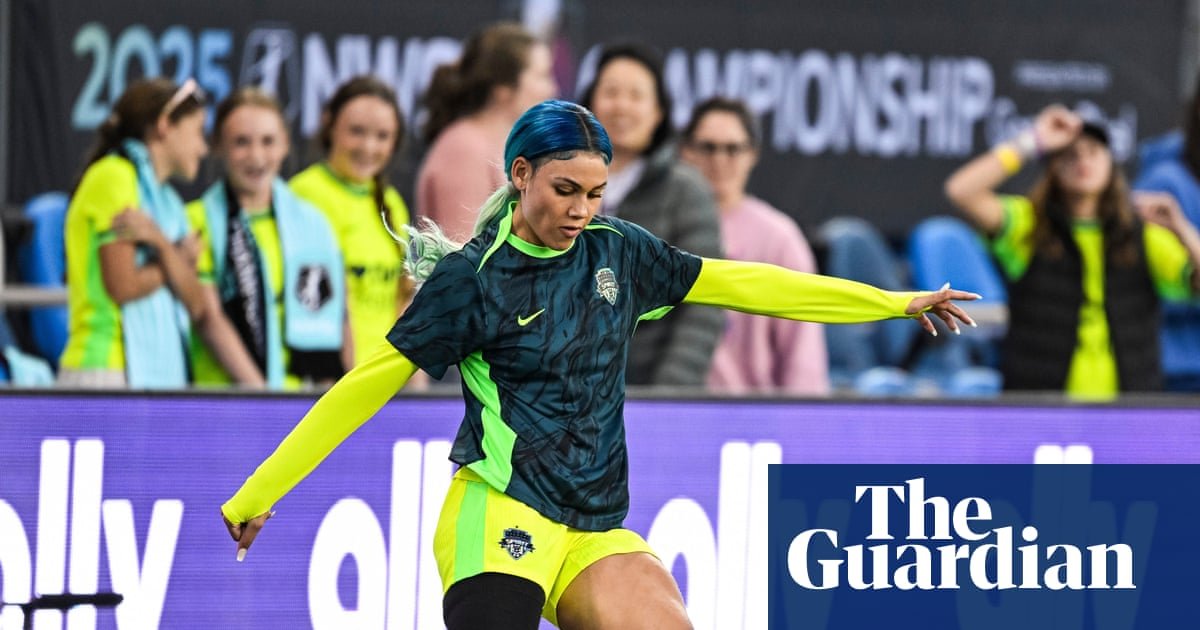
Sometimes, a rule’s official name is superceded by the player who seemingly inspired it. But sometimes, the origin story is a bit more nuanced.
Contrary to its initial prevailing narrative, the NWSL says it didn’t rush to create the High Impact Player rule (HIP) in reaction to the Washington Spirit’s efforts to sign Trinity Rodman. Stephanie Lee, the league’s vice-president of player affairs, said the league began looking at how it could keep pace with the growing women’s soccer market in the summer of 2023.
Does she mind that it bears Rodman’s name, though? Not at all.
“I mean, the NBA has the Bird rule,” Lee told the Guardian this week, “so it’s not uncommon for rules to seem reflective of a period of time. It just so happened to align with the expiration of Rodman’s previous contract, but it was [driven by] the larger strategic planning of our caps, and our rosters, and our plans for building those out.”
The mechanism, unveiled on 23 December, allows every club to exceed the salary cap by up to $1,000,000 for HIP players. This threshold will grow at the same rate as the cap each year, and may be applied to multiple eligible players. Only players whose cap charge would exceed 12% of the total allotment (that’s a $444,000 salary, as this year’s cap is set at $3.7m) can nest into the provision.
Qualifying players must meet at least one of eight determining factors, including, strangely even for us, inclusion in the top 40 of the most recent Guardian “100 best” lists. Also on the list: On the most recent SportsPro Media Top 150 Most Marketable Athletes, On one of two most recent Ballon d’Or Feminil Top 30 lists, and a recent MVP finalist or Best XI honoree.
Lee described forming the criteria as “quite a tabulated process” involving the league’s board, which included Kay Cossington MBE, the CEO of the nascent Bay Collective multi-club platform anchored by Bay FC.
“We wanted to make sure that any kind of eligibility captured a mass amount of players that were world superstars and global icons and role models,” said Cossington, who spent two decades at the Football Association, serving as its women’s technical director from December 2020 to June 2025.
Some clubs had already tried to nestle multiple star players for club and country onto their roster. Few have gotten the balance as right in recent years as Gotham FC, led by general manager Yael Averbuch West, resulting in NWSL titles in 2023 and 2025.
After their first championship, Gotham stole headlines by adding multiple core members of the US women’s national team. Rose Lavelle, Tierna Davidson and Emily Sonnett all arrived that winter and remain key players, playing alongside Spain star Esther González and Germany goalkeeper Ann-Katrin Berger. In the summer, they acquired US international Jaedyn Shaw; Midge Purce enters her seventh season with the club and is vital when healthy. Accumulating that much proven talent requires creativity and clear messaging.
“Players on our team come to our team because they know other top players are here,” Averbuch West said. “To do that, any one player knows that they could make more money at another club if they were one of fewer star players. We’re very upfront about that; everyone knows it … With that, we have been very serious about understanding how to optimize based on the salary cap. Anytime there’s a new rule, we see that as an opportunity.”
Initial skeptics of the HIP rule wondered whether that would hamper a third player pool’s earning potential: veterans who usually earn more on their second or third contracts but may not qualify for HIP status due to the aforementioned fame-skewing criteria points that often focus more on international soccer than its club and league counterpart. To Averbuch West, those players’ opportunities are usually more directly affected by the salary cap than anything HIP is addressing.
“I think this will actually help everyone, because it creates more space,” Averbuch West said. “Some teams may decide to use a strategy where they have a much, much lower profile roster, and a number of top stars. Doing the math, there’s something you come up against [with that approach]because you can only have so many players in the high impact player list because of the cap hit component. You obviously need to fill out enough spots on your roster.”
The nature of the HIP rule’s criteria means that its eligibility list will evolve rapidly. Players may fall off the list due to factors beyond their control, such as an injury, but anyone eligible at the time they sign their contract will retain HIP status throughout that deal’s tenure. The Equalizer surveyed the lists and found, as of 23 December, that 30 eligible players are already in the NWSL and 65 are not in the league.
“This is part of our strategy: to attract and to retain,” Lee said. “Do we have players that can help a smaller-market team attract a player? Can Louisville keep Emma Sears with this? She doesn’t qualify now, but could she in two years when her contract’s up and they have the possibility of resigning her? I do think that ‘retain’ piece is an important element that sometimes get lost in the conversation, because it is just as important for us to keep those young, upcoming star players as it is to attract those global talents.”
It should also help Bay FC when they look to extend the contract of their star acquisition of the winter, Claire Hutton. The 20-year-old midfielder is an emerging mainstay of Emma Hayes’ USWNT, and became eligible for HIP status by making last year’s NWSL Best XI first team. After Hutton surveyed suitors in Europe before authorizing her trade from the KC Current, Bay can plan beyond her current deal with her at the heart of midfield. Regardless of how her first year with Bay goes, her deserved place on the 2025 team of the year ensures she’s HIP-eligible through the end of 2027.
Some skeptics of the HIP rule ask, understandably, why the league wouldn’t just increase its salary cap. Cossington believes that “we should be encouraged by the fact that the league is very open minded to try to be innovative, to try to find different solutions without completely changing the construct of the cap, because there’s other consequences that we should be mindful of.”
Those consequences aren’t just related to the bottom line; the NWSL Players Association contends that changes to compensation under a salary cap as a “mandatory subject of bargaining,” citing federal labor law. The current collective bargaining agreement runs through 2030.
“In its simplest form, a salary cap increase was not going to be possible to pass at the board level,” Averbuch West said. “There’s a lot of thought on that, both ways, and I understand that. This was born from a creative solution to try to allow for adding star names and star players to the league, which we already have a lot of, in a way that the board could vote on and accept.”
Still, the architect of a budding NWSL dynasty worries this isn’t enough of an advancement to keep the league at the standing it aspires to retain.
“The salary cap still needs to increase,” Averbuch West said. “[The HIP rule] does help, certainly, but from my understanding of where the market is going, it’s probably not enough … I realistically don’t think we can get to the end of this CBA and not have to talk about it again.”
The HIP rule will go into effect on 1 July, giving all teams time to strategize and lay groundwork for moves that can benefit from the additional leverage. Teams will not be able to trade HIP leeway like they can with allocation money, ensuring all 16 teams have an equal amount of flexibility to its end. It’s all part of configuring a potential title-winning team in a league that still aspires to retain parity as a core value.
“The more complex the rules get, and the more pressure there is on making good roster decisions,” Averbuch West said, “I think we’ll see continuous stratification in the league of the general managers and front offices who are managing this well and who are maybe behind on that. That’s a challenge for us all.”
