
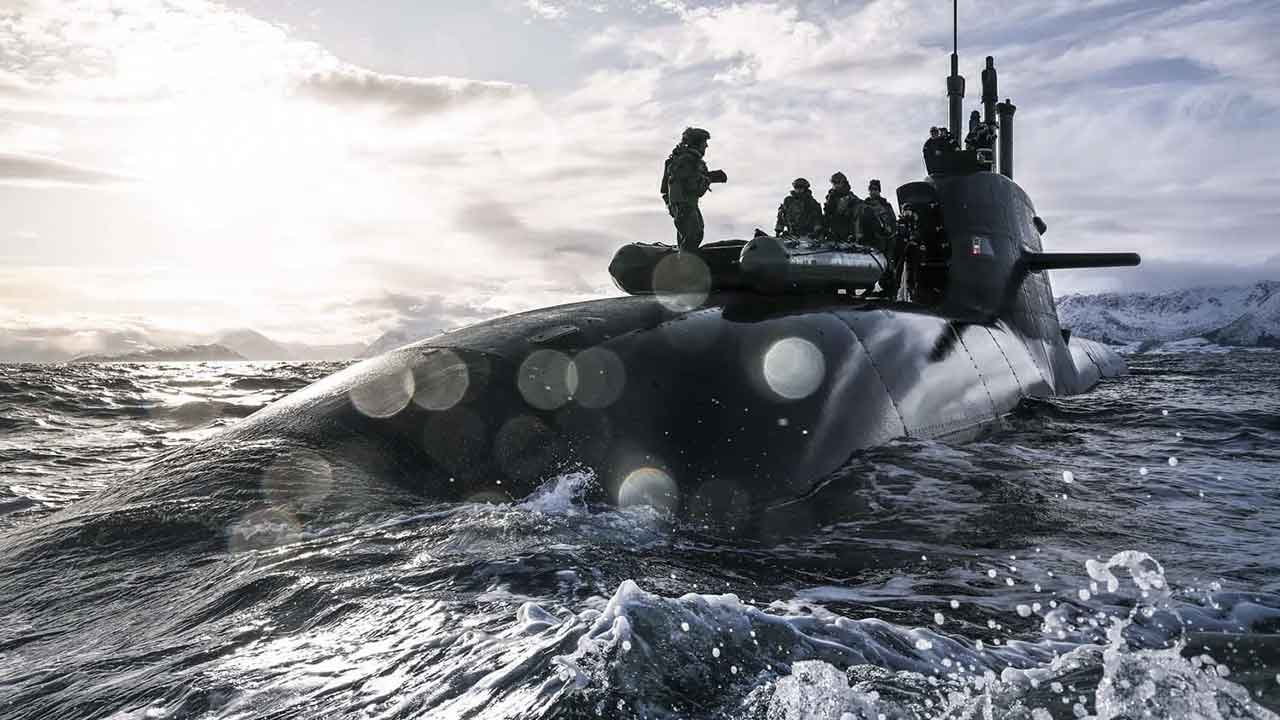
Britain’s Royal Marines carried out a daring infiltration operation in the farthest north of the planet when they emerged from the icy depths of an Arctic fjord from the deck of a German submarine during a major NATO exercise.
The operation took place about 200 miles inside the Arctic Circle, when British commandos used the German U-35 attack submarine to carry out a reconnaissance and simulated strike mission as part of the Cold Response 26 military exercise, which is considered the biggest NATO military exercise in the region this year.

The exercise involves 14 countries and more than 25,000 soldiers and simulates war scenarios in the northernmost part of Europe, an area of increasing strategic importance due to new sea routes and increasing military competition in the Arctic.
Silent infiltration by submarine
During the mission, the commandos would discreetly emerge from the submarine and then board inflatable assault boats (IRCs), which were used to reach the shore undetected.
From there, the troops moved into “enemy” territory with the aim of:
- perform advanced reconnaissance
- identify strategic positions
- direct the naval fire of allied ships
- sneak back to the submarine

The deputy commander of the Surveillance and Reconnaissance Squadron (SRS), whose identity has not been released for operational reasons, said the ability to deploy troops from submarines is key to modern Arctic operations.
“In the harsh environment of the Far North, dominated by extreme weather and enemy surveillance, covert infiltration by submarine-launched boats provides the stealth advantage necessary to penetrate restricted areas and obtain critical information,” he explained.

Elite units of the Commando Force
The operation was carried out by the most specialized units of the UK Commando Force, including:
- SRS (Surveillance and Reconnaissance Squadron)
- SRT (Special Reconnaissance Troop)
- 148 Commando Forward Observation Battery
These teams operate ahead of the main force, performing reconnaissance, target designation, and intelligence gathering.
In particular, 148 Battery has specialized training to coordinate naval fire, artillery and air strikes in support of Commando Force and British Special Forces units.
Destroy enemy radar during the exercise
During the simulation in Norway, the commandos identified an “enemy” radar installation along the coast.
After locating the target, troops from 148 Battery called in NATO destroyers to attack the radar, simulating the neutralization of a system that could detect the approach of Allied forces.
According to one of the team leaders of the unit, the mission also strengthens the historical capabilities of the British Army.
“Such exercises remind us of our experience in the Falkland Islands when Unit 148 directed naval fire before the islands were retaken. The combination of covert infiltration and naval support remains a key capability for operations in the Far North,” he said.
Preparation for the defense of NATO’s northern flank
The operation is part of a larger British military presence in the Arctic. Since January, around 1,500 British Royal Marines have been training in northern Norway in preparation for the Cold Response 26 military exercise.
The purpose of the training is to strengthen NATO’s ability to protect the northern flank, especially in an area where military presence and strategic interest are growing rapidly.
With its deep fjords, extreme climate, and vast, little-observed areas, the Arctic has become one of the most challenging—and strategic—environments for modern military operations.
+ Serbia equips its MiG-29 fighters with Chinese CM-400 long-range supersonic missiles
Source and images: Royal Navy. This content is generated with the help of artificial intelligence and verified by the editorial team.
