
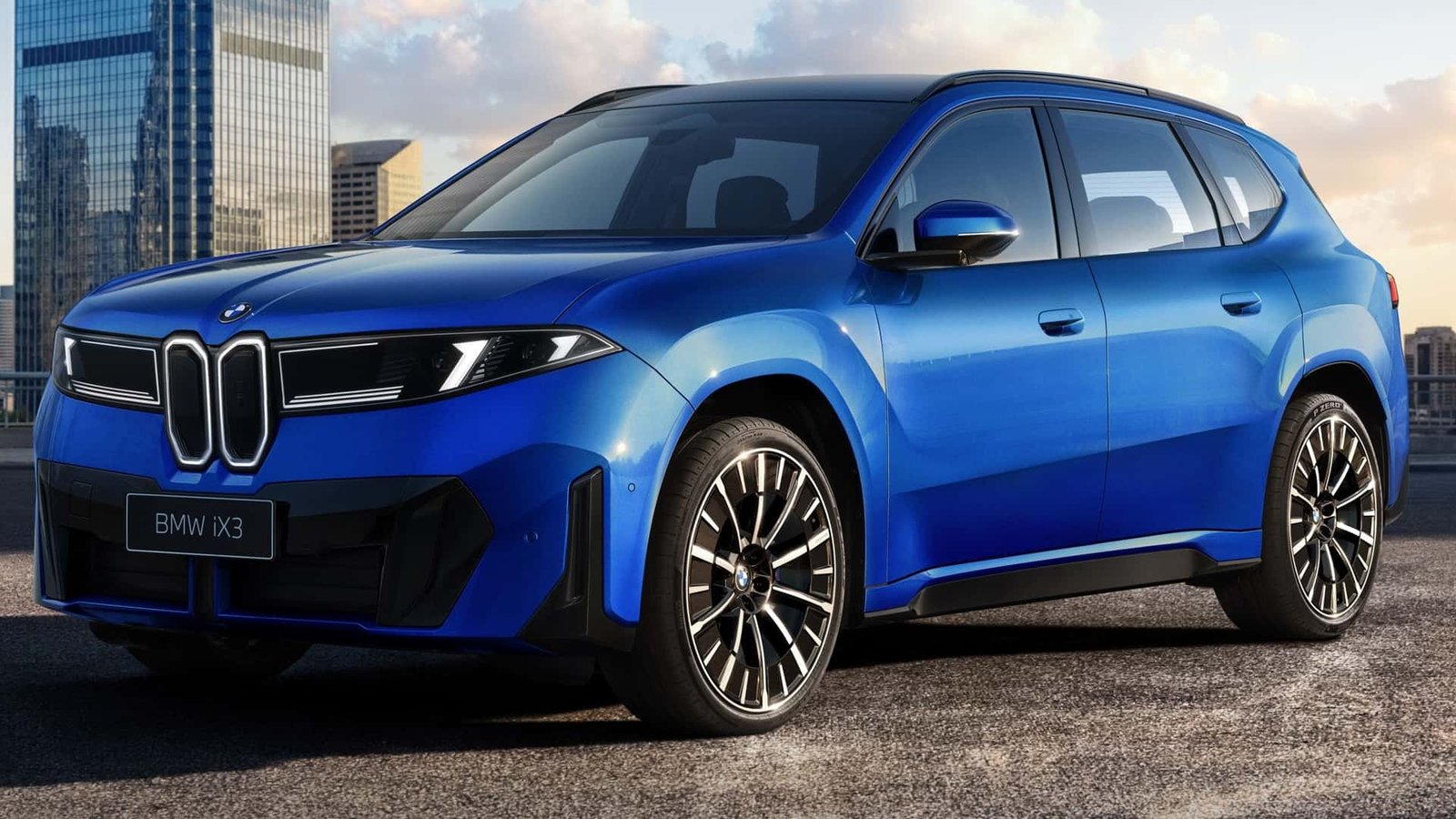
- The long-wheelbase BMW iX3 has semi-enclosed door handles.
- BMW plans to sell the stretched iX3 outside China.
- Compared to the global version, it adds a camera mounted in the roof spoiler.
When BMW teased the iX3 for China at the beginning of the year, it showed a prototype with the same flush door handles as the global version. However, a new regulation for new vehicles in China, effective January 1, 2027, outlaws this design due to safety concerns. Models already approved for sale by then will have to comply with the new rule by January 1, 2029.
China’s iX3 is set to go on sale before 2027, but rather than updating the electric SUV after series production begins, BMW is applying the change at the official debut. Its first public outing will be next month at the Beijing Auto Show, before sales start shortly thereafter. Meanwhile, the long-wheelbase model has been revealed by the company on its Weibo social media account in China.
Gone are the electronic pop-out door handles, replaced by a design seemingly taken from existing models such as the combustion-engine X3. It’s worth noting that the bigger iX3 won’t be exclusive to China, as BMW intends to sell it in at least four other markets: India, Thailand, Indonesia, and Malaysia.
Compared to the global iX3, the Chinese version has had its wheelbase stretched by 108 millimeters (4.2 inches) to 3005 millimeters (118.3 inches). Consequently, the rear doors are longer, and the greenhouse is slightly more generous. At the back, an updated roof spoiler integrates a central camera required for the advanced driver assistance systems (ADAS) developed in partnership with Momenta, a local company specializing in self-driving technology.
China’s iX3 will cover over 900 kilometers (559 miles) on a single charge, and while that eclipses the global model, it’s important to make a distinction. BMW quotes the locally applied CLTC range, which is known for being overly optimistic compared to WLTP and especially EPA.
The long-wheelbase derivative also supports 400-kW charging and can juice the battery from 10 to 80 percent in 21 minutes. It’ll need only about 10 minutes to add enough energy for over 400 kilometers (249 miles), but again, that’s the CLTC figure. BMW hasn’t revealed the lithium-ion battery’s capacity, although it’s unlikely to differ much from the 108.7-kWh net energy content of the global model.
<img src="https://cdn.motor1.com/images/static/16×9-tr.png" alt="
2027 BMW iX3 (China)
” width=”16″ height=”9″ loading=”lazy”/>
Photo by: BMW
Just like the rest of the world, China is initially getting only the iX3 50 xDrive with dual motors. The combined output hasn’t been announced, but it should be close to, if not identical to, the 463 horsepower and 645 Newton-meters (476 pound-feet) of torque available in the standard-wheelbase model.
Chances are that China’s iX3 is slightly heavier after the wheelbase stretch, so expect the curb weight to surpass the 2,285 kilograms (5,038 pounds) of the European model. The added heft is likely to have a marginal negative impact on performance. In the case of the Euro version, 0 to 62 mph (100 km/h) takes 4.9 seconds before the iX3 reaches an electronically capped 130 mph (210 km/h).
Full details will be released when the long-wheelbase iX3 premieres at the 2026 Beijing Auto Show. The event kicks off on April 24 with the first press day. Deliveries are likely to commence in the second half of the year.

6
Source: BMW
Motor1’s Take: Given that January’s official images showed prototypes with the global model’s door handles, it’s clear that BMW had to make a last-minute change for the Chinese version. Considering the iX3 Long Wheelbase would have been approved for sale before January 2027, BMW could have waited until 2029 to implement the change, but it chose not to.
An educated guess suggests this forced update is also planned for the stretched i3 that BMW intends to sell in China from 2027. The long-wheelbase sedan hasn’t been revealed yet, but it should follow the global model’s formula, minus the door handles that retract into the body when not in use.
