
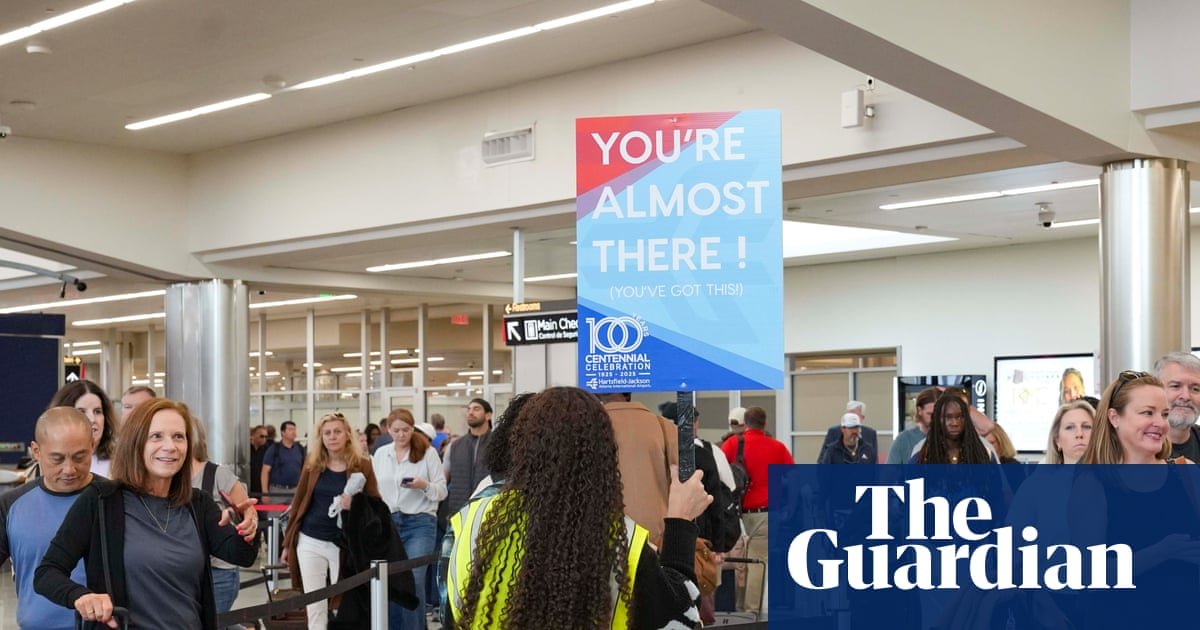
Hartfield-Jackson Atlanta international airport turned the digital wait time sign off days ago. Predicting passenger behavior can be hard; predicting the behavior of unpaid TSA agents is also hard. Keeping an accurate clock has been impossible.
Even though ICE agents have started filling in for TSA screeners at some airports, a morning flight might mean a three-hour slog with lines winding around baggage carousels, from the security checkpoint all the way outside to the curb.
Travelers across the county might have found themselves in Disneyland-like lines at an airport on Thursday, while others got to the concourse in 20 minutes, with wait times unpredictable.
The fatal collision between a cargo plane and a fire truck at LaGuardia in New York scrambled travel plans nationwide, ripping from Seattle to Miami, anywhere connecting flights needed to be made. But on Thursday, drummer Kenny Wollesen didn’t miss a beat on his way to the Big Ears festival in Knoxville.
“That’s one of the easiest check-ins I’ve ever had,” he said. Wolleson had a well-worn round leather bag of brass cymbals on his back, and usually the metal means extra time. But not this day. “The whole thing was 15 minutes.”
Airports are life for Wolleson right now. “I’ve been flying for the last two weeks, basically two flights a day, because I’ve been on tour. I just got back from Europe yesterday,” Wolleson said, noting new biometric screenings that began this year. “It takes a little bit longer, and there have been some really, really long lines for Americans.”
The US Senate voted early in the morning on Friday to fund the Department of Homeland Security, sending the bill back to the House. Earlier on Thursday night, Donald Trump said was willing to sign an executive order paying 50,000 TSA agents out of other government funds allocated to the Department of Homeland Security.
“I am using my authorities under the Law to protect our Great Country, as I always will do!” Trump said in a post on Truth Social. “Therefore, I am going to sign an Order instructing the Secretary of Homeland Security, Markwayne Mullin, to immediately pay our TSA Agents in order to address this Emergency Situation, and to quickly stop the Democrat Chaos at the Airports.”
Both developments would probably bring relief to travelers who are looking for a resolution to the dispute as soon as possible and certainly before the World Cup.
On Thursday, people in Atlanta waiting to clear screening or board planes talked about how they had rescheduled flights, or left home for the airport four or five hours before a flight.
There is no indication that passenger volume has decreased substantially, despite the disruptions. Spring break creates a travel surge right now in most years. The problem is that the bottleneck at the start of the day is shaping behavior.
A shortage of TSA screeners, with nearly 500 reportedly quitting in recent weeks thanks to the gridlock in Washington and missed paychecks, creates a bottleneck.
Word is getting out in Atlanta that morning flights have terrible wait times, and that screening times rapidly shrink after noon, though they bump up a bit for evening flights.
“We arrived at 1pm and literally, we’re 20 minutes and checked a bag – international – and we’re an hour in line,” said Lindy Rosenkampff of Alpharetta, Georgia. She and Gail Smith of Steamboat Springs, Colorado, were flying to Europe for a vacation. Smith cleared her local airport in under half an hour. Both were aware of ICE agents at the airport.
On Monday, ICE was not doing much at the airport except standing around in military-style equipment harnesses in packs of three and five, looming from balconies or trying to be unobtrusive amid the chaos. They still drew stares on Thursday.
“I’m not afraid of anybody,” said Funsho Ladipo, a Nigerian emigre and American citizen who flew on Thursday to Atlanta from Minnesota, on his way to Lagos. “I’m a citizen, so I’m not afraid. I’m not a criminal. It depends on how you present yourself.”
Ladipo said he felt like this was a normal Thursday at an airport for him. But ICE’s presence demanded responsibility, he said. “Everybody in this country believes they have freedom. Dear human beings, they are carrying guns. That’s one thing that I do tell people. Be careful.”
Libby Belden was coming from Madison, Wisconsin, for a trip to Morocco. She found ICE’s presence problematic.
If there have been confrontations, none have risen to official notice so far. But few people are willing to jeopardize their travel plans to make a political point.
“It’s absolutely horrible,” she said. “It’s a violation of people’s rights to move about the country. I find it disgusting.”
By Thursday, ICE agents had started making tentative steps toward productivity, staffing TSA security terminals where passengers provide their ID. They aren’t operating screening stations, a task which requires a couple of months of training.
They wore no masks. They smiled at travelers, sometimes. Travelers smiled back, sometimes. Mostly, people moved along.
“They know they have an optics problem, a PR nightmare right now, and so they’re doing everything they can to change that,” Rosenkampff said. “And by helping and pitching in and meeting hundreds and thousands and millions of people that are traveling, they’re able to maybe change that.”
“This move is made to rehabilitate ICE’s image,” said a federal employee who asked for his name to be withheld. “They’re extremely polite, smiling. It’s all fake to me.”
If ICE can replace TSA agents, then that diminished the incentives for Congress to come to terms on a funding bill, he said. “It’s almost like they want them to take over.”
“I think they’re in a pissing match,” Smith said. “I think they’re trying to see who’s going to blink first and, you know, to the victor go the spoils. I’m not sure what the spoils are.”
