
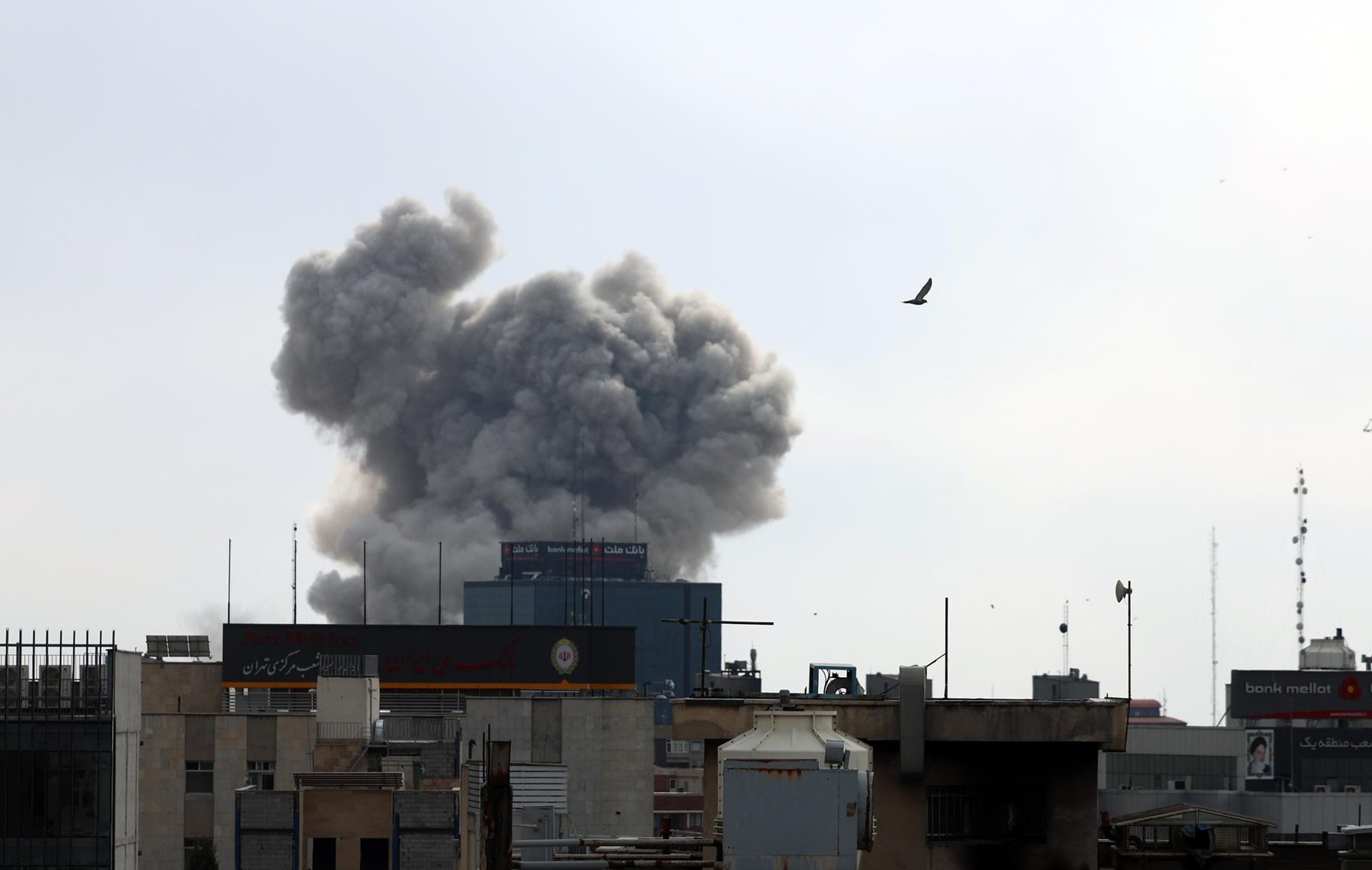
Coordinated attacks by Israel and the United States intensified in Iran for the third consecutive day, after the war began in the early hours of last Saturday, and have already resulted in the death of several regime officials, including the supreme leader, Ali Khamenei.
A new front was opened in Lebanon this Monday (2), after the terrorist group Hezbollah demonstrated support for Tehran with bombings against military installations in northern Israel. Israel responded with an intense retaliatory campaign against southern Lebanon and the southern suburbs of Beirut known as Dahye. One of the eliminated targets was the head of Hezbollah’s intelligence headquarters, Hussein Makled.
From planning to military action: behind the scenes of the attack
The joint military decision to begin bombings in Iran relied on strategic detail collected by the CIA, the US intelligence agency, moments before the attacks began this weekend.
Sources familiar with the operation told the newspaper The New York Times that the CIA identified the precise location of the regime’s most important target, Ayatollah Ali Khamenei, the country’s supreme leader, who was killed in one of the targeted attacks that same day.
American intelligence had been monitoring Tehran’s highest authority for months, since the first attacks launched against nuclear infrastructure in June last year. Information collected during that period made it easier to track their routine and behavior patterns.
Then the CIA discovered that the country’s most senior officials, including Khamenei, would meet one Saturday morning at a leadership compound in the heart of Tehran that was already known to the American and Israeli military. American sources stated that this information was crucial for a rapid advance on the Iranian regime.
The operation exposed basic failures of Iranian leaders who, amid constant threats from the Trump and Netanyahu governments, decided to meet in a well-known and unsafe military complex in Tehran in broad daylight. What would initially be a nighttime action by the countries was adjusted to the time of greatest chance of reaching the targets on Saturday morning.
What explains the attack and why now?
The joint operation with Israel, which the Pentagon dubbed “Epic Fury”, comes after months of pressure from President Donald Trump on the Iranian regime on points he considers essential for US protection: the end of the nuclear program and the sponsorship of terrorism.
For both Israel and the United States, Tehran would be secretly enriching uranium to manufacture nuclear weapons, something that would put both nations at risk. The Islamic regime categorically denies the allegations.
This Sunday, the American president said that the US campaign in Iran will continue until all military objectives are achieved. Trump cited the lack of agreement after rounds of negotiations with Iran as a reason that contributed to the bombings.
“They want to talk, and I agreed to talk, so I’m going to talk to them. They should have done this sooner. They should have offered something that was very practical and easy to do before. They waited too long,” the president told the magazine The Atlantic. Despite this, he did not rule out dialogue with Iran’s new leadership following the death of the supreme leader.
The CIA’s collection of sensitive information about the meeting of Iranian leaders on Saturday morning helped define the timing of the attack over the weekend.
What was Iran’s response and why did the country attack neighbors besides Israel?
The Iranian regime promised a “historical lesson” to Israel and the US on the same day that bombings against Iranian cities began. Since then, Tehran has launched attacks on several countries in the region where there are US military and diplomatic bases, in addition to Israel.
So far, 10 people have died on Israeli territory after the launch of Iranian missiles in ten waves of attacks until this Monday.
Iran has also launched attacks against more than a dozen countries in the region, including the United Arab Emirates, Bahrain, Kuwait and Qatar, where there are American bases.
The US Army Central Command (Centcom) confirmed this Monday the fourth death of a US soldier during Operation Epic Fury. Centcom also commented on an incident involving three American military planes that crashed in Kuwait this Monday, shot down “in error” by Kuwaiti “friendly fire”. According to the information, the crew ejected in time and are in “stable condition”.
Some of the attacks launched by Iran hit countries that were not used for this weekend’s bombings. Saudi Arabia issued a statement condemning Iranian actions targeting the capital Riyadh and the eastern region of the country, although all attempts were intercepted.
Qatar reported that at least 65 missiles and 12 drones were launched against its territory and eight people were injured. In Kuwait, at least one victim died after being hit by missile debris.
Iranian attacks also hit UK and French bases in the Middle East. The French Defense Ministry said a naval base was hit in the United Arab Emirates, while a British Air Force base was targeted by a drone in Cyprus.
What are the world’s reactions?
Leaders from several countries have reflected on the attack launched by the USA and its ally in the Middle East, Israel, and discussed scenarios for the region.
On Sunday, Germany, France and the United Kingdom said they could take measures to destroy Iran’s ability to launch missiles and drones, in defense of its interests and those of its allies in the Middle East.
The countries also suggested that they could collaborate with the US in the offensive against the Iranian regime. However, on Monday, German Foreign Minister Johann Wadephul categorically ruled out Germany’s direct participation in the war against Iran, while warning that the drone attack on a British Army base in Cyprus shows Tehran’s willingness to escalate.
“The government definitely has no intention of participating in any way,” said the minister in an interview with the broadcaster Deutschlandfunkemphasizing that Germany does not have military bases in the region nor the necessary military resources.
Russian dictator Vladimir Putin and the leader of the United Arab Emirates, Mohamed bin Zayed, called this Monday, during a phone call, for a “quick” end to hostilities around Iran, whose territory is being bombed by the US and Israel.
“Both parties highlighted the need for a rapid ceasefire and return to the political-diplomatic process,” the Kremlin said in a statement. In turn, the UAE leader denounced in his dialogue with Putin that Tehran’s response attacks hit his country, which he considered “unjustified”, since the territory is not being used as a platform to bomb the Islamic republic.
The Kremlin also ruled out that the Brics group, which includes countries such as Iran, Russia, China and Brazil, will help the Islamic republic in the conflict.
“Brics membership does not include an obligation to offer mutual assistance during military aggression,” Russian spokesman Dmitry Peskov said in his daily telephone press conference.
The Ministry of Foreign Affairs of Brazil condemned the military attack by the US and its ally, Israel, on Iran. The Brazilian government highlighted on Saturday that the military offensive took place in the midst of negotiations, calling diplomacy “the only viable path to peace”, which is the “position traditionally defended” by the country.
What are the consequences for Iran?
One of the most direct consequences for the Iranian regime is the possibility of its fall with the death of supreme leader Ali Khamenei and other authorities.
Attacks on countries in the region that were not directly involved in the bombings also increase pressure on Tehran, with the possibility of expanding the war on other fronts.
An analysis of the American think tank Atlantic Council highlights this as a critical error made by the Persian country. “Iran made a serious strategic miscalculation by widening its confrontation to include the countries of the Gulf Cooperation Council (GCC), despite these countries’ clear and consistent rejection of war.”
What made the escalation particularly alarming is the fact that the Iranian attacks were not limited to military installations, despite Tehran’s claims. They affected airports, critical infrastructure, hotels and residential areas – spaces where civilians live, work and travel.
HAS People’s Gazetteeconomist Igor Lucena, PhD in International Relations, pointed out that the fact that some of these nations, such as the United Arab Emirates and Saudi Arabia, are increasingly aligned with the West, paves the way for retaliation against Iran.
“Iran attacked countries in the region: it hit areas in the Gulf, Israel and Kuwait. We also saw attacks and threats involving airports in the United Arab Emirates and Saudi Arabia. These countries are now mobilizing to retaliate and reinforce their territorial and institutional defense, especially as they are nations that are increasingly aligned with the West and that need to demonstrate to society and the international community that they are capable of protecting themselves from hostile actions by Iran”, he assessed.
Can the US and Iran return to the negotiating table?
President Trump did not rule out a return to dialogue with Iran, despite emphasizing in statements after the military operation that it would be “too late” for negotiations. This Sunday, he said in an interview with the magazine The Atlantic that he would be willing to negotiate with Iran’s new leadership after the death of supreme leader Ali Khamenei.
In turn, Iran appears to have closed its doors to meeting with the Americans once and for all. The secretary of Iran’s Supreme National Security Council, Ali Larijani, one of the late supreme leader’s trusted arms, stated this Monday morning (2) that the regime will not negotiate with the USA.
“Trump plunged the region into chaos with his false hopes (…) With his delusional actions, he transformed his slogan ‘America first’ into ‘Israel first’ and sacrificed American soldiers for Israel’s desire for power,” said Larijani.
How long will the attacks continue?
The chairman of the US Joint Chiefs of Staff, General Dan Caine, said this Monday in a press conference with the Secretary of War, Pete Hegseth, that military operations against Iran are in their initial phase and “will take some time” to achieve their objectives.
Caine also acknowledged that these operations will require “a lot of work” and could cause new casualties among troops.
“This is not a one-day operation. It will take some time to achieve the Central Command and joint force objectives that have been assigned. In some cases, difficult and arduous work will be required. We expect to suffer further casualties, but as always, we will work to minimize them,” he said.
The military chief guaranteed that the operation is “escalating” after 57 continuous hours of exercises that, according to him, are part of the “initial phase” and will require the deployment of new troops in the future. Caine said the commander of Central Command, Admiral Brad Cooper, “will receive additional forces later today (Monday).”
The Secretary of War, in turn, said at the press conference that the military operation ordered by President Donald Trump against Iran caused a change of regime in that country and would not become an “endless” conflict.
Hegseth called Operation Epic Fury the “most lethal, most complex and most precise” in history and dismissed comparisons with Iraq. “This is not Iraq. This is not endless. (…) This is the complete opposite. This operation is a clear, devastating and decisive mission: destroy the missile threat, destroy the Navy, without nuclear weapons,” he said.
Trump also revealed his prediction about the duration of the conflict. To The New York Times, he suggested that fighting in Tehran could last “four to five weeks” if necessary.
