
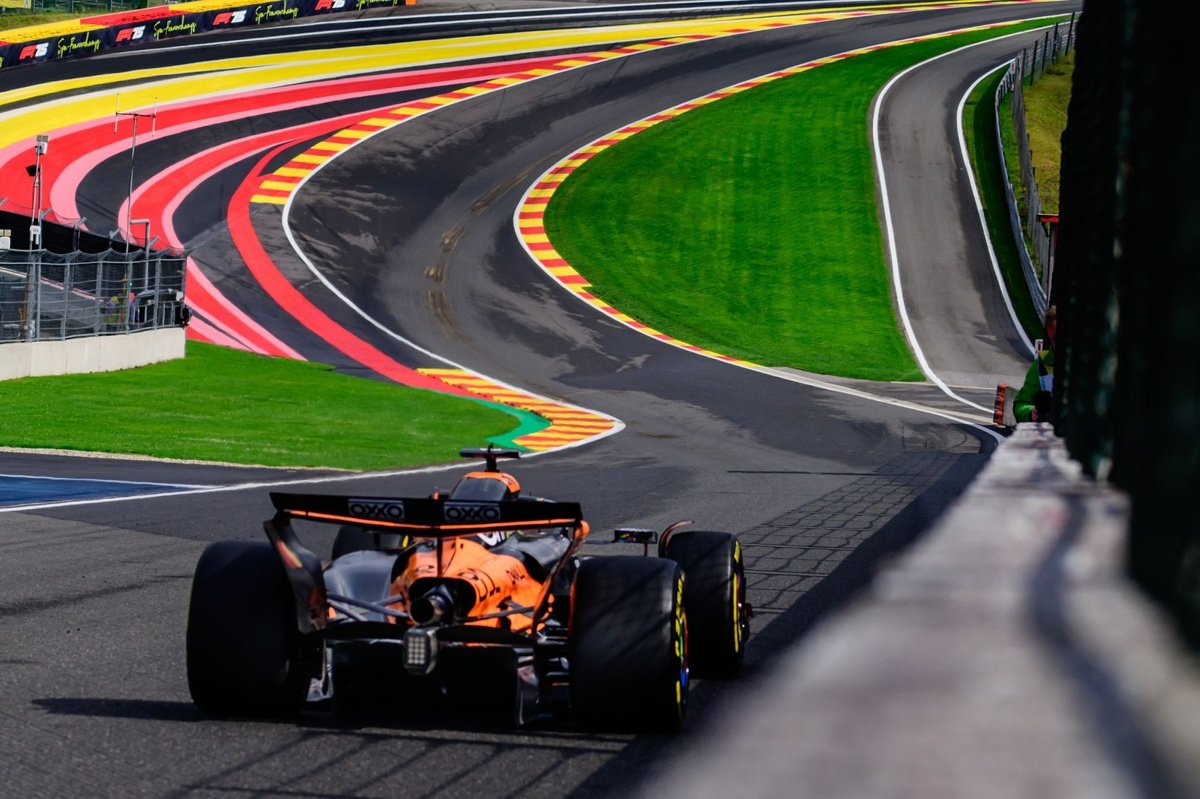
While many drivers complained in the Melbourne paddock about “yo-yo racing” and overtaking that was, according to Lando Norris, “way too artificial”, another factor also stood out during the first weekend of Formula 1’s new era – one made clear when looking at the onboard footage after qualifying.
The Turn 9-10 combination used to be one of the most challenging sections of the Albert Park circuit, but last weekend drivers had already switched to super clipping several hundred metres before the corner – meaning they were charging the battery while driving flat out.
A look at the data confirms that the speed dropped significantly despite drivers remaining full throttle, leading to them arriving in the braking zone at lower speeds than last year. It should be noted, however, that the speeds at Turn 9 were still comparable to the 2022 season, the first year under the previous regulations.
Nevertheless, many drivers concluded that the change in regulations has turned a tricky chicane into a place to mainly recharge the battery, and that it has taken away the challenge of pure driver skills. Fernando Alonso said it is simply the new reality in F1, with several iconic corners becoming less of a performance differentiator under the new ruleset.
“We used to fight for our life in Turn 12 in Bahrain, Turn 9, 10 and Turn 11 in Melbourne, Sector 1 in Suzuka, 130R, and Turn 7 and Turn 8 here in China. There were always certain corners in Formula 1 that were challenging the limits of the physics going through those corners, and the driver had to use all the skills and be brave in some of the moments as well,” the Spaniard explained.
“When you put new tyres on and you go through the corner at the speed that you’ve never been before in any of the free practices, that challenge is gone in a way. You use those corners to charge the battery, not anymore to make the lap time. So, it is a different challenge what you face now behind the wheel. Still fun? Yes, we love racing. Is it the future? We don’t know.”
Fernando Alonso, Aston Martin Racing
Photo by: Andy Hone/ LAT Images via Getty Images
Making a difference by using the power unit “in the correct way”
When Alonso refers to a different challenge, that is closely related to energy management. Drivers – especially on energy-poor tracks such as Melbourne – must use the limited amount of energy that they can harvest as efficiently as possible, meaning that simply going through every corner as fast as possible is no longer necessarily the best option for overall lap time.
“There’s still a challenge in those kind of corners, but it’s a very different challenge and it’s not quite as simple as just who’s the bravest and who’s willing to carry the most speed,” Oscar Piastri added. “Last week I got braver and braver throughout qualifying and it made me slower and slower down the straights. There’s some kind of secondary elements to it, but again, it will change from circuit to circuit. I think Melbourne was one of probably the top three most extreme cases for that.”
According to team-mate Norris, the new challenge is mainly related to handling the power unit in a very precise way – in line with what has been discussed with the engineers prior to a session, getting back on throttle at the most efficient spot or applying exactly the right amount of throttle at certain points. If 30% throttle is the most efficient somewhere, but the driver actually applies 40%, Norris says the difference is already noticeable throughout the lap.
“It’s gone [away] from just seeing how you can optimise every single millisecond out of the car itself and purely from a driver and car combination – forget about the engine because that was always pretty good for everyone, let’s say,” the reigning world champion explained.
“I think for the first time in our lives, it’s forget everything you’ve learned in F4, F3, F2 and drive it in a completely different way. The thing is the driver can still make a big impact and can certainly have a big impact on driving the power unit in the correct way. It’s just that’s not what any of us have ever grown up doing, and probably not something any of us grew up wanting to do either, but that’s the way it is now.”
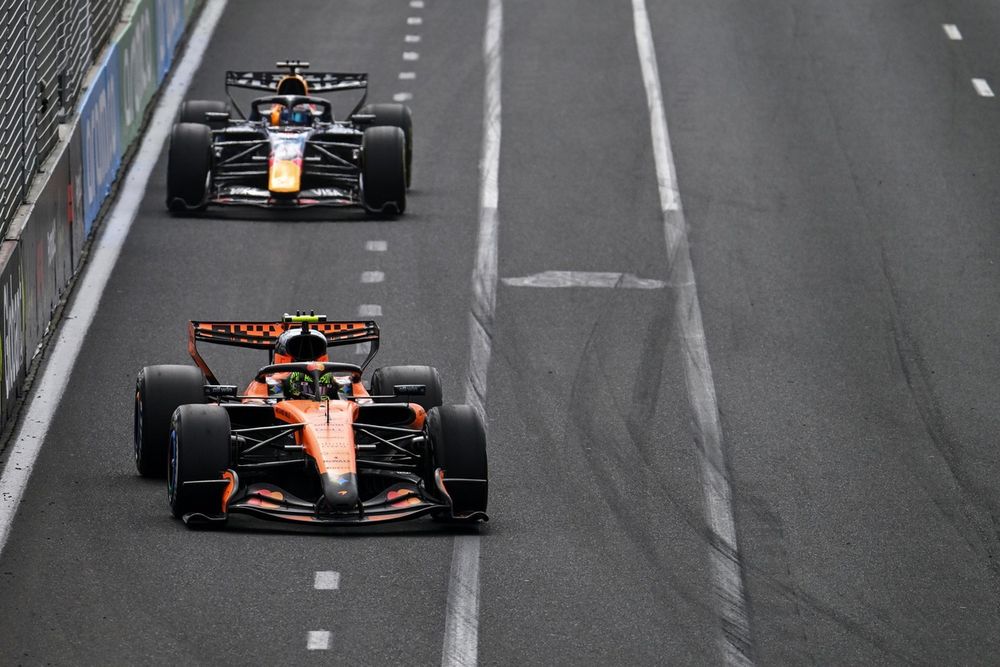
Lando Norris, McLaren, Max Verstappen, Red Bull Racing
Photo by: Sam Bagnall / Sutton Images via Getty Images
Verstappen fears “big balls” can actually work against F1 drivers now
It makes the challenge of certain corners different from what it has been in the ground effect era. At tracks such as Shanghai and Bahrain this is less of an issue, as those tracks are harvesting-rich, but Norris expects it to resurface later in the year. Alonso mainly referred to the next race weekend with Suzuka’s first sector and the 130R, while Norris also already has Spa-Francorchamps in mind.
“You’re not going to go into Pouhon now, I think, and see who has the biggest balls,” he smiled. “You’re not going to see that. You’re just going to see who can lift at the correct point and use the amount of throttle that you have to use, so that it doesn’t use the power, so that it doesn’t use the battery and those kind of things. The driver can still make a difference by driving the power unit to the maximum of its ability, but that’s quite a different style to just saying who can carry the most speed through Pouhon, who can carry the most speed into Turn 9 last weekend.”
While Norris mentions Spa, thoughts quickly turn to Eau Rouge-Raidillon. That iconic sequence is followed by the Kemmel Straight, meaning drivers may also want to recharge the battery there to avoid being vulnerable on the long straight. Max Verstappen, however, expects a different picture, with Eau Rouge-Raidillon still likely to remain easily flat out, while he anticipates more unnatural behaviour in other parts of the Ardennes circuit.
“Yeah, that will be easy flat,” Verstappen replied when asked by Autosport about Eau Rouge. “But then it will probably be more that in the middle sector where we’ll use very little battery, so I actually think that the middle sector will be very slow this year.”
To prevent that scenario, several teams still want adjustments to the regulations to be considered – something that will be discussed again after the Chinese Grand Prix weekend, when another evaluation with the FIA and all teams is scheduled. Both harvesting and deployment could be looked at, although Verstappen believes situations like those seen in Melbourne should mainly be avoided.
“I think we need to move away from lifting in qualifying at certain circuits, which just makes no sense. Basically it punishes the driver who wants to go the fastest. Because if you look at the past years, on average the fastest drivers are the ones who spend the most time on the throttle over a lap. And now that works against you because the more you are on the throttle, the more battery you use. So the later you brake and the earlier you get back on the throttle, the worse it actually is for the battery. And that has such a big impact that at the moment that it simply doesn’t work in your favour.”
That last point means drivers now have to think differently when trying to find lap time, and that approach does not appeal to many drivers yet, especially when it affects some of the most iconic corners on the F1 calendar. In China the picture is significantly better due to the track layout, but the concerns from Melbourne could resurface elsewhere – particularly if no solution is found that everyone can agree on, which is always a major challenge in F1.
We want to hear from you!
Let us know what you would like to see from us in the future.
– The Autosport.com Team
