
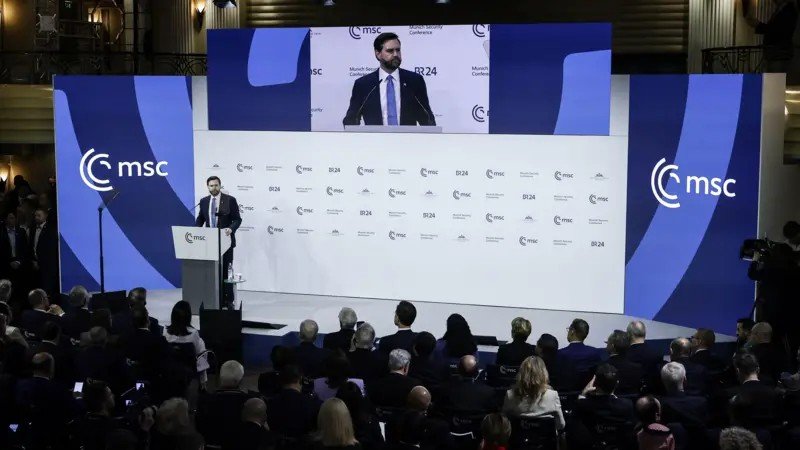
United States Vice President JD Vance at the Munich Security Conference in 2025. EPA via BBC It has been a year since United States Vice President JD Vance gave a surprising speech at the Munich Security Conference, criticizing Europe for its immigration and free speech policies and asserting that the greatest threat facing the continent comes from within. ✅ Follow the g1 international news channel on WhatsApp This year, the conference, which starts this week, once again promises to be decisive. US Secretary of State and National Security Advisor Marco Rubio leads the American delegation, while more than 50 other world leaders have been invited. This comes at a time when Europe’s security appears increasingly precarious. The most recent US National Security Strategy, published late last year, called on Europe to “stand on its own two feet” and assume “primary responsibility for its own defense”, raising fears that the US is increasingly unwilling to support Europe’s defense. But it is the Greenland crisis that has really shaken the fabric of the US-European alliance. Donald Trump has stated on numerous occasions that he “needs to take control” of the island for the sake of US and global security. For some time, he did not rule out the use of force. Protest in Nuuk, Greenland, against the US attack last January. Reuters via BBC Greenland is an autonomous territory that belongs to Denmark. There was no surprise, therefore, when the Danish prime minister said that a hostile US military takeover would mean the end of the North Atlantic Treaty Organization (NATO), which has underpinned Europe’s security for the past 77 years. The Greenland crisis was averted for now, as the White House was distracted by other priorities. But it left a nagging question hanging over the Munich Security Conference: Are security ties between Europe and the US irreparably damaged? They have changed, there is no doubt, but they have not disintegrated. Alex Younger, who was head of the United Kingdom’s Secret Intelligence Service, MI6, from 2014 to 2020, told BBC News that although the transatlantic alliance will not return to the way it was, it is not broken. “We still benefit enormously from our security, military and intelligence relationship with the United States,” said he, who also believes, like many, that Trump is right to make Europe bear a greater share of the responsibility for its own defense. “You have a continent of 500 million [Europa]asking a country of 300 million [EUA] to deal with a 140 million [Rússia]. It is the opposite of what is expected,” he said. This imbalance, which has led the American taxpayer to effectively subsidize Europe’s defense needs for decades, has underpinned much of the White House’s resentment toward the continent. Russia’s invasion of Ukraine is about to turn five years old. Getty Images via BBC But the divisions in the alliance go far beyond the number of troops and irritation with NATO countries, such as Spain, which have failed to achieve the minimum 2% of GDP on defense (Russia currently spends more than 7% on defense, while the UK spends just under 2.5%. On trade, migration and freedom of expression, the Trump team has sharp differences with Europe. Meanwhile, democratically elected European governments are alarmed by the relationship between Trump and Vladimir Putin and their propensity to blame Ukraine for the Russian invasion. post-World War II. This strategy, he argues, was based on three pillars: belief in the benefits of multilateral institutions, economic integration, and the conviction that democracy and human rights are not just values but strategic assets. document as “a real, painful and shocking warning for Europe” and “a moment of profound divergence between Europe’s vision of itself and Trump’s vision for the continent.” Donald Trump has deeply shaken relations between the US and Europe. “civilizational erasure.” However, the document maintains that “Europe remains strategically and culturally vital to the United States.” “But they are very explicit in their desire to demolish existing institutions, and we call them demolishers.” The ‘Narva’ Test But the fundamental question in all of this is: “Does Article 5 still work?” The strength of the alliance, backed by the military might of the United States, would come to his aid. Although NATO officials have insisted that Article 5 is still alive and well, Trump’s unpredictability, combined with his government’s contempt for Europe, inevitably calls it into question. hypothetically, if Russia tried to seize it under the pretext of “coming to the aid of its Russian compatriots”, would the Trump government come to the aid of Estonia? already has a colony in Barentsburg. Given Trump’s recent territorial ambitions to seize Greenland from NATO member Denmark, no one can predict with certainty how he would react. And this, at a time when Russia is waging a full-scale war against a European country, Ukraine, could lead to dangerous miscalculations.
Source link
What is the ‘Narva test’, a symbol of tension between Europe and the USA over NATO’s role in the event of conflict
28
