
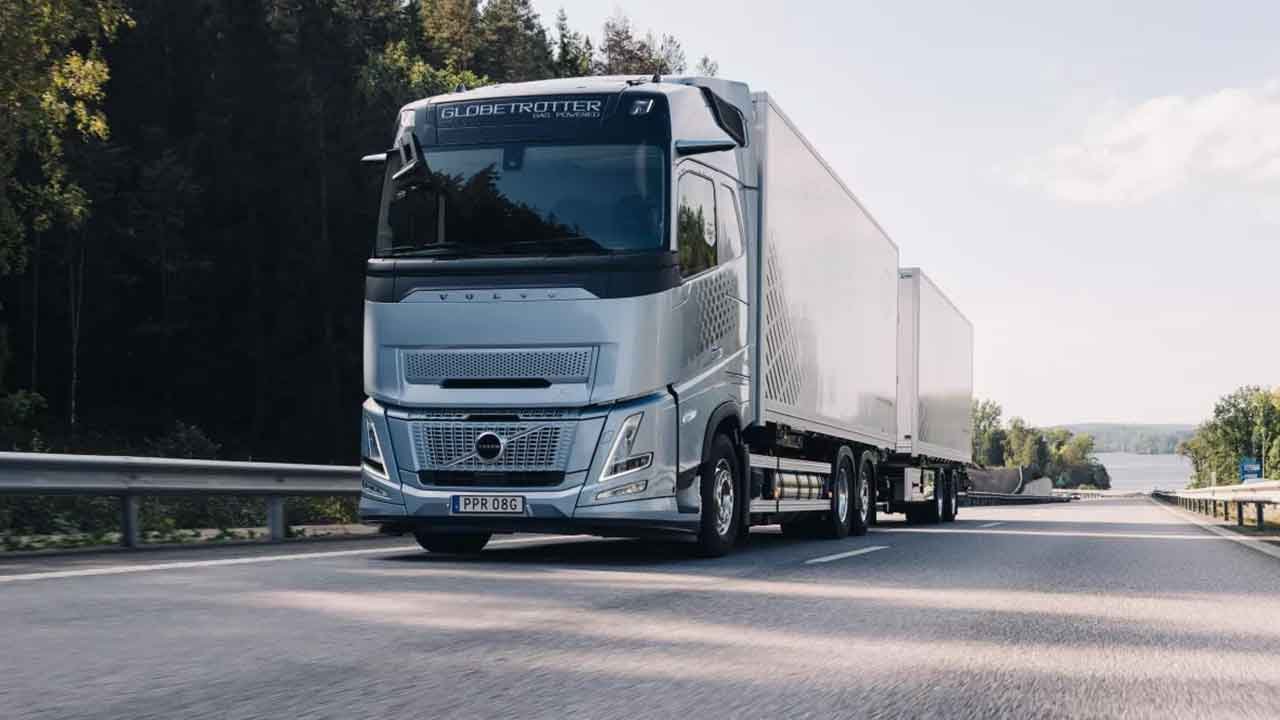
Volvo Trucks has announced that it has surpassed the milestone of 10,000 gas-powered lorries delivered globally since introducing the technology in 2018.
The result underlines growing demand for lower-carbon transport solutions across a range of markets.
According to the manufacturer, 2025 was the strongest sales year on record for its gas-powered lorries, driven by an expanded product offering and improved fuel availability and competitiveness in several countries.
The United Kingdom currently leads sales of this type of vehicle, followed by Germany, Sweden, the Netherlands, Norway and France. New markets, such as India and countries in Latin America, have also recorded steady growth in adoption of the technology.
+ NATO plans to send the world’s largest drone fleet to protect the Baltic Sea

Gas engines are available in the heavy-duty Volvo FM, FH and FH Aero ranges. The models can operate on conventional LNG (Liquefied Natural Gas) as well as bio-LNG, a non-fossil variant produced from organic waste.
According to Jan HjelmgrenHead of Product Management at Volvo Trucksthe company’s gas engine technology combines power, torque, responsiveness and energy efficiency with performance comparable to that of a diesel lorry. He stated that these vehicles represent an important step in the transition towards zero-emission transport.
With a range of up to 1,000 kilometres on a single tank, Volvo’s gas-powered lorries are suited to long-haul operations, regional distribution and construction activities. The manufacturer notes that, in several countries, there is already a well-established gas refuelling network and a rapidly expanding supply of bio-LNG.
In Germany, Norway, Finland and Sweden, for example, all gas filling stations now offer renewable fuel, enabling CO₂ reductions of up to 100% on a “Well-to-Wheel” basis, which considers the entire fuel lifecycle.

Volvo’s gas engine technology is based on the proven D13 powertrain and uses the HPDI (High Pressure Direct Injection) system supplied by Cespira. The solution employs a small quantity of diesel as an ignition fuel. When HVO (Hydrotreated Vegetable Oil) is used at this stage, CO₂ reductions can reach up to 100% across the full cycle compared with a lorry powered exclusively by diesel.
Bio-LNG is produced from biomethane generated from organic waste and liquefied for use in combustion engines. Volvo considers this fuel a key element of its strategy to achieve net-zero tailpipe emissions by 2040.
The company is pursuing a three-pronged strategy to reach this goal: battery-electric lorries, fuel cell electric vehicles and combustion engines powered by renewable fuels.
Source and images: Volvo Trucks. This content was created with the assistance of AI and reviewed by the editorial team.
