
The largest military mobilization by the United States in the Middle East since 2003 leaves Iran facing a high-risk decision. With aircraft carriers, state-of-the-art fighters and naval reinforcements already in place, the United States is signaling that it is ready to act, while diplomatic negotiations try to avoid escalation. The scenario points to three possible paths: controlled military pressure, expanded war or diplomatic concession.
The American government is working on the hypothesis of an imminent attack, possibly as early as this weekend. On the other hand, President Donald Trump indicated that he will allow ten days for negotiations to move forward.
The dialogue takes place in Oman, in an attempt to contain the escalation, but the impasse persists: so far Iran has not signaled a willingness to review its nuclear program, ballistic missiles or support for terrorist groups in the region. The scenario indicates that the time for diplomacy is getting shorter and could end for good in the coming days.
The Islamic regime, in turn, is suspicious of the diplomatic deadlines announced by Trump – and has at least one strong reason for this. Last year, Iranian facilities were bombed by the US days after Trump said he would give the Persian country two weeks to sign a nuclear deal with the Americans.
What are the possible scenarios?
One of the options seen as most likely by military analysts is specific action by the US. In this hypothesis, American military forces would bomb strategic points in Iran, such as installations of the Islamic Revolutionary Guard and the Islamic regime.
Sources familiar with the matter explained to the Wall Street Journal that, if the president follows this plan, he would aim for a smaller-scale mobilization to force the enemy side to meet his demands for a nuclear deal. According to the newspaper, it would be a one-off military attack that would not result in significant retaliation.
If Iran still refuses to accept Trump’s conditions, the US would respond with a second option: a broad campaign against regime facilities, with the potential to overthrow the ayatollahs.
An analysis of the think tank The American Atlantic Council, which specializes in international relations, assesses that this alternative would require a well-coordinated military campaign, supported by regional allies, which would force the regime to choose between following Trump’s orders or facing a direct war with the US that would put its very existence in question.
In this scenario, the risk of instability increases both within Iran and in the region, with the possibility of rival armed factions or even a large-scale civil war emerging.
For retired military analyst Paulo Roberto da Silva Gomes Filho, columnist for People’s Gazettethe possibility of an American attack occurring is very high.
“The military resources concentrated around Iran have reached a level only comparable to that used for the invasion of Iraq, and this is very expensive. It would not be that way if there was no purpose of acting militarily”, he observes.
According to Paulo Filho, an attack will be more likely to happen with the arrival of the second aircraft carrier in the region in the coming days. The USS Gerald Ford is expected to arrive off the coast of Israel next Monday or Tuesday.
The third hypothesis is that Iran accepts a diplomatic agreement under the conditions imposed by the USA. THE NewsweekMick Mulroy, who served as US Deputy Assistant Secretary of Defense for the Middle East, said that in this scenario the Persian country would need to make critical restrictions on its nuclear and ballistic missile program.
“If they [iranianos] reject these terms, I believe that the United States is not only ready to take significant military action against nuclear facilities and ballistic missile production and launch sites, but is also prepared to do so in a sustainable manner, including responding to any escalatory actions by Iran,” he said.
Although Iran denies the production of nuclear weapons and any project to develop such an enterprise, the Islamic regime currently has the largest arsenal of missiles and drones in the Middle East (see each country’s capabilities).
Paulo Filho highlights that all military action serves a political objective. “She [a ação] it will be specific or broader according to this objective. If this is, like last year, just launching an attack to destroy certain military capabilities, such as ballistic missile batteries, without the objective of changing the regime, it will be a one-off attack.”
For the analyst, there is a complicating factor, which is the fact that Iran is able to retaliate in kind, threatening the integrity of the American military, which could open space for a wider war.
“If Iran, when attacked, manages to react and cause significant casualties among the American military, the situation could escalate into a broader conflict scenario.”
What is the US military deployment in the Middle East?
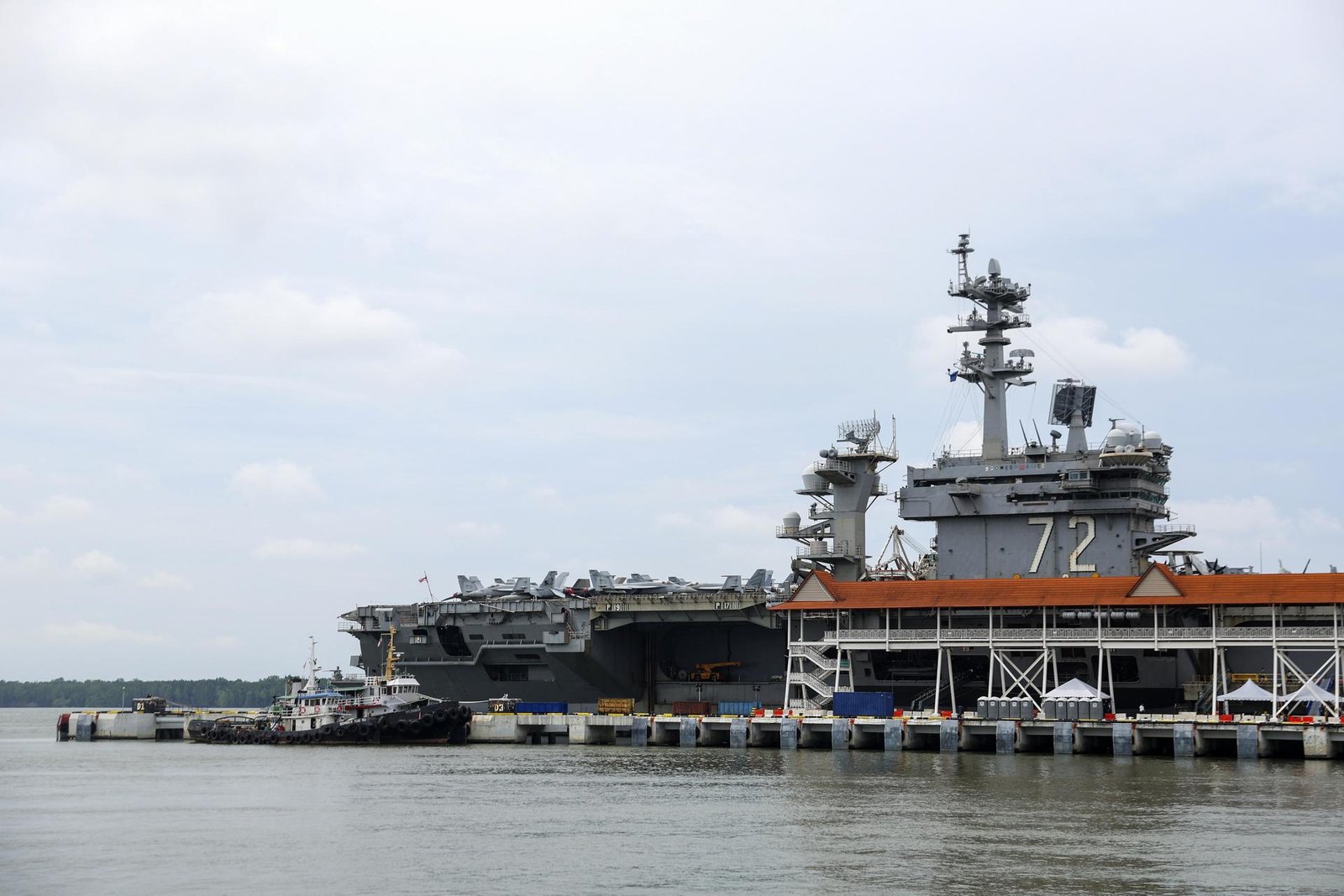
The US military has assembled one of the largest concentrations of naval and air power in the Middle East in more than a decade, as other reinforcements head towards the region in a historic mobilization.
To date, two aircraft carrier strike groups operate in the region: o USS Abraham Lincolnwhich is operating in the Arabian Sea and is supported by Arleigh Burke-class destroyers including the USS Spruance, USS Michael Murphy, USS Frank E. Petersen Jr. and USS Pinckney; and the Gerald Fordthe world’s largest aircraft carrier heading to the Middle East.
A military reinforcement with two warships, with high offensive power, signals an attack formation rarely seen outside of major conflicts.
Although the US Department of Defense has not reported the number of aircraft that were mobilized for the eventual operation, the air presence in the region increased drastically until this week.
Satellite images captured advanced fighters at regional bases, including the F-22 Raptor (the US Air Force’s world’s first 5th generation fighter) and F-35 Lightning II (stealth supersonic multirole fighter).
In total, more than 50 advanced fighters were deployed to strategic bases. In addition to aircraft carriers, the Pentagon also mobilized guided missile destroyers, submarines and logistical support ships.
Once air defenses are degraded, the US has the possibility of using aircraft such as carrier-based F-15E Strike Eagles (high-performance, long-range fighter-bombers) and F/A-18 Super Hornets (supersonic twin-engine multirole fighter) to carry out follow-on strikes against missile infrastructure, command centers and Islamic Revolutionary Guard Corps (IRGC) facilities.
