
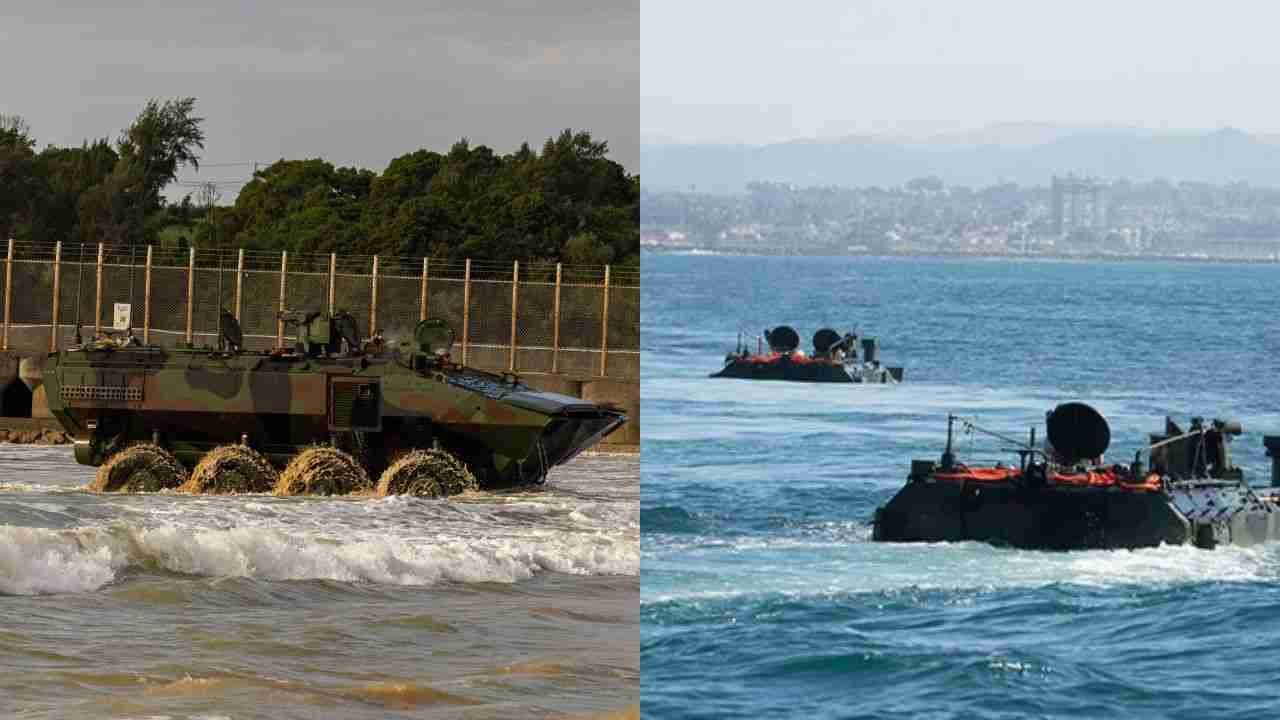
The United States Marine Corps has expanded its order for Amphibious Combat Vehicles (ACVs) with BAE Systems, in an additional US$195 million contract that foresees the production of an additional 30 units of the ACV-30 variant.
As a result, the total number of vehicles of this model requested in the program now exceeds 150 copies.
Equipped with a 30 mm cannon, the ACV-30 was designed to increase the firepower of troops in amphibious operations, allowing the engagement of targets at greater distances. The ACV family is treated by the manufacturer as a new generation platform, designed to raise levels of mobility, protection and versatility in landing and coastal combat scenarios.
In addition to the ACV-30, BAE Systems maintains active contracts for other versions of the vehicle, such as the ACV-P, intended to transport 13 fully equipped marines plus three crew, and the ACV-C, configured for command and control missions with multiple internal workstations.
+Saab and Babcock promote Arrowhead 120 for Sweden’s future Luleå class
The company has also produced three test examples of the ACV-R, a variant aimed at field maintenance and recovery, which will feature a crane integrated by the US government at the Anniston Army Depot. Production of the new ACV-30s will take place at industrial units in Pennsylvania and South Carolina, where combat turret integration is also led by the United States government.
Source: UK Defence Journal | Photo: X @USMC @BAESystemsInc | This content was created with the help of AI and reviewed by the editorial team
#Marines with 4th Marine Regiment, @3d_Marine_Divland on a beach in an Amphibious Combat Vehicle (ACV) during a low-tide crossing rehearsal.
The ACV is certified to conduct a wide range of mission sets, including open water, protected water, and land-based operations.#USMC pic.twitter.com/l8SZfNl1JN
— U.S. Marines (@USMC) December 2, 2024
NEWS: @USMC has awarded BAE Systems a contract of $169 million for 33 Amphibious Combat Vehicles. pic.twitter.com/DN21GhBvst
— BAE Systems, Inc. (@BAESystemsInc) January 24, 2022
