
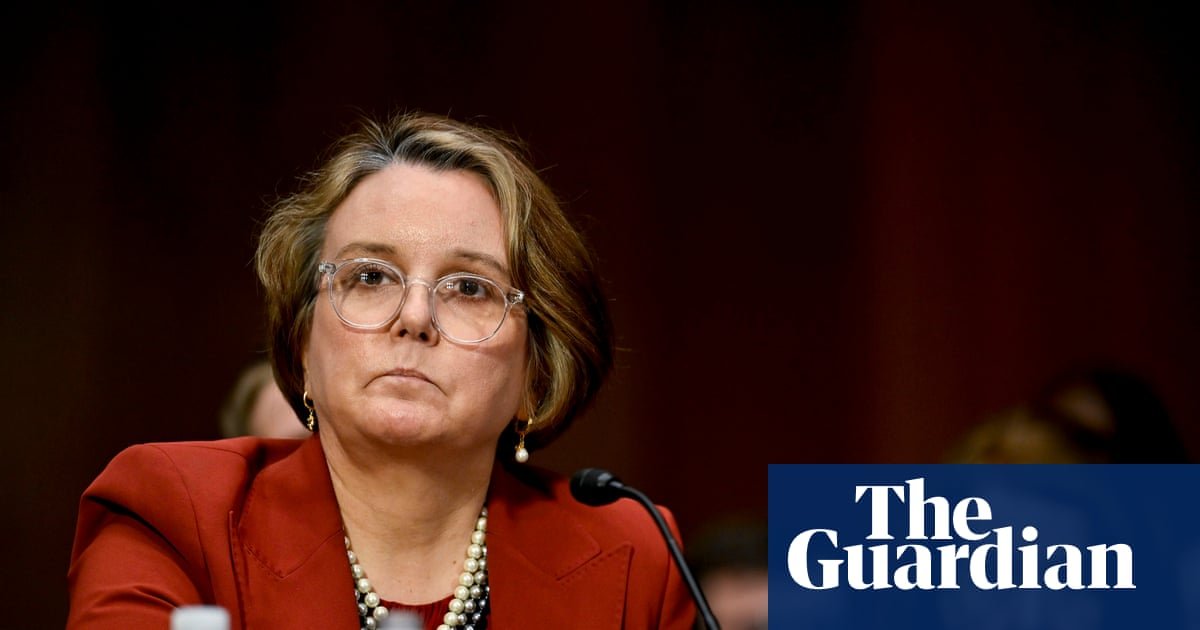
Gail Slater, the head of the US justice department’s antitrust division, was forced out of the Trump administration on Thursday after a turbulent tenure and months of simmering tensions with senior cabinet officials, according to two people directly familiar with the matter.
“It is with great sadness and abiding hope that I leave my role as AAG [assistant attorney general] for Antitrust today,” Slater said in a post announcing her departure.
Her defenestration followed a strained relationship with the attorney general, Pam Bondi, who had reiterated to the White House in recent weeks that their differences over the direction and management of the division were irreconcilable.
Slater also found herself isolated outside the department, most notably with JD Vance – once her most powerful ally – who grew weary of hearing complaints that Slater had invoked his name, one of the people said.
The decision is a victory for Bondi and a clutch of Donald Trump lobbyists who started to grow increasingly frustrated with Slater last summer, when she sought to block a $14bn merger between Hewlett Packard Enterprise and Juniper Networks, a cloud-computing and software company.
Supporters of Slater have portrayed her as an antitrust purist deeply skeptical of Trump allies and lobbyists. But her skepticism of corporate mergers led critics to allege she was more interested in advancing her own agenda than the business-friendly stance of the administration.
In the Hewlett Packard Enterprise case, according to three people directly familiar with the episode, Slater opposed the deal because it potentially created a duopoly for cloud-computing and wireless-networking systems.
But Slater claimed to Bondi that the US intelligence community had not raised any national security concerns about blocking the merger – a consideration that provides a legitimate basis for allowing a deal to proceed.
That prompted a scramble inside the justice department when the CIA director, John Ratcliffe, said blocking the merger would in fact pose national security risks and questioned why he was never consulted.
An exasperated Bondi later told associates she felt Slater had lied to her to continue with the suit, which the justice department dropped in June 2025 in favor of negotiating a settlement with Hewlett Packard Enterprise.
Tensions between Bondi and Slater extended beyond the merger. Last year, Slater planned to go to a conference in Paris – as her predecessors had done and as is required under a treaty to which the United States is a party.
But Bondi denied Slater’s request to travel on account of the cost. When Slater went to the conference anyway, Bondi cancelled her government credit cards, the people said.
Omeed Assefi, who served as acting head of the antitrust division at the start of Trump’s second term before Slater’s appointment, is expected to take over on an interim basis.
Spokespeople for the justice department and the White House did not respond to requests for comment. A Vance spokesperson disputed some of the characterizations about the vice-president’s thinking.
Slater rose to prominence in Trumpworld after serving as a senior adviser to Vance. An accomplished lawyer, she was confirmed to the post by the US Senate with 78 votes, more than almost any other Trump official other than the secretary of state, Marco Rubio.
Under her leadership, the antitrust division accelerated the early review process for proposed mergers in an effort to encourage dealmaking. Although the government has 30 days to assess a transaction, Slater shortened that window if there were no competition concerns.
But the dispute over the Hewlett Packard Enterprise deal and her interpersonal issues became a recurring problem. Vance initially backed Slater and instructed aides that she should not be criticized after her decision to block the merger was overruled.
The administration instead dismissed two of Slater’s deputies to keep the peace, although Senate Democrats then alleged the removals were the result of improper political influence and asked the federal judge overseeing the case to start a lengthy review of the settlement.
Vance’s support for Slater ultimately waned as he learned Slater was dropping his name and continued to hear about her tensions with Bondi. Vance ultimately decided that he could not stand in the way of Bondi wanting to run her agency as she saw fit, the people said.
