
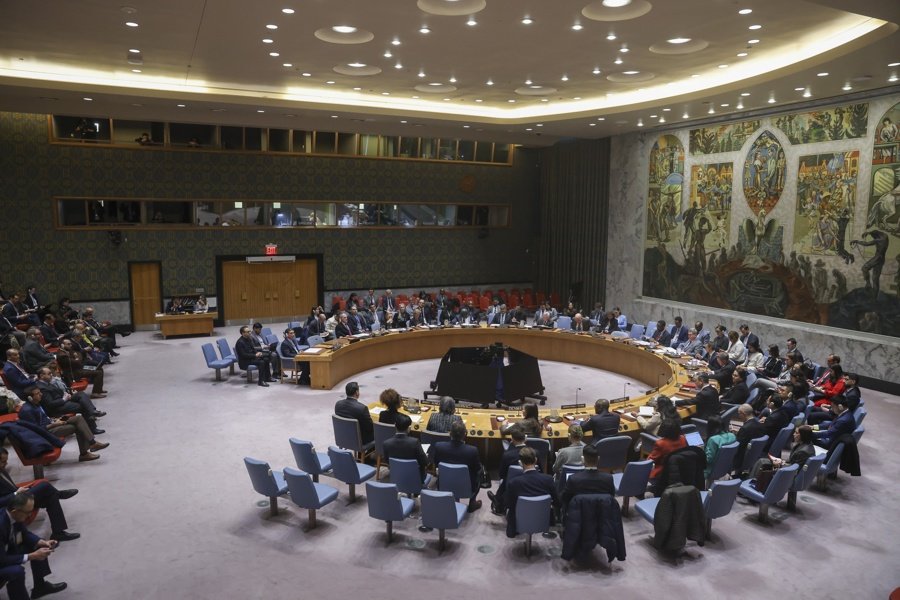
The Security Council of the United Nations (UN) held an emergency meeting this Saturday (28), following the attacks launched by the United States and Israel against Iran, amid negotiations over the Iranian nuclear program. The meeting was marked by calls for de-escalation and warnings about the risk of expanding the conflict in the Middle East.
UN Secretary-General Antonio Guterres stated that there are reports of at least one civilian killed as a result of the interception of a missile, in addition to information about civilians impacted in Iraq.
According to him, the attacks occurred while there were indirect talks between Israel and Iran, with preparations for technical meetings scheduled for next week. “I deeply regret that this opportunity for diplomacy was lost,” he declared.
Guterres called for an immediate halt to the attacks and the resumption of negotiations. He highlighted that military actions have “major consequences for civilians” and defended that all States respect international law, especially with regard to the protection of the civilian population and nuclear safety.
The secretary-general also stated that he had been in contact with leaders of Saudi Arabia, Qatar, the United Arab Emirates and other countries in the region, reinforcing the need to avoid further escalation.
US defends offensive and accuses Iran of destabilization
US Ambassador to the Council Mike Waltz said the Iranian government had “destabilized the world,” killed American forces, threatened allies and compromised the security of international waters.
According to him, Iran financed organizations classified as terrorist, such as Hamas, supported attacks against troops in Iraq, carried out kidnappings of American citizens and attacked ships in the region. Waltz declared that no responsible nation can ignore this record.
The diplomat stated that, since 2006, the Security Council has approved resolutions demanding the suspension of Iranian nuclear activities, imposing sanctions, freezing assets and restrictions on the program. He also said that last year, measures were restored to send a clear message that the continuation of the nuclear program would not be tolerated.
Waltz argued that there were diplomatic attempts led by President Donald Trump and the Secretary of State, but that there was no effective response from the Iranian side. According to him, “when there is no partnership for peace, it is impossible for peace to happen.”
The ambassador stated that Iran’s attacks against bases and regions such as Kuwait, the United Arab Emirates and Jordan reinforce, in the American view, the need for military action. He declared that the security of the United States’ allies is “not conditional” and that the president’s decision was made based on defending global security.
SEE ALSO:
-
Trump confirms death of Iran’s supreme leader and promises to continue bombings
-

Opposition wants to summon Lula’s minister after Itamaraty note against the USA and Israel
France warns of risk of new war
French ambassador to the UN, Jerome Bonnafont, stated that the region “needs peace” and warned that a new war could get out of control.
He said Iran must respect its international obligations, but stressed that escalation is dangerous for everyone and must cease immediately. France condemned attacks that hit several countries in the region and emphasized the importance of ensuring the safety of civilians — not only in Iran and Israel, but also in affected neighboring nations.
Bonnafont further mentioned that despite previous diplomatic efforts, Iran has not had the opportunity to conclude an agreement related to its nuclear program. He cited recent difficulties in the international agency’s access to the Iranian program and recalled that sanctions procedures had been initiated in August in response to concerns about the country’s nuclear commitments.
Attacks and retaliation
The United States and Israel struck targets in Iran this Saturday, while Iranians and Americans negotiated issues linked to the nuclear program. In response, Iran launched attacks against American bases in the region, including facilities in Bahrain, Qatar and the United Arab Emirates.
The scenario in the Security Council was one of strong diplomatic tension. The main concern expressed by the representatives was to prevent the confrontation from turning into a larger regional conflict, with a direct impact on civilians and international stability.
