
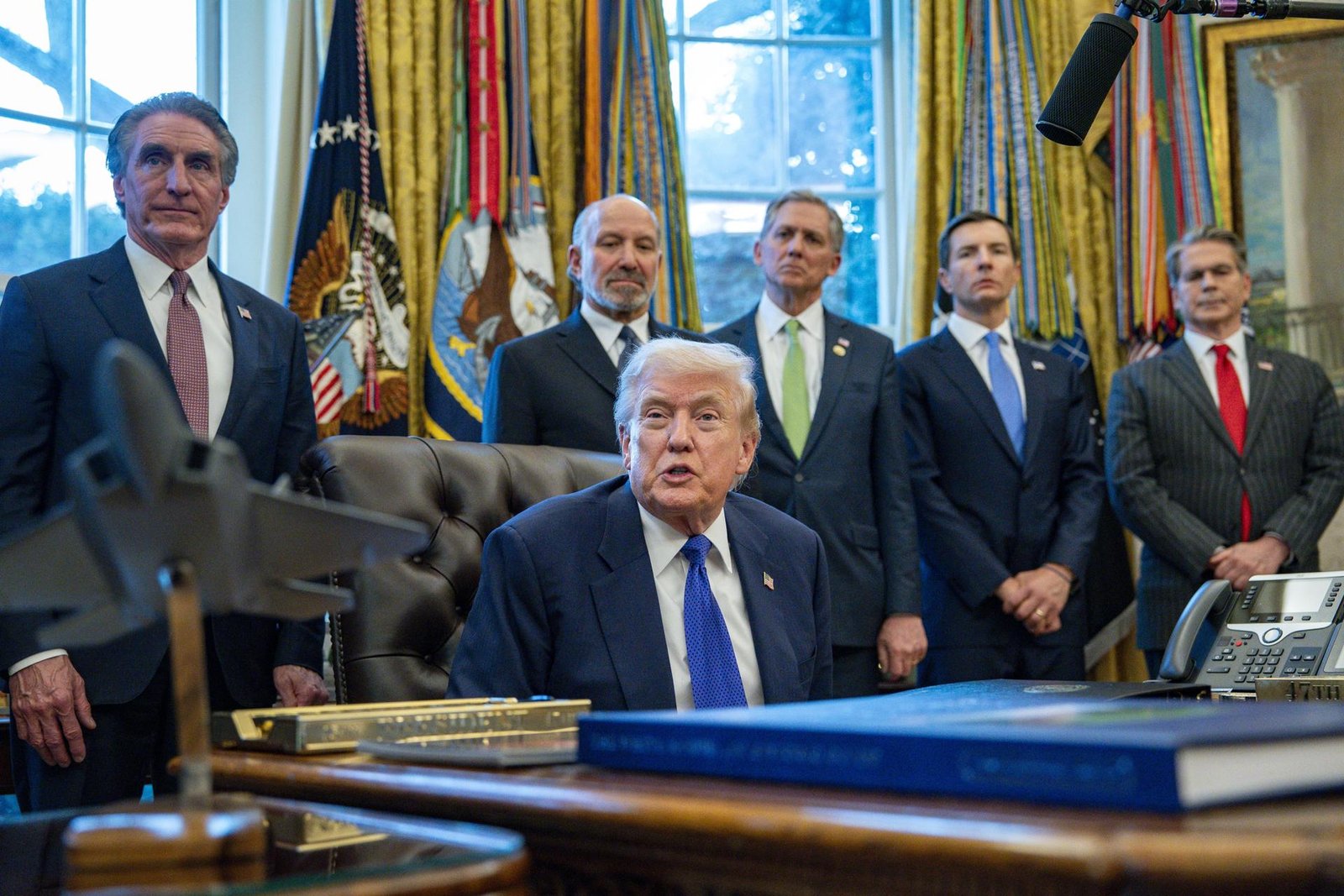
United States President Donald Trump earlier this month launched the so-called “Project Vault,” a strategic plan to create a national stockpile of rare earths and other critical minerals with the aim of reducing American dependence on China and shielding U.S. industry from supply chain shocks.
According to the American press, the initiative foresees investments of around US$12 billion to create a strategic stock of critical minerals, destined for sectors such as the automotive industry, electronics, defense and advanced technology. The model follows the logic of the strategic oil reserve created by the United States in the 1970s, after the oil crisis.
Known as the “gold of the 21st century”, rare earths are a group of 17 chemical elements composed of scandium, yttrium, lanthanum, cerium, praseodymium, neodymium, promethium, samarium, europium, gadolinium, terbium, dysprosium, holmium, erbium, thulium, ytterbium and lutetium, used in the production of components for electric vehicle engines, wind turbines, defense systems, radars, missiles and satellites, as well as applications in electronics, such as cell phones, computers, screens, batteries and telecommunications equipment. In turn, critical minerals are those considered strategic by governments due to their economic and technological importance. Among them are lithium, cobalt, nickel, copper and graphite.
According to the American government, the creation of the stock is a direct response to restrictions imposed by Beijing during trade disputes, such as those recorded last year, when the Chinese communist regime limited the export of rare earths used in strategic sectors. China currently concentrates around 70% of the global mining of these minerals and almost 90% of the world’s processing capacity, which guarantees it ample power to pressure countries dependent on these inputs. Trump stated during the launch of the project that he seeks to prevent the United States from “going through shortages again”.
In addition to storage, “Project Vault” includes long-term agreements, financial support and, in some cases, equity participation by the US government in companies in the critical minerals chain. According to Bloombergthe strategy is already causing Washington to increase investments in mining companies outside China, as part of a greater effort to diversify suppliers and strengthen strategic partners.
In this context, South America must enter the United States’ strategic radar once and for all. On Wednesday (4), Argentina signed an agreement with Washington for cooperation in the supply and processing of critical minerals, during a ministerial meeting led by the State Department. The initiative is already part of the White House’s new strategy to reorganize global supply chains outside of China.
According to the Argentine government, the understanding with the USA foresees the strengthening of value chains and the attraction of investments for the mining sector in the country. Argentina has large reserves of critical minerals, such as lithium – of which it is the fourth largest producer in the world and one of the main holders of reserves – in addition to still little explored potential in other strategic inputs.
Japan, the European Union and Mexico also committed to the American project in a first meeting, held on Wednesday, which brought together around 50 countries.
Brazil also participated in the event, but informed, according to the agency Reuterswhich is still evaluating whether to formally integrate the US initiative – which was described by Vice President JD Vance as part of an effort to bring together “allies around critical minerals”. Brazil has the second largest global reserves of rare earths, behind only China, and the topic should be on the agenda of the meeting between Trump and Lula, which should take place in March, in Washington DC.
Despite the apparent “caution” of the Brazilian government, this Thursday (5) the mining company Serra Verde, the only rare earth producer operating in Brazil, closed a financing agreement worth US$565 million (around R$3 billion) with the United States government, through the United States International Development Finance Corporation (DFC). The agreement includes the option of American minority participation in the company, located in Minaçu (GO).
Thras Moraitis, CEO of Serra Verde, thanked the United States government for the support. “We hope to work together to build new independent value chains,” he said in a statement released by the company on Thursday.
The announcement occurred days after the launch of the “Project Vault”, which indicates that Washington has already started moving to guarantee access to strategic assets in Brazil within the scope of its new policy for critical minerals.
The governor of Goiás and presidential pre-candidate, Ronaldo Caiado (PSD), was also in the USA last week, participating in meetings to promote the state as a producer of critical minerals, defending partnerships aimed at technology transfer and industrialization.
South America in US sights
In the view of Nelio Fernando dos Reis, PhD in Production Engineering and director of the Center for Strategic Studies of the DEX Initiative, the “Vault Project” should place South America at the center of the American strategy for rare earths and critical minerals.
“A strategic stock like ‘Project Vault’ only works if there is diversified origination of supply and, mainly, processing capacity outside of China. South America comes into (the Americans’ sights) precisely because it brings together: (I) relevant geological resources and (II) space for long-term agreements with predictability”, he highlighted.
In this context, the analyst pointed out five factors that could consolidate Washington’s interest in the region:
1 – Geographic diversification of risk: which serves to reduce concentration in a few countries/routes.
2 – Potential for partnership in processing: since the bottleneck is refining/separation, not just mining.
3 – Logistical proximity and possible regulatory affinities (when there are agreements).
4 – Portfolio of critical minerals in addition to rare earths (lithium, copper, etc.), useful for composing a stock.
5 – Space for long-term contracts with investment/technology transfer clauses.
For the expert, Trump’s initiative also puts the region – and also Brazil – in the eye of the China-USA dispute “in a geoeconomic sense”.
“If China dominates critical stages of processing, any American initiative to build stock and resilience redistributes demand, financing and influence to countries with geological and institutional potential. This puts the region more exposed to disputes over contracts, financing and industrial standards”, he highlighted.
Can Brazil be a strategic supplier outside of China?
In Nelio’s assessment, Brazil is only partially prepared to act as a strategic supplier of rare earths and critical minerals outside of China.
“Brazil has potential and is already starting to appear on the international radar, but ‘being a strategic supplier’ requires 3 layers,” he said.
According to Nelio, these layers are:
1 – Mining/production: where, according to him, “we have advances and the capacity to expand”;
2 – Processing/refining/separation: according to the analyst, this “is the most sensitive point; without it, the country becomes a low-value exporter”;
3 – Industrial applications (magnets, alloys, components): this is where the economic and technological power lies.
According to the analyst, the announcement of the US minority entry into the Serra Verde mining company “indicates that capital and foreign industrial policy are already moving here – which is an opportunity, but also requires a clear national strategy”.
For finance and taxation specialist Adriana Melo, Brazil has the potential to play a strategic role as an alternative to China, but only if it moves forward in building an integrated and scaled production chain.
“If it only focuses on intermediary exports, it helps the diversification of the West, but it does not dictate conditions, nor does it capture the strategic prize”, he stated.
According to the expert, Brazil is currently “prepared in resources and opportunities” to be this supplier, but only “partially in industrial execution and, above all, in capturing the middle of the chain”.
Risks and opportunities
For Nelio, the launch of Vault by the USA represents both an opportunity and a risk for Brazil. According to the doctor, “it is an opportunity if Brazil uses external interest to: attract investment in local processing; internalize R&D (research and development) and workforce training and negotiate industrial counterparts (local content, technological centers, long-term purchases)”, he said. For him, the American project could become a risk for Brazil if the country does not move forward in adding value.
“It becomes a risk if it becomes a ‘race for assets’ with little added value, export of concentrate or input and import of high-value product, in addition to geopolitical pressure that reduces the diplomatic room for maneuver,” said the doctor. “Brazil needs to treat rare earths and critical minerals as State policy: adding value, mastering processing and connecting mining to industry. External partnerships are welcome, as long as they convert natural resources into technological and industrial capacity in the territory”, he added.
Intensification of the global dispute
In Nelio’s assessment, the American project tends to intensify the global dispute for rare earths and critical minerals by inserting a large state buyer in a coordinated manner into the market.
“A large buyer with a budget and state coordination tends to increase competition for contracts, put pressure on prices in some links and accelerate bilateral agreements and blocks of confidence,” he stated. According to him, this movement could act as a “strategic demand shock”, by tightening available supply and increasing international rivalry around chains considered critical.
According to the doctor, the “Project Vault” does not yet eliminate 100% the structural dependence of the United States on China, on the issue of rare earths and critical minerals, but it acts as a risk mitigation mechanism in the short term.
“From what has been disclosed, the very logic of Vault is resilience and mitigation: a stock to cover something like a short window of emergency supply, stabilizing shocks and volatility,” he stated. For him, the initiative helps to cushion specific interruptions in the chain, but “does not replace mining outside China, processing and metallurgy and advanced manufacturing”, steps considered central to an effective reduction of Chinese dependence.
In Adriana Melo’s view, the American initiative should serve as an instrument for mitigating risk in the short term and strengthening bargaining power.
“It (Vault Project) does both things, but at different intensities: it mitigates short-termism immediately and improves bargaining power,” he stated.
