
A space where users can access content blocked by governments, browse anonymously and, in practice, bypass various restrictions imposed by local laws that limit digital freedom. This is the objective of Freedom.gova website that is being developed by the United States Department of State, under the administration of President Donald Trump, and which should be launched in the coming months.
Although there is no information about which countries will directly benefit from the website, the launch of Freedom.gov raises expectations that information blocked by Brazilian justice systems can be accessed through the new platform.
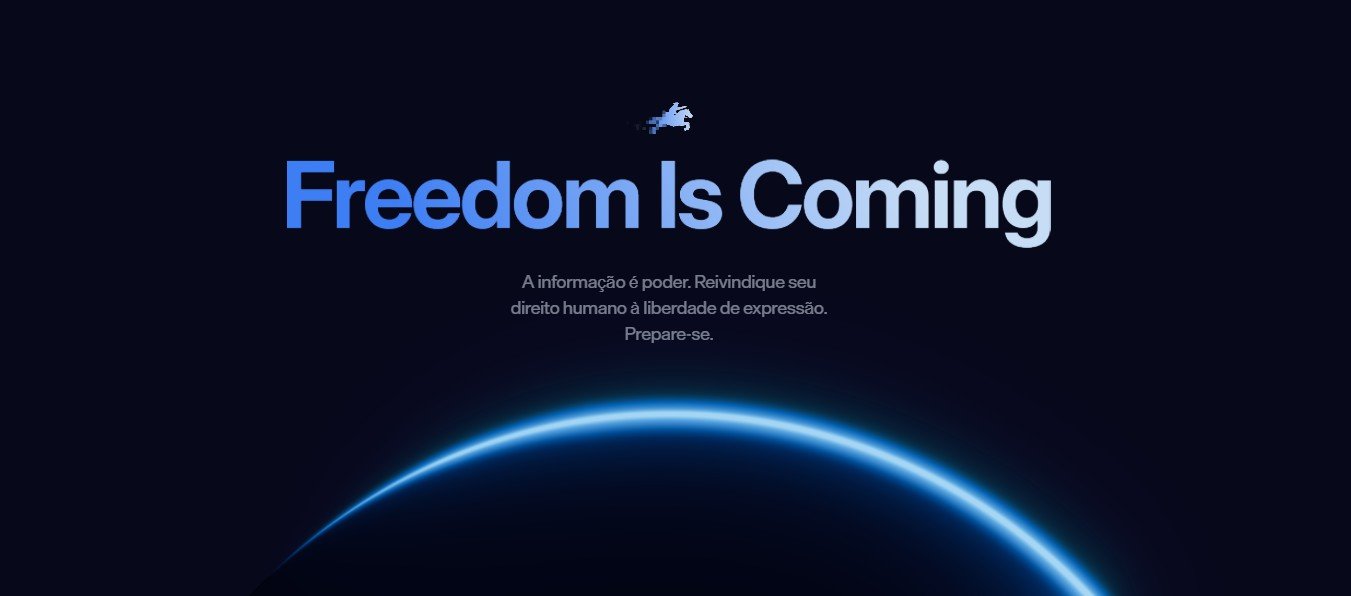
The site, officially registered in January and already accessible at freedom.gov, so far only displays a home page with the message: “Freedom Is Coming. Information is power. Reclaim your human right to free expression. Get ready.” (“Freedom is coming. Information is power. Claim your human right to free expression. Get ready.”).
The initiative is led by Sarah Rogers, U.S. Department of State Under Secretary for Public Diplomacy. In an interview with the Semafor website in January this year, before news about the site came to light, Rogers stated that one of the State Department’s priorities is to pressure governments around the world to “open the space for freedom of expression” on social media.
This month, during her appearance on the “Louder with Crowder” podcast, hosted by conservative commentator Steven Crowder, the undersecretary said that the Trump administration “firmly supports digital freedom” and that everyone in the world should have access to information “without censorship imposed by foreign governments”. At the time, without mentioning the creation of the website, Rogers stated that supporting tools to circumvent restrictions imposed by governments is part of a broader commitment to freedom of expression, which he classified as a “fundamental human right”.
How it should work
Freedom.gov’s proposal is to serve as a kind of “alternative gateway” to the internet. The portal should allow people in countries with digital restrictions access content that has been removed, blocked or prohibited by government decisions or local laws.
The website must operate as a technological tool aimed at protecting user navigation. The idea is to integrate a system similar to a VPN (virtual private network) into the portal, capable of making traffic appear to originate in the United States, even when access occurs from another country. In practice, This would allow you to bypass geographic blocks and restrictions imposed by legislation that limit freedom of expression.
Sources heard by the agency Reuters state that the site will not record IP addresses, browsing history or any data capable of identifying the user. The proposal, according to American authorities cited by Fox News, is to make available to citizens of all countries in the world “the same open internet available to Americans”, especially to those who live under censorship regimes or regulations that restrict digital freedom.
On the subject, the US State Department declared to Reuters that “digital freedom is a priority” for the Trump administration and that this includes the promotion of privacy technologies and tools to circumvent censorship.
Project emerges amid global clashes over digital censorship
Freedom.gov was born at a time of strong repression of freedom of expression online in the world.
In Europe, for example, the Digital Services Act (DSA) expanded the power of the European Commission – the executive arm of the European Union (EU) to demand, under penalty of fines and blocking, the rapid removal of content classified by the bloc as “illegal”, including so-called “hate speech and extremist propaganda”.
At the end of last year, the European Commission applied the first fine against platform X, controlled by businessman Elon Musk, based on the bloc’s new digital legislation. The penalty, of 120 million euros, was imposed on the grounds of non-compliance with obligations set out in the DSA, including alleged failures in advertising transparency, researchers’ access to data and the functioning of the account verification system.
Musk’s company has already appealed the decision to the General Court of the European Union, arguing that the interpretation adopted by the European executive body was excessive and that the sanction compromises principles linked to freedom of expression and legal certainty. The punishment against X was the first imposed under the DSA.
In the United Kingdom, the “Online Safety Act”, a digital regulation law, establishes significant fines for platforms that do not comply with moderation requirements imposed by the British government.
Not Brazilrecent decisions by the Federal Supreme Court (STF) ordered the suspension of digital platforms for non-compliance with court orders that required the blocking of profiles for comments and criticism on the internet.
Rumble CEO suggests Freedom.gov could bring blocked content in Brazil
American press reports indicate that the initial focus of the Freedom.gov platform includes nations with strong state control of the internet, such as China and Iran, as well as European countries that apply DSA rules.
When sharing news about the launch of Freedom.gov, the CEO of the video platform Rumble, Chris Pavlovski, published a message saying “Hello, Brazil”, on his X account, an indication that the site could end up serving to make content available to Brazilians that is currently blocked in the country by decision of the judiciary.
The Rumble platform has been blocked in Brazil since February last year, following a decision by STF minister Alexandre de Moraes. The suspension occurred after the platform refused to comply with Moraes’ orders that determined the blocking of profiles such as that of journalist Allan dos Santos, the appointment of a legal representative in Brazil and the payment of fines.
Last year, Rumble, together with Trump Media, President Trump’s company, filed a lawsuit in federal court in Florida against Moraes. The companies claim that the minister’s orders violate the First Amendment of the United States Constitution, which protects freedom of expression, and argue that the orders could affect services operating in American territory.
The case is being processed in the American Courts and, recently, the companies’ lawyers requested that Moraes be formally notified about the process through his institutional email at the Federal Supreme Court, under the argument that other contact channels would be unavailable. To date, there has been no definitive decision on the merits of the action.
This month, Rumble started working again in Brazil for a few hours after changing its IP address. The National Telecommunications Agency (Anatel) reported that it identified the change and ordered a new block, claiming that the platform used third-party infrastructure to reestablish access. The service became unavailable again shortly afterwards.
