
Washington — Hours after the Supreme Court struck down President Trump’s sweeping global tariffs, the president directed his ire at the six justices who ruled against him — including a pair of conservative jurists who were nominated to the bench by Mr. Trump.
Mr. Trump told reporters he’s “ashamed of certain members of the court.” He criticized the three liberal members, calling them an “automatic no,” but appeared especially frustrated with the three conservatives who concluded that the International Emergency Economic Powers Act, or IEEPA, doesn’t give the president the power to unilaterally impose tariffs.
“You can’t knock their loyalty,” Mr. Trump said of the liberal justices. “That’s one thing you can do with some of our people.”
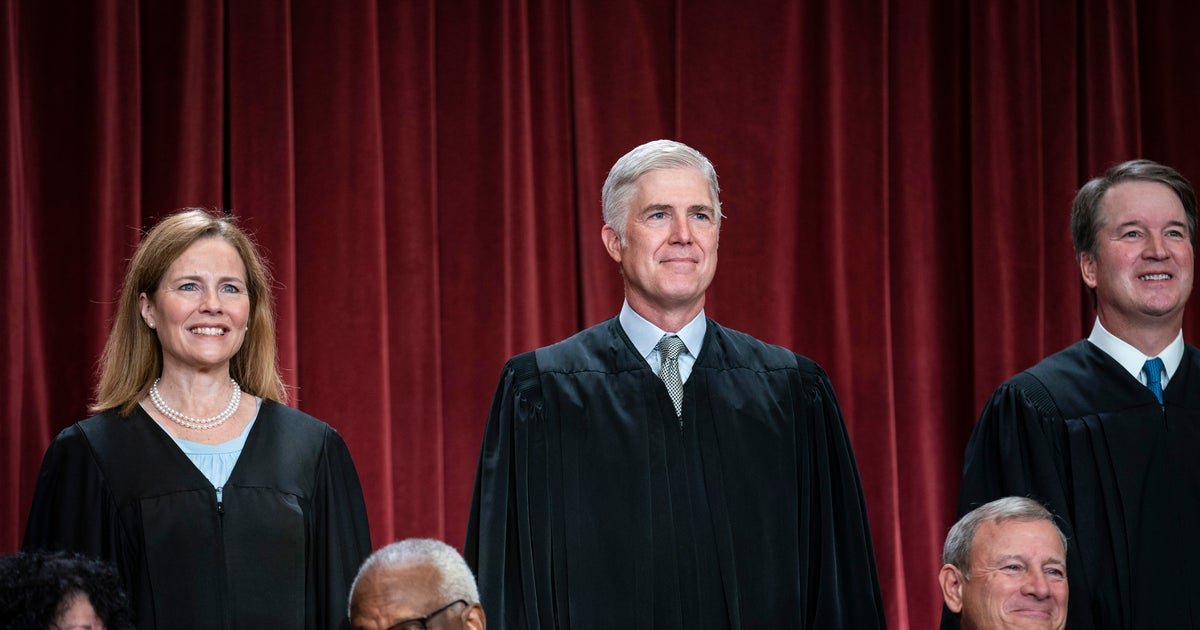
The three conservatives who ruled against the administration’s tariff strategy were George W. Bush-appointed Chief Justice John Roberts, and two justices who were appointed in Mr. Trump’s first term: Neil Gorsuch and Amy Coney Barrett.
Asked if he regrets nominating Gorsuch and Barrett, Mr. Trump declined to answer, but called the decision “an embarrassment to their families.”
He also alleged — without evidence — that the court has been “swayed by foreign interests,” and said the justices in the majority were “fools and lap dogs for the RINOs and the radical left Democrats.” RINOs is short for “Republicans in name only.”
Mr. Trump heaped praise on his third nominee to the court, Justice Brett Kavanaugh, who penned the principal dissenting opinion, arguing that the president’s power under IEEPA encompasses tariffs. Kavanaugh also laid out a menu of other laws that could be invoked to potentially justify levies, some of which the president indicated he would use. Mr. Trump called him a “genius” and said his stock is on the rise.
The ruling could make for a strange dynamic during Mr. Trump’s State of the Union address on Tuesday, which some Supreme Court justices usually attend. The president told reporters Friday the justices are still invited, but the six who ruled against him are “barely invited,” while the three dissenting justices are “happily invited.”
“I couldn’t care less if they come,” Mr. Trump said.
A spokesperson for the Supreme Court did not immediately return a request for comment.
Prior presidents have criticized the Supreme Court for decisions they disagree with, though not as sharply as Mr. Trump did Friday or through personal attacks. After the high court in June 2023 struck down former President Joe Biden’s plan to forgive $400 billion in student-loan debt, Biden called the decision “a mistake” and “wrong,” and said the majority “misinterpreted the Constitution.”
Then, after the Supreme Court ruled in July 2024 that presidents have immunity from federal prosecution for official actions taken while in office, Biden said the decision was a “terrible disservice to the people of this nation” and a continuation of what he said was the court’s attack “on a wide range of long-established principles.”
During his State of the Union address in 2010, then-President Barack Obama criticized the Supreme Court’s decision in the landmark campaign finance case Citizens United v. Federal Election Commission, warning it would “open the floodgates for special interests, including foreign corporations, to spend without limit” in federal elections.
Justice Samuel Alito, sitting alongside his Supreme Court colleagues, shook his head and appeared to mouth “not true” in response to Obama’s comments. He has not attended a State of the Union since.
Mr. Trump has criticized the Supreme Court in the past for ruling against him. After the court declined to take a longshot lawsuit from the state of Texas to halt the certification of his 2020 election loss, the president said the court “really let us down. No Wisdom, No Courage!”
And in a 2023 speech, while Mr. Trump was out of office, he called his nominees “outstanding people” and “great scholars” who have “done a great job” — “except for me,” he joked.
“They don’t help me much, I’ve got to tell you that,” the president said. “They vote against me too much, but one of those little things in life, right?”
Mr. Trump’s three appointments to the Supreme Court shifted the court to the right. In the years since Barrett was confirmed to replace the late Justice Ruth Bader Ginsburg in 2020, which expanded its conservative majority to 6-3, the Supreme Court has overturned Roe v. Wade, which established the constitutional right to abortion, ended affirmative action in higher education and curtailed the regulatory power of federal agencies.
The court’s conservative majority also expanded gun rights in 2022, recognizing for the first time that the Second Amendment protects the right to carry a firearm in public.
One influential adviser who helped Mr. Trump shape the judiciary in his first term was Leonard Leo, a former Federalist Society leader who advised the president on Supreme Court picks.
Since then, Mr. Trump has had a falling-out with the powerful legal activist. After an appellate court ruled against his tariffs last year, Mr. Trump publicly blamed Leo, whom he called a “sleazebag” and a “bad person” who “probably hates America.”
