
You can’t miss it, the giant “Crossbar” flanked by two stylised crosses in black on the whitewashed outside walls glares down the street, a stone’s throw from Brighton’s Churchill Square. Outside is the narrow shelf that the co-owner Lucy Tallant, the DIY enthusiast of the pair, attached to the wall for those wanting to hang around outside. As she worked on that shelf, two girls walked past and one proclaimed: “Yeah, they’re opening a lesbian club.” “A lesbian club?” replied the other, “Yeah, there’s one outside now.”
Lucy was in stitches, and so was social media when she posted about what she had overheard. The shelf has become a thing, with lesbians posing for photographs and then sharing online with versions of “there’s one outside now” as the caption.
Crossbar has taken on a life of its own in the few months since Lucy and her wife, Pippa Tallant, announced to their 12 followers on Instagram, all their close friends, that they were opening the first women’s sports bar in the UK. They don’t like the camera but they thought they had better announce and get it out of the way. “So, we just filmed it, one take, and were like: ‘Nobody will see this, I’ll just put it up there and then it will be buried and we’ll do a normal post once we open’,” says Pippa.
The problem is, it was an idea whose time had come and far more eyes saw it than they expected. Since they announced the opening on social media at the start of December, they now have more than 17,000 followers on Instagram without really trying, people clicking to follow the renovation.
Before the opening on 6 February, a tour revealed there were no tables and chairs yet, there were still plumbers and electricians in, boxes were placed strategically to keep their two dogs out of trouble and the Guardian’s interview was conducted in one of the two upstairs function rooms, the Clubhouse, which has white paint flecks all over the floor that are keeping Pippa up at night. The bar door is Lucy’s nemesis – stripping, sanding and painting it a battle they post about online.
The bar was Lucy’s idea and she had spent so many many years talking about doing it that Pippa started to fear the repercussions if someone else got there first. “I’d been toying around with this idea for a long time within our friend group, over a few bottles of wine, and we’d all have a little moan about why there isn’t a female-centric space, but also somewhere that supported women’s sports,” says Lucy. “That theme sort of grew and grew until Pip got fed up hearing about it.”
The 2025 European Championship was the turning point, but not because that tournament demonstrated the growth of interest in women’s sports but because of how “the next day, it just drops off,” says Lucy. “There’s all these people that have come out, that care, that are excited and celebrating and then days later it’s like it hasn’t happened, and that felt quite weird.”
It got serious from there. They started looking at possible premises and Pippa was still somewhat in denial, until they stepped into an unloved and empty bar on the corner of Upper North Street and Regent Hill. “We walked in here and I was like: ‘I can see it working here. Oh my God, this actually might happen’,” says Pippa.
It was the deep green tiles behind the bar, the black and white ones on the floor in front of the bar, the hardwood floors, the function rooms, the space for the pool table, the floor-to-ceiling windows in the Clubhouse and the exposed brick in the smaller Boot Room function space that made “the bones of this place feel like the right kind of thing,” says Pippa.
Pippa wasn’t a big football watcher: she liked playing sport but if they were going to watch she would want to do it at home whereas Lucy preferred a pub. “There was a barrier there. Where could we go that would have an atmosphere you would enjoy with a few friends or just the two of us for a decent period of time?” she says.
There is another issue facing fans of women’s sports, not just female fans, all fans, adds Lucy, who also coaches Brighton Seagals FCthe inclusive team that the comedian Maisie Adam plays for. “You often have to run around to multiple venues to see if someone’s showing it. Either it’s just ‘no’ or you get a yes but then you get there and it’s either on on the smallest screen in the corner with no sound or they’ve changed the channel because someone wanted something else,” she says. “That’s a recurring story and it’s problematic for the growth of women’s sports across the board.”
They won’t show only women’s sports, though. The pub’s tagline is: “The best place to watch women’s sport, and the best place for women to watch sport”. They were granted a late licence, so they could screen the Super Bowl and will be showing the World Cup in the summer because the bar is a safe space for anyone wanting to watch sport, but women’s sport is the priority.
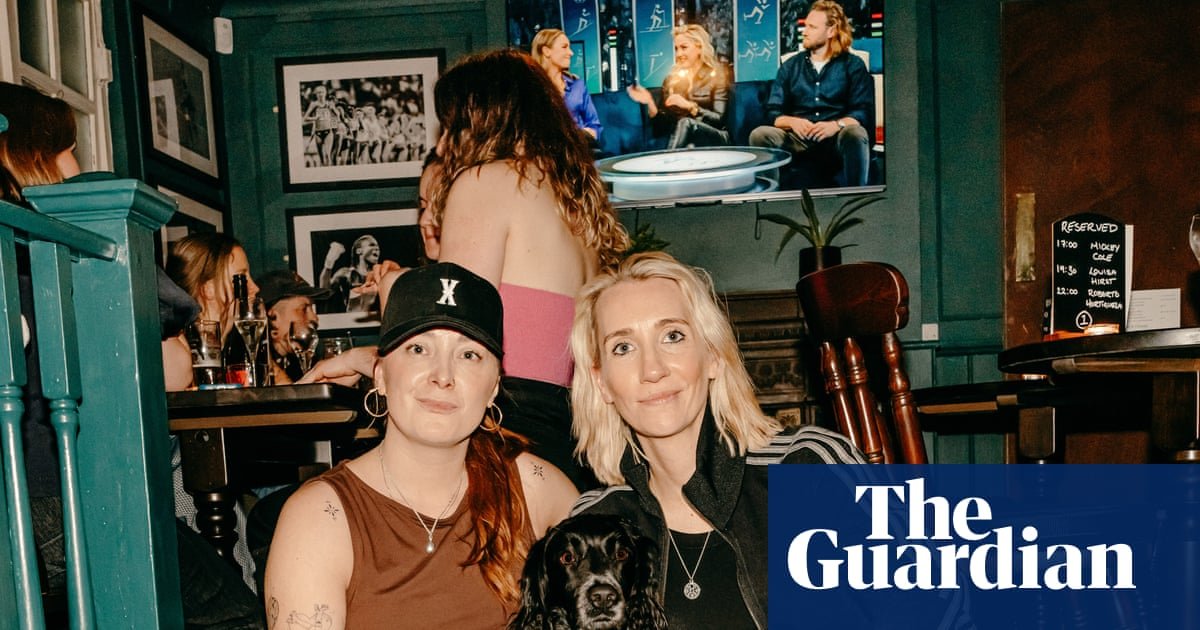
One day later and the Guardian is back for Crossbar’s launch. The doors opened at 4pm and it’s already buzzing. Lucy and Pippa had shared their fears about ticket sales for opening night, but they sold out within four minutes.
“I’ve been waiting for a place that really focuses and appreciates women’s sport because I’m a huge fan of women’s football,” says one of the early patrons, Popsy Greader-Palme. “I’m so glad that there is a dedicated space where people can feel safe and watch women’s football, women’s sport, without feeling judged.”
Another visitor to Crossbar is Serena Ferguson. “I was never interested in football but my girlfriend got into it and I started watching a bit more and going to games with her,” she says. “I feel like this space is the perfect place for people like me, who want a nicer environment to enjoy the sport instead of going to a shitty bar where there’s a load of lads waiting for the game to be turned over so they can get what they want on.”
The three spaces make it a place where lots of different groups can go. It’s called the Clubhouse because Pippa and Lucy hope that teams will want to adopt it as a place to go and hang out.
For the co-owners there is joy in seeing it take off so quickly. “I love that already this feels like a space that someone could come by themselves to watch something at 11pm on a Sunday and have a great time and feel already comfortable,” says Lucy after Super Bowl night.
They have funded the bar themselves, Pippa investing her inheritance after the death of her mother. “It’s not been super scary in that sense, because it’s not money we had originally,” she says. “Later in life my mum’s attitude towards money was: ‘Don’t sit on it, do something’.
“I don’t know how she would feel about a women’s sports bar, I don’t know if she’d get it, but us doing something for us and trying something new I think she’d be really excited about. ”
The pressure instead comes from doing right by those women who are desperate for a space like this. “We want the community of people that are already excited about the bar to feel well looked after and like it’s how they wanted it to be,” says Lucy.
