
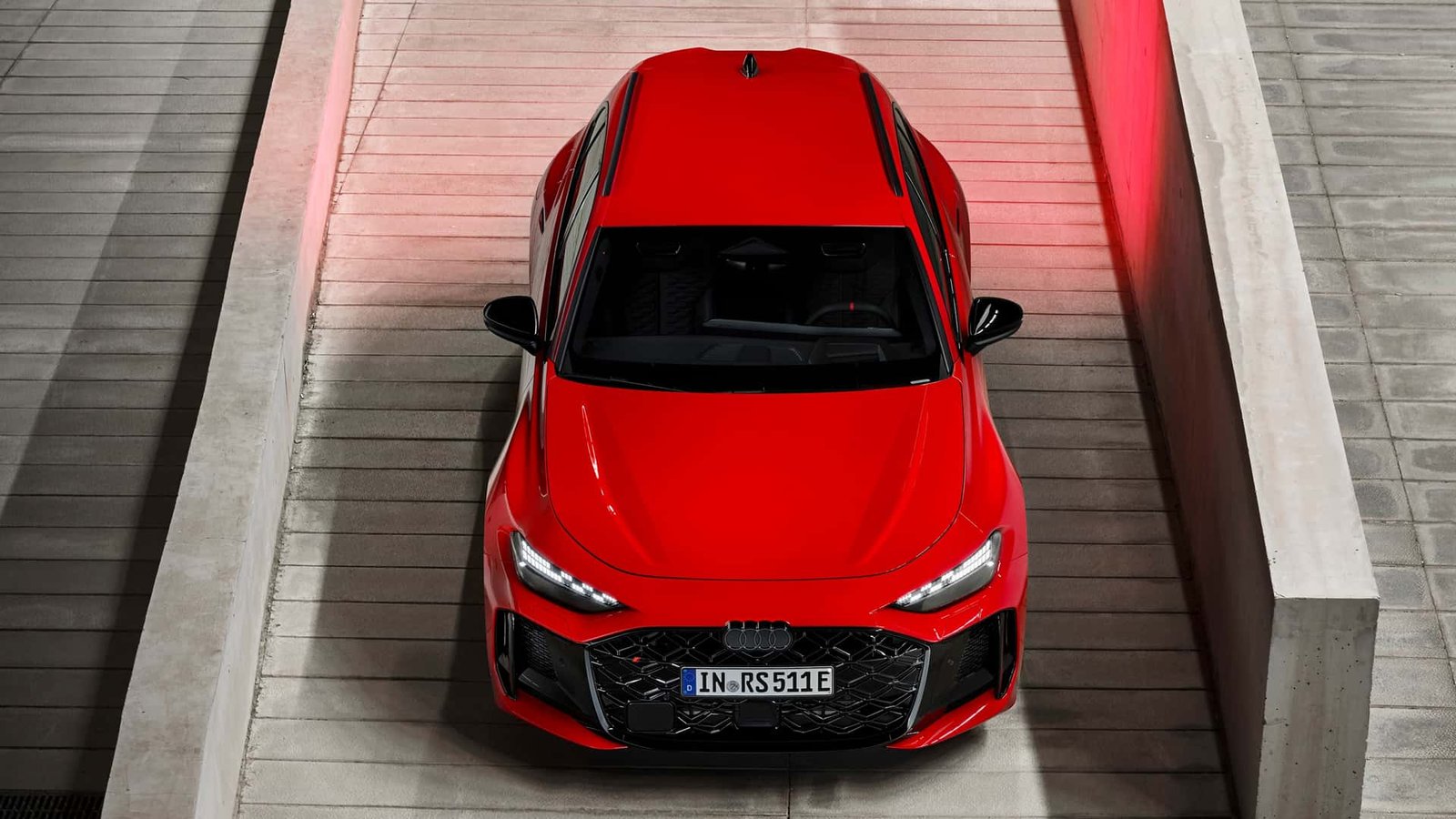
- Audi admits the new RS5 has put on ‘some weight,’ but swears you won’t feel it.
- The RS5 Avant weighs 5,225 lbs (2,370 kg).
- The sedan isn’t much lighter, at 5,192 lbs (2,355 kg).
They say weight is the enemy of performance, but the company with the Four Rings is confident it has found a way to offset the massive heft brought by the new RS5’s plug-in hybrid system. In an official post on LinkedInAudi Sport’s Managing Director pledged the new fast wagon “feels agile and light on its feet.”
Although he does admit that switching to a complex PHEV setup does “add some weight,” there are benefits that go beyond an electric range of 53.4 miles (86 kilometers) in city driving:
‘Plug-in hybrid hardware does add some weight, but it also opens fresh possibilities for driving dynamics. Our electromechanical torque vectoring at the rear axle, together with the RS sport suspension, uses that capability smartly. The result is a new RS5 that is more stable and precise but feels agile and light on its feet at the same time.’
Photo by: Audi
Ultimately, that’s for journalists to decide and prospective buyers to discover during a test drive. In the meantime, the weight figures highlight just how much mass the original RS model from Ingolstadt has gained over the years. When the RS2 Avant debuted in 1994, it tipped the scales at a reasonable 3,516 pounds (1,595 kilograms).
In 2026, its modern-day equivalent is 1,709 pounds (775 kilograms) heavier, at a whopping 5,225 pounds (2,370 kilograms). Of course, 32 years is a long time, especially with far stricter safety regulations requiring automakers to bulk up their cars. Modern vehicles also feature significantly more technology, which isn’t necessarily a good thing, but that’s a story for another day.
Most of the added weight accumulated over the years comes down to two factors: size and powertrain complexity. The Porsche-built RS2 Avant of the 1990s measured just 177.5 inches (4,510 millimeters) in length and 66.7 inches (1,695 millimeters) in width. The new long-roof RS5 is 15.2 inches (386 millimeters) longer and 10.1 inches (257 millimeters) wider.

Photo by: Audi
Transitioning to a plug-in hybrid system with a 22-kWh battery pack has also taken its toll on curb weight. The RS5 wagon is 1,378 pounds (625 kilograms) heavier than its immediate predecessor, the RS4 Avant B9. In other words, much of the added heft stems from packaging a lithium-ion battery beneath the cargo floor.
Nevertheless, Audi seems confident you won’t feel it, and there is a way to shave off a small portion of that bulk. Optional ceramic brakes at both axles are about 66 pounds (30 kilograms) lighter than the standard steel brakes. Sure, it’s a drop in the bucket, but it’s worth mentioning.
Photo by: Audi
Motor1’s Take: The RS5 is the first plug-in hybrid from Audi Sport and paves the way for an even larger and heavier model: the RS6 Avant. We’ll likely see it in the coming months, with an electrified V8, it’s all but confirmed to share with the returning RS6 Sedan.
Why is Audi Sport following Mercedes-AMG and BMW M into the PHEV era? To cut CO₂ emissions by offering an electric range that offsets the combustion engine. In doing so, performance cars can continue to be sold in Europe while reducing their carbon footprint and still appealing to enthusiasts. Call it a compromise born out of necessity.
