
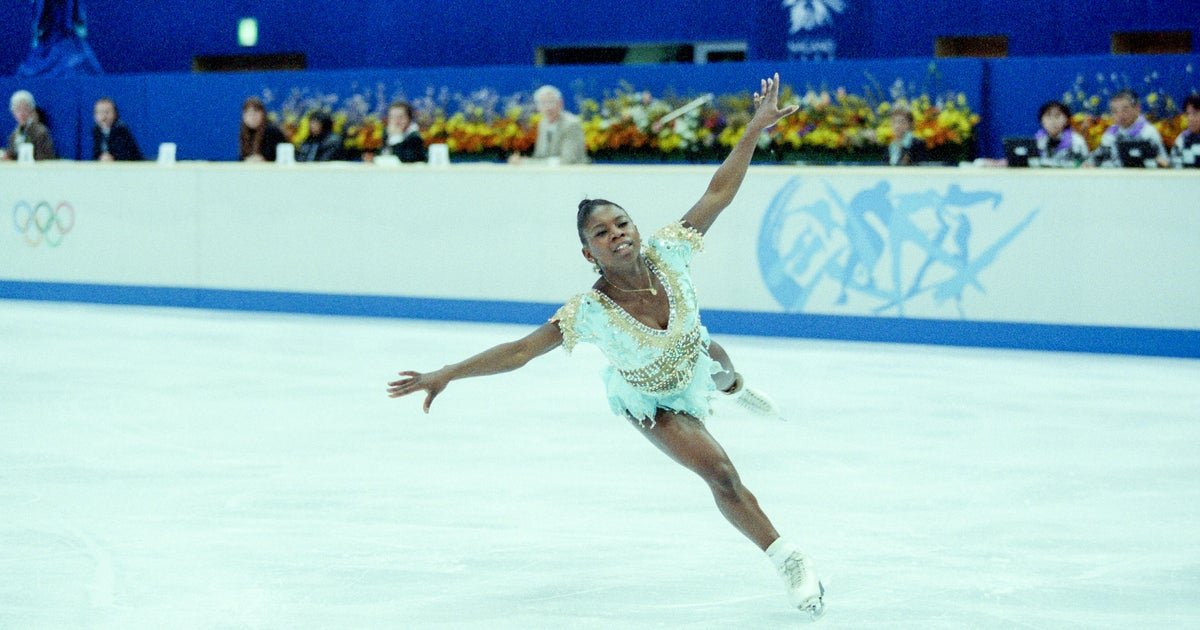
The Olympian’s thin, silver-edged skates sliced up into the air in a rare, sensational backflip — one leg, then the other — landing on a single skate a split second later that shaved back into the ice. The audience, first stunned, then thundered applause in awe.
That was not at this year’s Milano Cortina Winter Olympics, however, and the athlete was not the young U.S. figure skating phenom Ilia Malinin. It was a generation ago — six years before Team USA’s “Quad God” was even born — when the backflip wasn’t even permitted at the Games. And French figure skating legend Surya Bonaly, later lauded for her bold move, was first penalized for it.
“I think it’s great,” Bonaly told CBS News of the 21-year-old American Olympian’s feat in Milan, lauding him for “wanting to go further, going beyond, you know, the rules. I mean, that guy is amazing. So good for him to even try to go further, and doing the backflip.”
The gravity-defying gymnastic move has been called the “Bonaly backflip” for good reason.
Simon Bruty/Anychance/Getty
It was the 1998 Winter Olympics in Nagano, Japan, where the then-24-year-old Bonaly, with just moments left in what would be her final performance at her third Winter Games, gave herself, the crowd and the cameras something unforgettable. Still recovering from a ruptured Achilles tendon, Bonaly knew she was very unlikely to win a medal.
So she decided to go big, with the first Olympic figure skating backflip by a woman, and the first ever landed on just one skate.
The judges docked points over the then-banned move. She started the competition in sixth place and finished in 10th.
“I came really early. I was always ahead of my time,” Bonaly told CBS News. “So, people didn’t like that. Also, maybe jealousy, a sense of jealousy, a sense of fear — being next to me or competing with me.”
The backflip had been banned since 1977 by the International Skating Union, the worldwide governing body for figure and speed skating, “as both too dangerous, and because it violated the figure skating principle of landing on one skate,” according to the Olympics.
The first skater to land a backflip in competition was American Terry Kubicka, just a year before the ban was implemented, in 1976. But he landed on both feet. It wasn’t until almost half a century later, just two years ago, that the world skating body dropped its ban on the move.
Bonaly, now 52 and a coach at Minnesota’s Shattuck-St. Mary’s Figure Skating Center of Excellence, told CBS News she wasn’t at all disappointed to see Malinin celebrated for the move that once cost her points.
“Because somebody had to start,” she said. “It’s already difficult to be the first one for anything you try. I was a pioneer … great … (but) was not really welcome. But now I opened the doors or broke the ice for many people. And I think that is even more important.”
Eric Fougere/Corbis/Getty 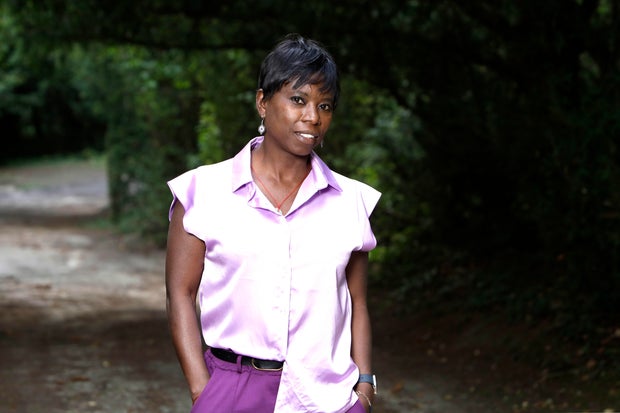
Some supporters have pointed to racism in the predominantly white sport, contrasting the optics of Malinin, a white man, being celebrated years after Bonaly, a Black woman, was criticized as brash and rebellious for doing the same thing.
Bonaly is one of only a handful of globally-renowned Black figure skaters. She told CBS News she “didn’t have much example” to follow as a young athlete.
“I didn’t have that much encouragement beside my own, my parents and my team,” she said. “Thirty years ago, people have more narrow minds, so we were not aware about what’s going on, how to treat or feel good being near a person of color.”
But she remembered watching another Black woman on the ice, who blazed tracks years before her.
“Way before me, I had Debi Thomas, you know, that American champion, which actually got a medal in 1988 Olympics, was already amazing,” Bonaly said. “At that time, I was in France watching her on TV. I was like, oh wow, that’s cool.”
Bonaly was just 14 at the time. She would go on to not only follow Thomas’ path, but to surpass her in total major titles, taking 10 French national championships, five European titles and three world silver medals. Though she never won an Olympic medal, unlike Thomas who won a bronze, Bonaly competed in three Winter Games and bent the sport’s boundaries in creativity, diversity and acceptance with her daring routines.
That desire to break new ground is shared by Team USA’s Malinin, even after his disastrous wipeout on the ice last week, when he fell out of all medal contention.
“I think it’s more important for me to just push the sport forward,” he told CBS News. “A lot of the time, it’s not a lot of people (who) talk about the Olympic champions anymore, and it’s more about what image you leave for the sport.”
He said he’d keep pulling the backflip that first debuted 50 years ago.
“It’s honestly just a really big wow factor,” he said.
Bonaly, who is also now a motivational speaker, said she encourages others to carve out their own destiny on the ice, despite any judgments or criticisms like the ones she faced.
“It’s already better to be the first one to try something,” she said, “and people will be able to look up to you and say ‘you’re being copied.’ I never copy anyone.”
“I believe that this new generation can do great things, but you have to keep your head over your shoulders. Stay cool,” she added, “and stay human. Because even though you’re a champion or celebrity, you still have to be a nice person on a daily basis. It’s very important. And also, I believe, even if you do not have a world title or medal around your neck, it still does not define you. You are still a great person.”
