
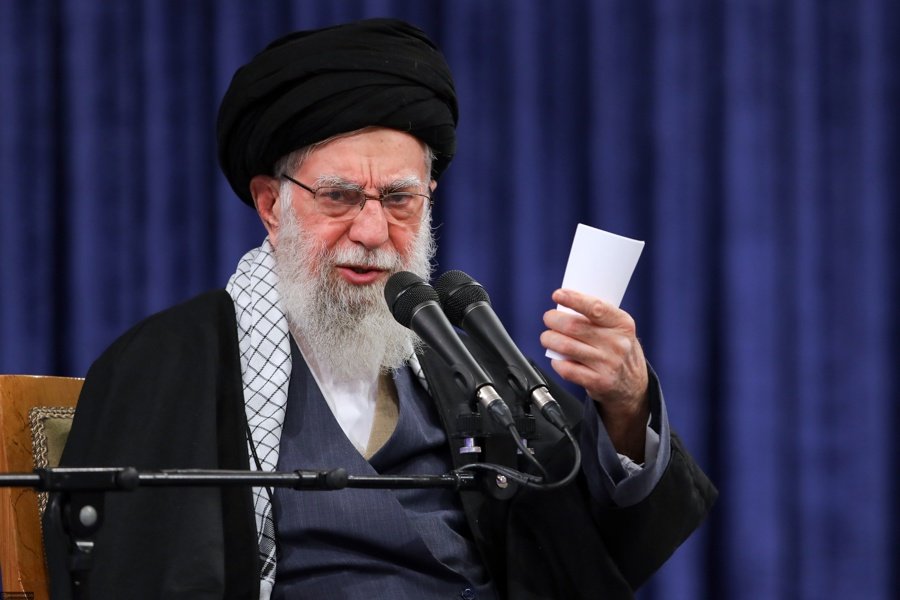
Iran’s Supreme Leader Ali Khamenei warned the US not to rely too much on military power deployed to the Persian Gulf, pointing out that even “the strongest army in the world can sometimes be hit so hard that it cannot stand up.”
“An aircraft carrier is certainly a dangerous machine, but more dangerous than the aircraft carrier is that weapon that can send it to the bottom of the sea,” Khamenei added.
The Ayatollah’s statements take place simultaneously with high-level negotiations between the two countries, in Geneva, mediated by the Sultanate of Oman. And they coincide with the increase in American military presence in the Middle East and Trump’s threats to overthrow the regime. The aircraft carrier USS Abraham Lincoln arrived in the Arabian Sea at the end of January. And the largest aircraft carrier in the world, the USS Gerald Ford, is on its way from near Venezuela.
Missile program is non-negotiable, according to Khamenei
Donald Trump insists that Tehran give up its nuclear and missile programs, in addition to stopping support for armed groups in the region. But the Ayatollah’s regime only accepts discussing the nuclear issue. The missile program, Khamenei said, “has nothing to do with the US.” The Ayatollah also increased tension between the countries by announcing that he will partially close the Strait of Hormuz. The strait is the main shipping route for oil from the Middle East.
“The president of the United States said that it has been 47 years and they still haven’t managed to destroy the Islamic Republic. This is a good confession. I say: you won’t be able to do it either,” he highlighted.
“(The US) says: ‘We are going to negotiate about your nuclear energy and let the result of the negotiation be that you do not have this energy,’” Khamenei said at a meeting in Tehran with representatives from the province of East Azerbaijan.
No chance of an agreement in the short term
“If there really must be a negotiation, because there is not always room for it, determining the outcome of the negotiation in advance is an incorrect and stupid act,” he commented.
While Khamenei was speaking, Iranian Foreign Minister Abbas Araghchi held an indirect meeting with the American team in Geneva. The team is made up of White House special envoy Steve Witkoff and Jared Kushner, Trump’s son-in-law. The two sides agreed on general negotiating principles, but the Iranian minister said there was still a lot of work ahead and an agreement would not be reached quickly.
This is the second meeting between Tehran and Washington after the resumption, on February 6, of nuclear negotiations in Muscat (Oman), in what was the first meeting since the 12-day war between Iran and Israel in June last year.
SEE ALSO:
-
US captures another oil tanker that tried to break blockade of Venezuela
-
Iran confirms negotiations with the US on nuclear deal and promises benefits
