
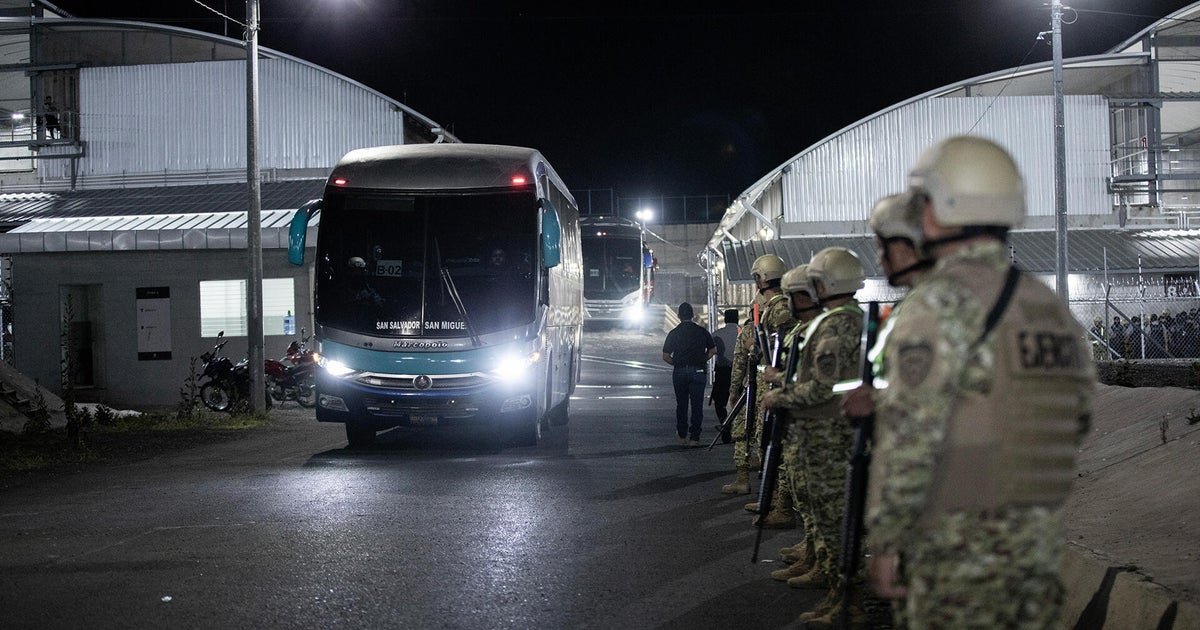
Washington — A federal judge on Thursday ordered the Trump administration to facilitate the return of Venezuelan migrants who he found were unlawfully deported to a Salvadoran prison under the Alien Enemies Act last year and then released into other countries.
U.S. District Judge James Boasberg said in a brief opinion that the number of Venezuelans who would likely want to be returned to the U.S. to continue challenging their detentions and removals is small, and acknowledged that they will be taken into immigration custody upon their arrival.
Still, he gave lawyers for the Venezuelan men until Feb. 27 to inform him of the number of plaintiffs who want to travel on their own to a U.S. port of entry or wish to be flown from a third country to the U.S. for court proceedings.
“These men suffered brutal abuse and torture because the Trump administration treated due process as optional,” Lee Gelernt, a lawyer with the ACLU who is representing the migrants, told CBS News. “The Court rightly has grown frustrated with the administration’s stalling tactics and has now taken the critical first step to provide these men with a chance to present their cases.”
Boasberg’s decision stems from a December ruling that the Trump administration had denied due process to a class of 137 Venezuelans who were deported to El Salvador last March under the Alien Enemies Act, a wartime law invoked by President Trump to summarily remove Venezuelans who were accused of being members of the gang Tren de Aragua.
In earlier stages of the case, the judge had determined that their removals were in defiance of an order that required the Department of Homeland Security to turn around planes bound for a Salvadoran prison with more than 200 Venezuelans on board.
“Against this backdrop, and mindful of the flagrancy of the Government’s violations of the deportees’ due-process rights that landed Plaintiffs in this situation, the Court refuses to let them languish in the solution-less mire Defendants propose,” Boasberg wrote Thursday. “The Court will thus order Defendants to take several discrete actions that will begin the remedial process for at least some Plaintiffs, as the Supreme Court has required in similar circumstances. It does so while treading lightly, as it must, in the area of foreign affairs.”
The judge cited a Supreme Court decision that required the Trump administration to facilitate the release of Kilmar Abrego Garcia from Salvadoran custody. A top immigration official had acknowledged that Abrego Garcia was mistakenly deported back to his home country of El Salvador.
Boasberg said that while he gave the government the opportunity to propose steps to facilitate hearings for the Venezuelan migrants who were challenging their detentions and their alleged gang membership, “the government’s responses essentially told the Court to pound sand.”
“Believing that other courses would be both more productive,” Boasberg wrote that he is ordering the government to “facilitate the return from third countries of those plaintiffs who so desire.” He said other plaintiffs can pursue additional legal claims from overseas.
Boasberg said his order does not apply to those who currently remain in Venezuela, citing ongoing tensions between the U.S. and Venezuelan government following the removal of former Venezuelan President Nicolas Maduro last month. Last July, El Salvador agreed to a prisoner swap in which over 250 Venezuelan men who were removed from the U.S. and sent to El Salvador’s notorious CECOT prison were returned to their home country.
Boasberg wrote that “it is up to the Government to remedy the wrong that it perpetrated here and to provide a means for doing so. Were it otherwise, the Government could simply remove people from the United States without providing any process and then, once they were in a foreign country, deny them any right to return for a hearing or opportunity to present their case from abroad.”
He continued: “It is worth emphasizing that this situation would never have arisen had the Government simply afforded Plaintiffs their constitutional rights before initially deporting them.”
In arguing for this remedy, Gelernt, the ACLU lawyer representing the men in this case, said in an earlier hearing that his team had only gotten in touch with a few of the men who were removed. Boasberg said that the number of Venezuelan migrants who may wish to return to the U.S. as they pursue legal remedies, “would likely be very small if not zero.”
