
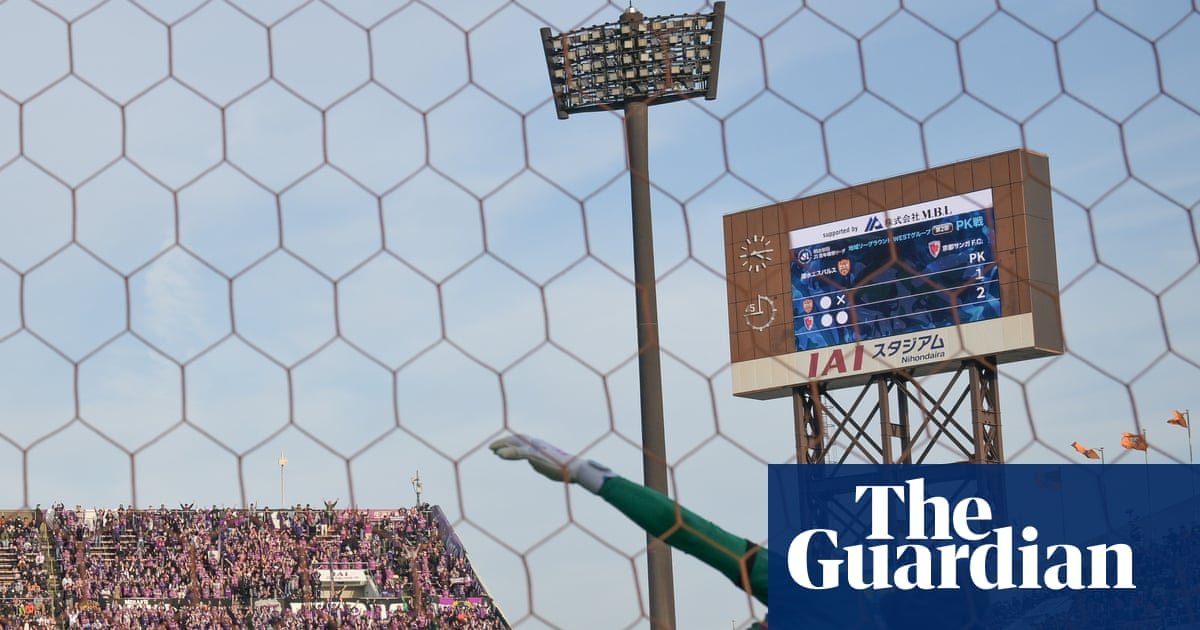
Cynics may say it is no coincidence the J.League has introduced penalty shootouts to replace draws just before the World Cup. Japan have identified the quarter-finals as the target this summer after failing to progress past the last 16 on three of the past four occasions, with two of those disappointments coming after failures from the spot.
The 2022 tournament was the worst, with the Samurai Blue, who should have seen off Croatia during normal time, losing the shootout 3-1 in dismal fashion.
For this “J1 100 Year Vision League” season, which started on 6 February, games that finish all square have gone straight to shootouts. “Why not? Japan’s bad at penalties,” Saburo Kawabuchi, the inaugural chair of the J.League said this month. “You just can’t win if you don’t practise regularly. Even in the last World Cup, it was all mistakes right from the start. I felt like telling them to be a bit more inventive.”
Well, this season feels inventive and players are getting plenty of practice from the spot. Last season, fewer than a quarter of games ended all square. In the first two rounds of this one, half of the 20 were tied, until they weren’t, with the shootout victors getting two points and the losers one. In the Osaka derby on the opening weekend 42,000 fans saw a 0-0 draw in which Gamba dominated Cerezo and then won thanks to their penalty prowess.
“It was a weird feeling,” said the Gamba fan Hiro Tanaka. “I started thinking about penalties with about 20 minutes left and there were lots of people talking about it. Winning felt nice because in normal rules we would have left the stadium disappointed to draw 0-0 when we should have won easily. And it was good to see the Cerezo fans having to watch us celebrate.”
A week later, Gamba drew again but lost the shootout to Nagoya Grampus, who have five points from two games.
All this is not really about the World Cup, at least not this one, but about taking Japanese football to the next level. This season is an unusual one as Japan transitions from the February-December schedule it has had for much of its 33-yearhistory to one that aligns with the European August-May schedule. This has left space for a three-and-a-half-month campaign that connects the last one, which finished on 6 December 2025, to the one that will start this summer.
To make things a little more fun and interesting, the 20 top-tier teams have been split into two regional groups of 10. There will be no relegation, but there are opportunities to qualify for Asian club competitions.
There are numerous reasons for the change. The authorities feel that being part of the same cycle as the big leagues will help with the movement of players and coaches in and out of the country. European clubs signing Japanese players in the summer – and this is an increasing number – have been taking these talents in the middle of the domestic season.
There is also a belief that being aligned with the most lucrative time in the transfer market will mean more revenue for teams after domestic criticism of the low fees that J.League clubs have received for their stars. This should, the theory goes, result in a better quality of recruit, higher attendances, more broadcasting and sponsorship revenue and the ability to help Japanese teams compete with the big-spending Saudi Arabian clubs in Asia, where the continental club competitions recently made the same schedule switch.
Asia, though, is not the objective. “We spent about 30 years establishing ourselves as an industry in Japan, with considerable success, but we have also fallen quite far behind the global football market’s expansion,” the J.League chair, Yoshikazu Nonomura, said. “Previously, our competitors were neighbouring clubs or domestic rivals. But now, our clubs’ rivals are Europe’s top clubs.”
The debate about the move has been around for almost as long as the J.League, which kicked off in 1993. Moving away from the middle of the hot and humid summer is a plus. Winter was long a sticking point, though not everywhere, and northern clubs – who at the moment are in the second tier – would probably have more away games scheduled when the snow starts. Neighbours China and South Korea, where the weather presents a bigger obstacle, are watching.
“Playing with no draws is good and the fans seem to find it exciting,” Sanfrecce Hiroshima’s Kim Joo-sung said. “I think it will be a positive and interesting year.”
It is a temporary measure for a placeholder of a season and there is officially no prospect of draws becoming obsolete for good. If all goes well, however, and Japan end up going far in the summer thanks to a shootout or two, then, who knows?
