
Outside the Pow Wow Grounds coffee shop in Minneapolis’s Native American cultural corridor, a group of watchers huddled around a small firepit. Some cuddled into heated camp chairs, as others grasped steaming cups of coffee as they scanned the intersection for ICE agents.
A volunteer periodically monitored a local chat group for reports of ICE agents in the area. Foot patrollers equipped with heated handwarmers and orange whistles were dispatched throughout the neighbourhood, and watchers with cars took off in pairs.
The Minneapolis and St Paul metro areas are home to one of the largest urban American Indian populations in the US. As federal forces descended on the Twin Cities this winter as part of Donald Trump’s aggressive immigration crackdown, tribal citizens, too, reported frequently being stopped and interrogated for their documentation.
During some weeks this winter, masked, armed federal agents in SUVs would circle this neighborhood over and over again – stopping undocumented immigrants, legal residents and tribal citizens alike. Sometimes the agents would hover outside Little Earth, the Native American community housing project just south of Pow Wow Grounds.
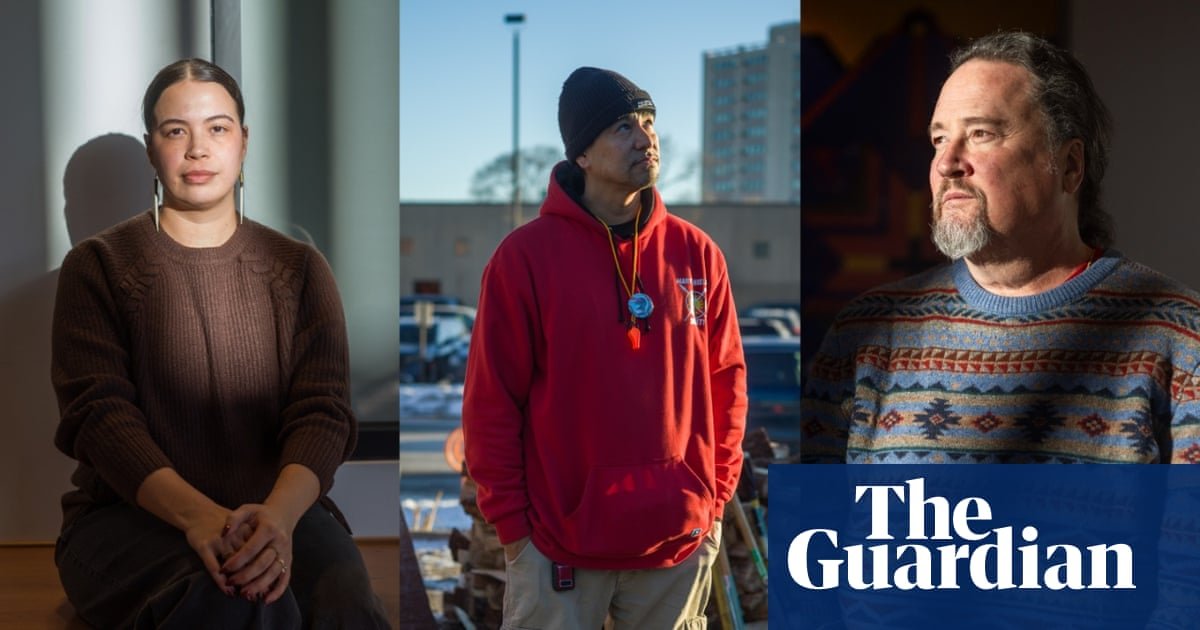
“Our kids are afraid, our elders are afraid. That’s really what sparked the fire to get us out here, ” said Vin Dionne, a leader of the Many Shields Society, a community safety group that has been working to help both Native and immigrant neighbors.
It seemed that often, Native people were stopped because they didn’t look white, said Robert Lilligren, CEO of the Native American Community Development Institute (NCDI). “This is a general attack on brown people, a ‘scoop them all up,’” he said.
More than 50 years ago, the American Indian movement (AIM) was born in this corner of south Minneapolis, just across the street from the coffee shop. In 1968, in response to escalating police brutality against Native people, the movement established citizen patrols. Now, Dionne said, Many Shields, along with Native and non-Native volunteers in the neighborhood, has reprised the practice.
At least four members of the Oglala Sioux Tribe have been detained in the operations, according to tribal president Frank Star Comes Out. The Department of Homeland Security disputed the tribe’s allegations.
In response, Star Comes Out and the leaders and representatives of at least 10 tribes travelled to Minneapolis and processed applications for tribal IDs, setting up booths at the Minneapolis American Indian Center.
It was an unprecedented move for many tribal governments, which normally require members to travel to their tribal reservations to collect IDs. But many Minnesotans don’t have passports or Real IDs issued by the Department of Motor Vehicles, meaning that tribal IDs are one of the few ways for Native people to prove their status to agents. “We felt an urgency to protect our people,” said Star Comes Out.
Local leaders expressed hope for a drawdown after the Trump administration said this week that it would pull back federal agents from the city, but remain concerned about the pain that operations have already inflicted.
On a chilly morning last month, Dionne was out patrolling his neighborhood. He kept an eye on community members walking outside, waiting at bus stops or walking to the grocery store. “If there’s anyone that agents would deem an immigrant, I’m watching for them,” he said later.
When he heard ICE agents were in the area, he ran back to his own apartment building – only to spot his own children at the window, recording the scene with their phones. Later, he had a talk with his eighth grade daughter about what she saw. “We talked about how sad, in 2026, even our Native American population – the first group of people on this continent – feel unsafe in their own neighborhoods,” he said.
That week, Dionne’s wife, Rachel Dionne-Thunder – who is Plains Cree and the co-founder of a local advocacy group called the Indigenous Protector Movement – was also stopped and questioned by federal agents, while driving along the Franklin Avenue corridor. Vin and others rushed over, and the agents left.
Down the road from Dionne’s apartment, Mary, 70, a US citizen and a citizen of the Lac Courte Oreilles Band of Lake Superior Ojibwe, said the pervasive presence of federal immigration agents near her home had been too much to bear. She asked the Guardian not to print her last name, because she was worried about federal agents tracking her.
“I have hardly slept in weeks,” she said. She lives south of the cultural corridor – a vibrant hub of shops, restaurants and community spaces – but comes to the American Indian Center several times a week to meet with friends and attend events. Lately, she had started splurging on Ubers rather than risk taking a bus, because she had seen that immigration agents had been stopping people at bus stops.
Agents had stationed outside of her apartment in January; neighbors had alerted each other by blowing whistles and honking their car horns. “I got so paranoid, I took my couch and I pushed it against the door,” she said. A few days later, she said, she decided it was time to leave and went to stay with her sister at the Lake Superior Ojibwe reservation in Wisconsin. “I ain’t going to fart around here anymore,” she said.
Mary believed she would be safer there, she said, because the tribe recently issued a statement emphasizing that it “does not support or cooperate with ICE”. The Oglala Sioux tribe has also banned ICE and US border patrol agents from the Oglala Sioux Pine Ridge Indian reservation.
For many Native elders especially, the sight of armed, masked federal agents have triggered dark memories and the generational trauma of violence from the US government against Indigenous people, said Jolene Jones, an organizer with NCDI. “We’re having so much anxiety because it’s in our bones,” she said. “We were still being chased, we’re still being snatched from our homes, our children are being snatched. It’s very triggering.”
A horrifying aspect of the recent immigration operation in the Twin Cities, she said, is that people detained by federal agents are being taken to an ICE processing facility located on Fort Snellingwhere the US government in the mid-1800s imprisoned more than 1,600 Dakota and Ho-Chunk people in a concentration camp.
“History repeats itself,” Jones said. “And as Indigenous people, we are trying to make sure we’re as prepared as we can be.”
Back at Pow Wow Grounds, a sign on the door signalled that ICE agents weren’t welcome, while another indicated that customers and volunteers should knock to be let in. A steady stream of locals politely did so – some bringing wheelbarrows full of diapers, pet food and other supplies. Others served themselves some of the hot soup and fresh fry bed that the cafe is offering locals.
Volunteers organized the gear in the All My Relations art gallery behind the coffee shop. Fold-out tables piled with handwarmers and other supplies for patrollers had replaced the usual art installations.
Jones and other leaders discussed whether it was safe enough to send the local youth basketball league for a game in another part of town. They decided it wasn’t; there were simply too many federal agents on the streets.
“A lot of my daughter’s friends are from Mexico. A lot of our children out here, whether they’re Native or Hispanic, we’re all the same people. Many of us are First Nations people of this continent,” Dionne said. “So we all are relatives. And that’s also why we stick up for our community members.”
Dionne motioned a fellow Many Shields member to a stack of gas masks and goggles, protection against the chemical irritants that federal officers have been using against observers. He took some handwarmers for himself, and prepared to head back out on patrol.
