
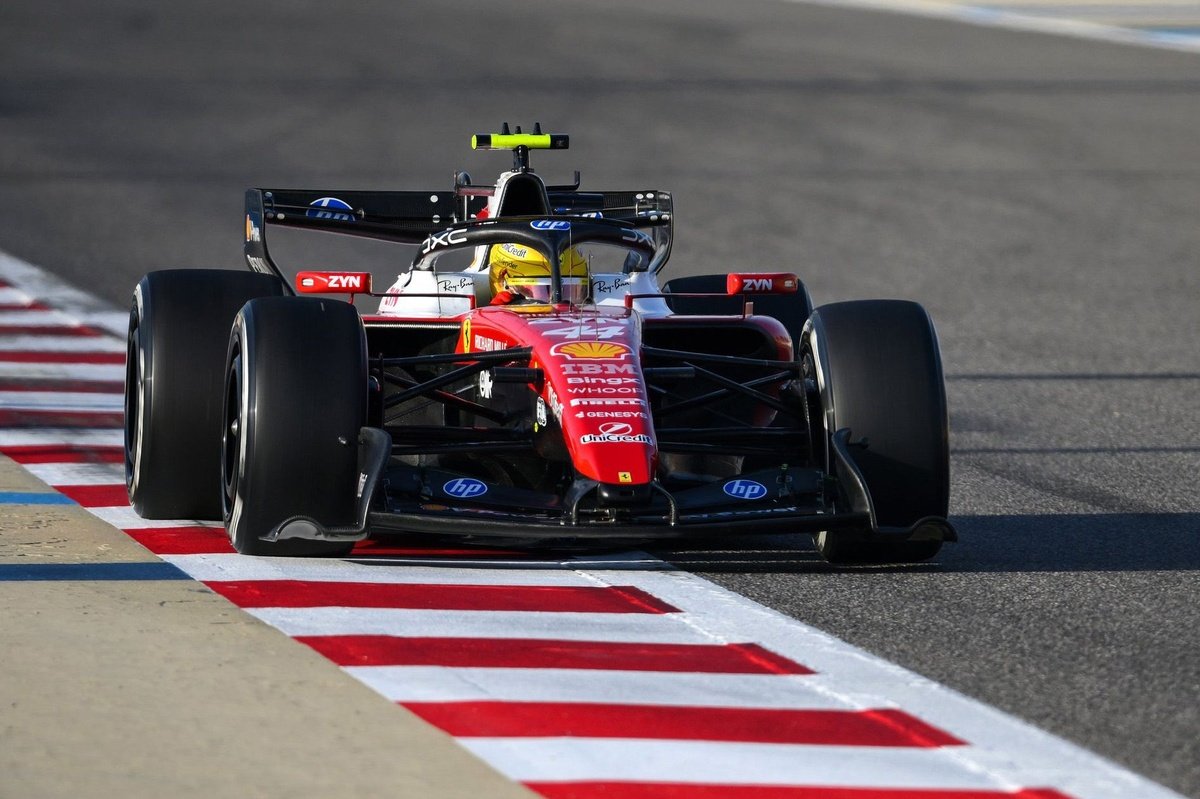
Ferrari has debuted a novel approach to its rear wing active aerodynamics package in the second week of Bahrain’s pre-season Formula 1 testing, sporting an upper wing flap that rotates over 180 degrees to run upside down.
With Lewis Hamilton behind the wheel for Thursday’s running, Ferrari put its new rear wing development into practice. With a turning axis positioned at the leading edge of the upper element, the wing was able to flip around. The leading edge of the wing was thus at the rear of the car when the active aerodynamics were applied.
Versus the old DRS regulations, the active aero rules are very different. DRS activation had a strict maximum slot gap size of 85mm, and with a fixed axis of rotation. There is much more freedom with active aero, as demonstrated earlier in the test as Alpine and Audi opted for front-mounted hinges – allowing the wing’s trailing edge to drop down, rather than lifting the leading edge.
The aerodynamicists’ main consideration will be determining which two wing angles offer the most amount of downforce in corners, at the lowest drag level in straight mode. Although there will be compromises between the two, creating a system that allows the most drag to be trimmed out when the wing is activated is nonetheless a bonus to efficiency.
Although reducing the frontal area is the obvious way to do this, there are further mechanisms at play: teams can induce a stall and slash induced drag in that manner without needing to rotate the wing as much. This was how the DRS system in the former Formula Renault 3.5 series worked; a hydraulic actuator actually closed the slot gap between the top two elements, creating the reduction in drag via stall.
In this case, Ferrari has opted to maximise the drag shed via a complete change in the wing’s working conditions. When the upper element rotates around, it does so to place the trailing edge at the front. The overall change will ultimately contribute to a smaller coefficient of drag.
However, studies in which the trailing edge of an aerofoil was placed further upstream than the leading edge demonstrate that it should minimise the amount of lift created as a result of the curvature of the wing, through a stall that ultimately cuts the induced drag.
How is the wing legal?
There are two key rules here that presumably ensure that the Ferrari wing is legal. The first is the interval; as long as the wing moves between its two positions within 0.4s, then this is enough time to be considered legal.
The other relates to wing curvature. Article C3.11.1(e) states: “‘Rear Wing Profiles’ Bodywork must in any Y-Plane, contain: i.) no concave radius of curvature visible from below, and ii.) no concave radius of curvature less than 100mm visible from above.”
In short, this means that any wing elements viewed from the bottom of any Y-plane (any plane perpendicular to the y-axis, in this case being the axis from the driver’s cockpit to the right-hand side of the car). In short, this translates to “no concave wing elements can be viewed from underneath the car”.
So long as the Ferrari’s floor and diffuser components can obscure the rear wing when viewed from underneath, or if any overhang can be demonstrated as not concave, then this should render the device legal.
Ferrari has stated that this is a test item, and will assess the wing’s credentials before deciding whether to carry it into the 2026 season.
We want to hear from you!
Let us know what you would like to see from us in the future.
– The Autosport.com Team
