
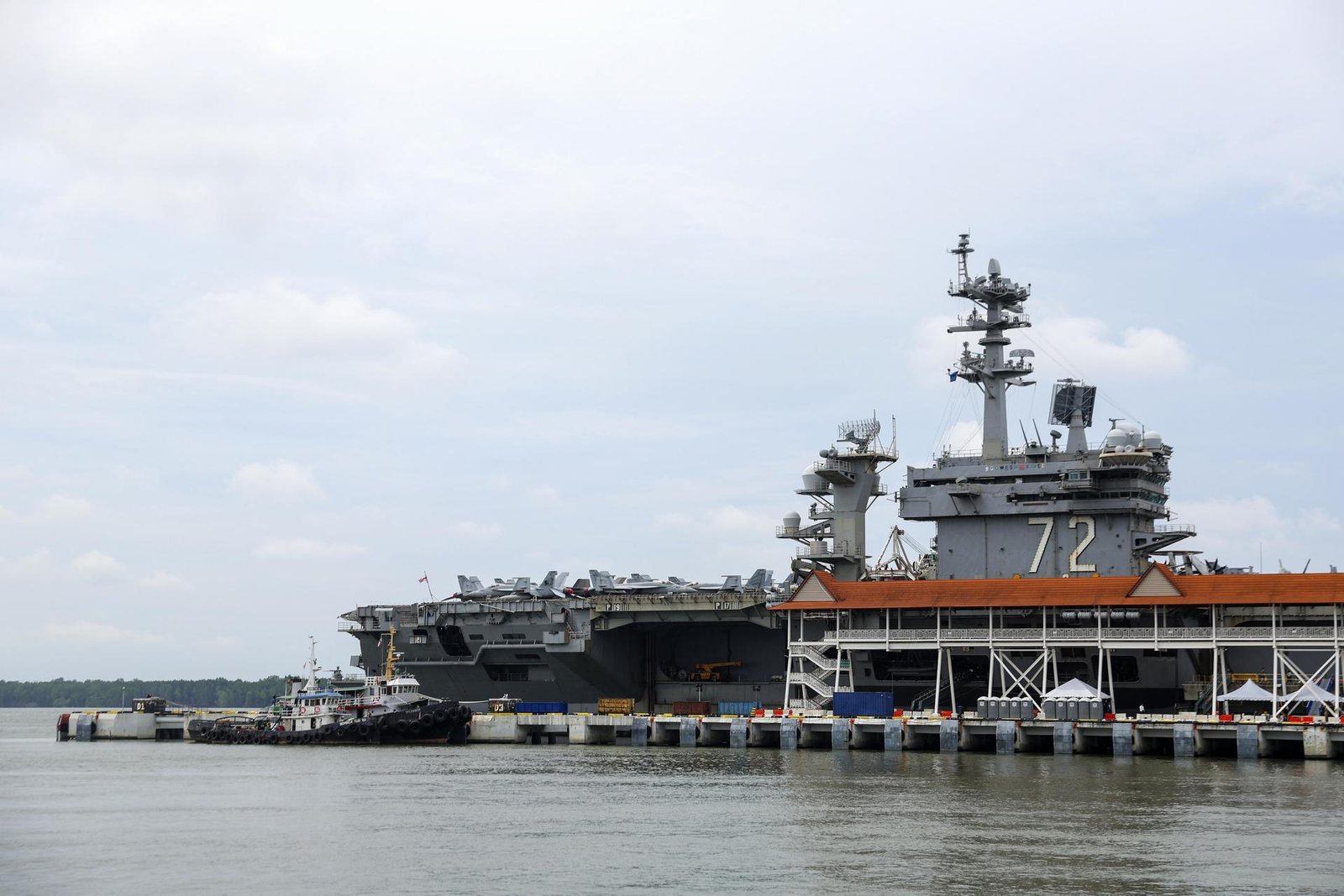
The United States has carried out the largest military deployment in the Middle East since 2003 to contain threats from Iran. With two groups of aircraft carriers and fifth-generation fighters deployed, the American government is trying to force a new nuclear agreement while monitoring the risk of an imminent attack.
What is the size of the military reinforcement sent by the United States?
The mobilization is described as historic, reaching levels comparable to those of the invasion of Iraq. The country deployed two groups of aircraft carriers, the USS Abraham Lincoln and the USS Gerald Ford, as well as more than 50 state-of-the-art fighters, such as the F-22 Raptor and the F-35. This concentration of naval and air power serves to signal that the Americans are ready to act if diplomatic negotiations fail or if there is a direct provocation against their forces in the region.
What are the main targets of a possible American attack?
Experts point out that military action would begin focused on degrading Iranian air defenses. Next, the main targets would be missile and drone infrastructure, military command centers and Islamic Revolutionary Guard Corps facilities. The objective would be to eliminate the regime’s ability to launch projectiles against American allies or troops, which could range from a surgical and specific attack to a broader campaign to weaken the ayatollahs’ government.
How is Donald Trump conducting diplomacy in this scenario?
The president indicated that he will allow a ten-day window for negotiations to progress in Oman before taking drastic measures. However, the history generates distrust in the Iranian regime, as on previous occasions there have been bombings shortly after announcements of diplomatic deadlines. The American demand is clear: Iran must accept severe restrictions on its nuclear program, halt the development of ballistic missiles and stop supporting regional extremist groups.
What would happen if Iran decided to retaliate with a one-off attack?
This is the greatest risk of escalation to all-out war. If the US carries out a small attack and Iran reacts by causing significant casualties to the American military, the conflict would no longer be a one-off. Military analyst Paulo Filho explains that the cost of maintaining this structure in the region is extremely high, which indicates a real purpose for the use of force. A corresponding Iranian retaliation would open space for a sustained campaign that could threaten the very existence of the Islamic regime.
What is the current status of Iran’s military capabilities?
Although Iran denies having plans to produce nuclear weapons, the country currently has the largest arsenal of missiles and drones in the entire Middle East. This capability is what makes the regime a real threat, as it allows long-range attacks against American bases and neighboring countries. Therefore, the US has deployed “stealth” technologies, which are planes invisible to radar, to ensure that they can reach these launch sites without being detected by Iranian defenses.
Content produced based on information gathered by the Gazeta do Povo team of reporters. To access the full information and delve deeper into the topic, read the report below.
SEE ALSO:
- US concentrates historic military power in the Middle East and puts Iran in front of three scenarios
