
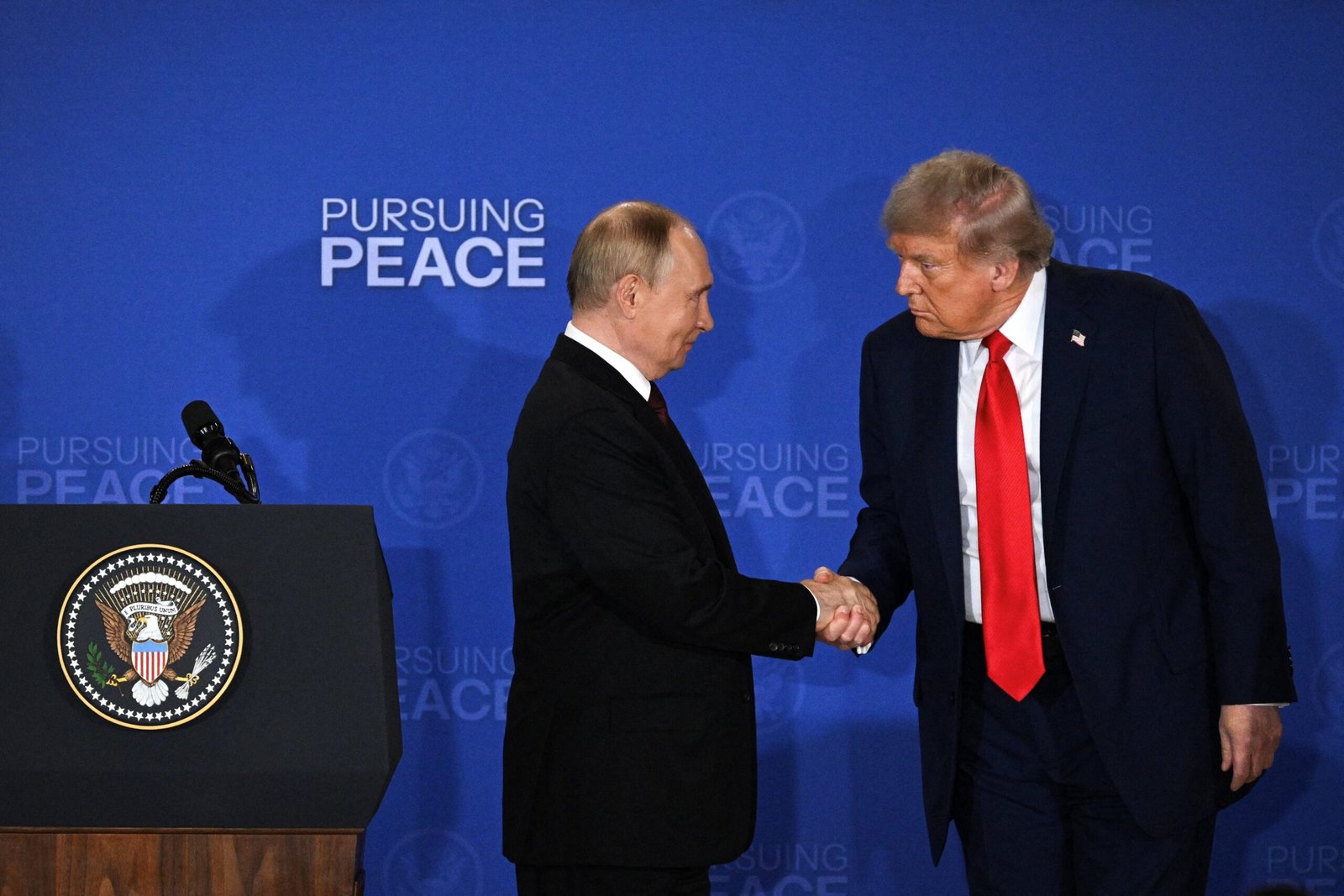
Putin and Trump meeting in Alaska Drew Angerer/AFP The United States and Russia, the world’s largest nuclear powers, are now without limits on the production and deployment of atomic warheads, following the expiration of the New START treaty on Wednesday (4). This new reality, unprecedented in the post-Cold War scenario, will accelerate the global nuclear race and throw the world into the unknown, according to experts interviewed by g1. ✅ Follow g1’s international news channel on WhatsApp ➡️ Signed in 2010, New START was an agreement between Washington and Moscow limiting the number of nuclear warheads that countries could have ready for use in their arsenals — up to 1,550 each. The treaty also imposed a cap on the number and use of nuclear weapons and regulated where they could be stored. (read more details about New START below). Considered a vital element in preventing nuclear escalation around the world, New START was also the last treaty of its kind between the US and Russia — the two countries already had other nuclear agreements, but they were all dissolved. The expiration of the treaty, for the experts interviewed by g1, is driven by the rise of China as a global nuclear power and consolidates the end of the logic of non-proliferation of nuclear weapons that has predominated in the world since the end of the Cold War. In this new reality, the declared gap between the largest nuclear powers opens up a global nuclear arms race that will be led by the USA, Russia and China in a context of mutual distrust in the global geopolitical panorama and which should cause a proliferation of warheads around the world in the coming months, according to experts. “The end of New START removes the last institutional brake that still contained this arms race and, in doing so, exposes and accelerates a dynamic of nuclear competition that was already underway. New START was a pillar, and its absence changes the global strategic environment”, UFF professor of International Relations and Harvard researcher Vitelio Brustolin told g1. According to Brustolin, New START “managed” the rivalry between the US and Russia. Without it, each side will need to assume the worst-case scenario to plan its military and nuclear forces. Even so, the Nuclear Proliferation Treaty (NPT) would be enough to avoid a nuclear race, according to Brustolin. The problem is that the NPT is not respected: China, for example, is rapidly expanding its arsenal in violation of the terms of the treaty. (Read more below) China, in fact, is the factor that changed the logic and made the USA let New START “die”, according to experts. Washington’s move indicates that Russia no longer matters as much as it used to and also not as much as Beijing at the moment. The USA, in fact, is focused on containing the Asian country, which in recent years has emerged as a global superpower. US President Donald Trump argues that China would need to be included in any new nuclear arms control agreement. Chinese President Xi Jinping, in turn, claims that the country would not need to be included in such a treaty because the US and Russia already have an advantage. With this impasse, it is clear that the world is entering a “3rd Nuclear Era”, with an increase in limitless arsenals in which no world leader trusts the other, Gunther Rudzit, professor of International Relations at ESPM and guest professor at Unifa, told g1. New START Treaty: the last limit on the arsenals of the USA and Russia China: rapid nuclear expansion and concern of the USA 3rd Nuclear Era: A world of uncertainty with the proliferation of nuclear warheads New START Treaty: the last limit on the arsenals of the USA and Russia The New START treaty was signed in 2010 by then presidents Barack Obama, of the USA, and Dmitry Medvedev, of Russia, and served to establish several limits and transparency mechanisms between the two countries in search of stop a nuclear escalation. The main limits imposed by the agreement on the USA and Russia are the following: Position a maximum of 700 means of launching nuclear warheads, including: intercontinental ballistic missiles on land, missiles launched by submarines and heavy bombers capable of carrying nuclear weapons; Have a maximum of 1,550 nuclear warheads ready for immediate use (positioned in the weapons mentioned above); Position a maximum of 800 weapons capable of launching nuclear warheads: including missiles positioned in land silos, on submarines or on nuclear bombers. Russia had at least 5,429 nuclear warheads in its arsenal, while the United States had at least 5,177 warheads in January 2025, according to data from the most recent survey by the Stockholm International Peace Research Institute (Sipri), a reference in nuclear weapons. See the infographic below for each country’s most powerful intercontinental ballistic missile and a timeline of the New START treaty. Infographic shows US and Russian nuclear capabilities and history of the New START treaty. Kayan Albertin/Arte g1 In addition, other New START terms included: Keeping Russian and US nuclear weapons at a safe distance, which takes at least 30 minutes to reach the other country; Up to 18 rigorous inspections per year by a team of experts of each country’s nuclear arsenal; Mutual sharing of nuclear arsenal data every two years; Notifications prior to the launch of intercontinental ballistic missiles; Mutual sharing of information on nuclear weapons movements. Despite having stopped being fully complied with by both countries over the years, New START played an effective and important role in limiting arsenals, according to Vitelio Brustolin. Both the US and Russia indicated that they respected the limit of a maximum of 1,550 nuclear warheads ready for use until the end of the agreement. In the text of the treaty available on the US State Department website, the US recognizes that New START reinforces the country’s national security by imposing verifiable limits on Russian weapons of mass destruction. “Without the New START verification measures, there would be a reduction in U.S. knowledge about Russian nuclear forces. Over time, we would have less confidence in our assessments of Russian forces and less information to inform decisions about U.S. nuclear forces,” the State Department said in the document. Other nuclear arms control agreements that the US and Russia have had in recent decades, which had already been terminated before New START, were: SALT I (1972): froze the construction of new intercontinental ballistic missiles and submarines with the ability to fire these missiles with nuclear warheads; START I (1994): actual reduction of nuclear warheads, which dismantled the Soviet Union’s remaining Soviet strategic arsenals; SORT (2002): limited the number of operational warheads and served as a transition to New START. China: rapid nuclear expansion and US concern DF-5C intercontinental ballistic missiles capable of carrying nuclear warheads are displayed in front of spectators at a military parade in Beijing, China, on September 3, 2025. China Daily via Reuters China is rapidly expanding its nuclear arsenal and has been producing around 100 new warheads per year since 2023, according to Sipri. This made the country a major player in the current arms race scenario. Beijing had at least 600 warheads according to Sipri data from January 2025. According to Professor Gunther Rudzit, China is seeking these warheads because it is not yet on equal military footing with the USA to become a global superpower once and for all. As a result, Beijing must seek at least 1,000 missiles with nuclear warheads for ready use. The problem is that this will cause a reaction from the US, which in turn will also cause Moscow to increase its arsenal as well. According to Sipri estimates, China could reach a stock of 1,500 nuclear warheads by 2035 and be on par with the USA and Russia in the number of intercontinental ballistic missiles capable of carrying nuclear warheads by 2030. Also according to Sipri, Xi Jinping’s government completed in 2025 the construction of around 350 silos to launch these missiles. Washington has around 400 of these projectiles in its arsenal, while Moscow has up to 330 of them. In addition to expanding nuclear warheads, China is also modernizing its Army and presented in September, in a grand military parade, new weapons with a futuristic look and new intercontinental ballistic missiles. All of this has made the US’ medium and long-term objective “deterring” China and, to do so, it will be necessary to start containing Beijing now, as stated by the US Department of War in its National Defense Strategy published in January. China has protested the new US strategy saying it will increase “strategic coordination” with Russia. On Wednesday (4) the two countries promised again to deepen their ties in search of stability to face the West. 3rd Nuclear Era: A world of uncertainty with the proliferation of nuclear warheads The new reality of the nuclear arms race will not be restricted just to the Washington-Moscow axis and will affect the entire world, both the nine countries that already have nuclear weapons and the others, which may want to build their own nuclear arsenal given the current scenario of insecurity. See in the infographic below how many warheads each of the nine countries with nuclear status has: Infographic shows the 9 countries with nuclear warheads in the world and the size of each one’s arsenal. Kayan Albertin/Arte g1 Germany, Poland, Ukraine and, outside Europe, South Korea and even Japan have already shown signs that they could resort to the nuclear alternative as a precaution. According to experts, this in itself already indicates a further escalation that could worsen the global security scenario. “The more atomic weapons there are in the world, the greater the chance of humanity killing itself.” This is because, the more countries have access to atomic bombs, the more humanity will be “hostage” to the rationality of world leaders. Furthermore, in this scenario, a possible nuclear war would not be restricted to Russia, China and the USA. Among the concrete examples of this is a speech by German Chancellor Friedrich Merz last week, who said in the European Parliament that EU leaders are discussing the future of nuclear policies in Germany and the European bloc as a whole. Professor Gunther Rudzit also highlights a military alliance signed between Saudi Arabia and Pakistan so that Riyadh has access to Pakistani nuclear weapons and can use them if necessary. “The case of Saudi Arabia is the first example of this new reality of a country that sought to have nuclear weapons indirectly by allying with a country that already has them,” he explained. Other signs of intensification of this arms race may appear in details such as: in Donald Trump’s Golden Dome project; when new missiles and other weapons capable of carrying nuclear warheads are tested; when nuclear rhetoric escalates; and when sensitive data is discovered, such as the substantial increase in Chinese warheads. According to Rudzit, another element that must also be taken into consideration in the global nuclear arms escalation is Artificial Intelligence, which is a central element in the modernization of military arsenals around the world. At the same time, having a greater mastery and sophistication of technology compared to the rival, increases the danger of delegating “With the advent of hypersonic missiles, the need to accelerate countermeasures to try to take them down has increased. The response has to be very fast and human beings cannot reason at that speed. The great fear of many researchers and scientists is that, faced with these missiles, some weapons will be placed under the exclusive control of AI”, stated Rudzit.
Source link
End of nuclear agreement between US and Russia should accelerate global arms race: ‘It was the last brake’
42

previous post