
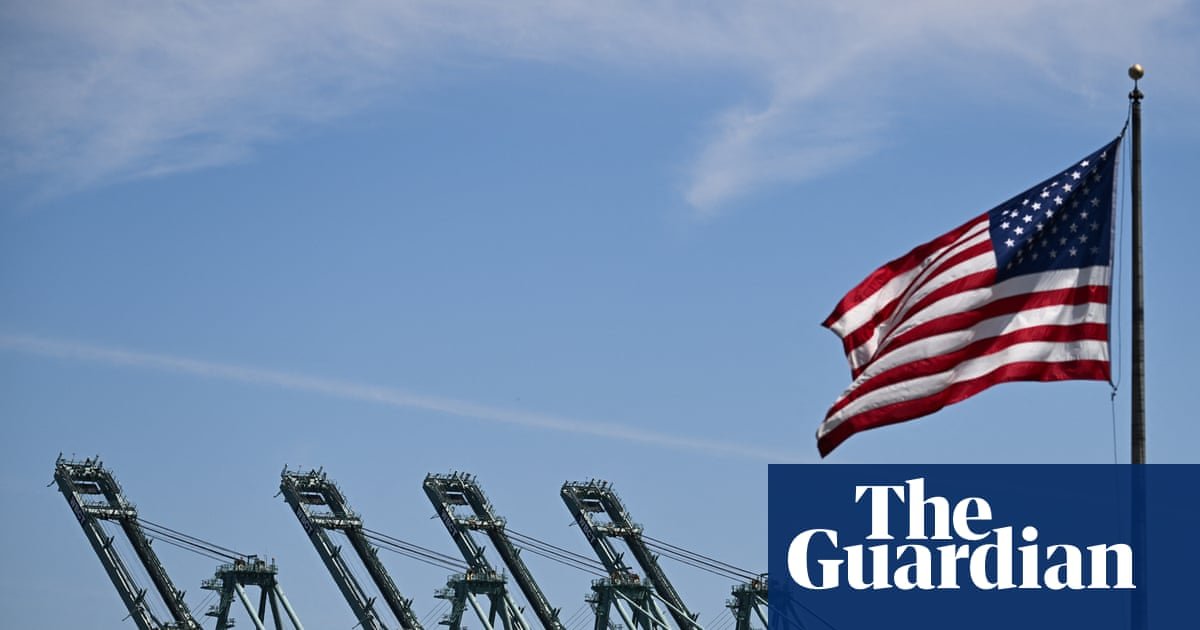
Donald Trump’s new global tariffs have taken effect at 10%, even though he had threatened a higher rate of 15% last weekend, providing “some relief” for British businesses, according to a lobby group.
After the US president suffered a defeat at the hands of the supreme court on Friday, which struck down his sweeping “liberation day” tariffs imposed last year, he angrily reacted by announcing a 10% global tariff, which he raised to 15% on Saturday in a post on his social media platform Truth Social.
According to a notice from the US customs agency“an additional 10% ad valorem duty on imported articles of every country” has been imposed for a period of 150 days from Tuesday, unless specifically exempt.
The Trump administration is applying the new duties under section 122 of the Trade Act of 1974, without approval from Congress. The 10% rate will apply on top of the US’s most favoured nation duties. The uplift to 15% announced by Trump on Saturday has yet to be implemented, but could be introduced at any time.
“While a new 10% tariff rate, instead of the threatened 15%, will provide some relief it shows how difficult it is for businesses to plan ahead,” said William Bain, the head of trade policy at the British Chambers of Commerce.
“It is far from clear what will happen next, and whether a higher tariff rate is still on the way. Despite the immediate reprieve, there is fresh uncertainty for UK firms exporting goods to the US.
“This makes it very difficult for firms to understand the prices and margins they will be able to secure for their goods, currently under production, for export in several months’ time. Inevitably this will have an impact on their sales and hit the economy.”
Last week, the US’s top court declared many of Trump’s tariffs illegal. It ruled that a 1977 law designed to address national emergencies did not provide the legal justification for most of the Trump administration’s tariffs on countries across the world.
Atakan Bakiskan, a US economist at the bank Berenberg, said: “The new section 122 tariffs may also face court challenges, as the current US trade deficit may not meet the condition of ‘large and serious balance-of-payments’ deficits that grant the president authority to impose tariffs to address ‘fundamental international payments problems’.”
However, he added: “It would be surprising if the Trump administration, after the 150 days during which the 15% tariffs remain in effect (assuming Congress does not vote to extend them), were to back down from its protectionist trade policy agenda. During this 150-day period, it will likely explore new pathways to move closer to its preferred tariff regime. There are several options available.”
On Monday, the European parliament paused its work on ratifying the US-EU trade deal agreed last year, after Trump’s announcement of a new global tariff.
But on Tuesday the European trade commissioner, Maroš Šefčovič, said the Trump administration had assured the EU that it wanted to abide by that deal.
Šefčovič told a hearing at the European parliament that he had been in repeated contact with his US counterparts, the trade representative, Jamieson Greer, and Howard Lutnick, the commerce secretary.
“They both reassured me that they stand by the deal with the European Union,” he said.
