
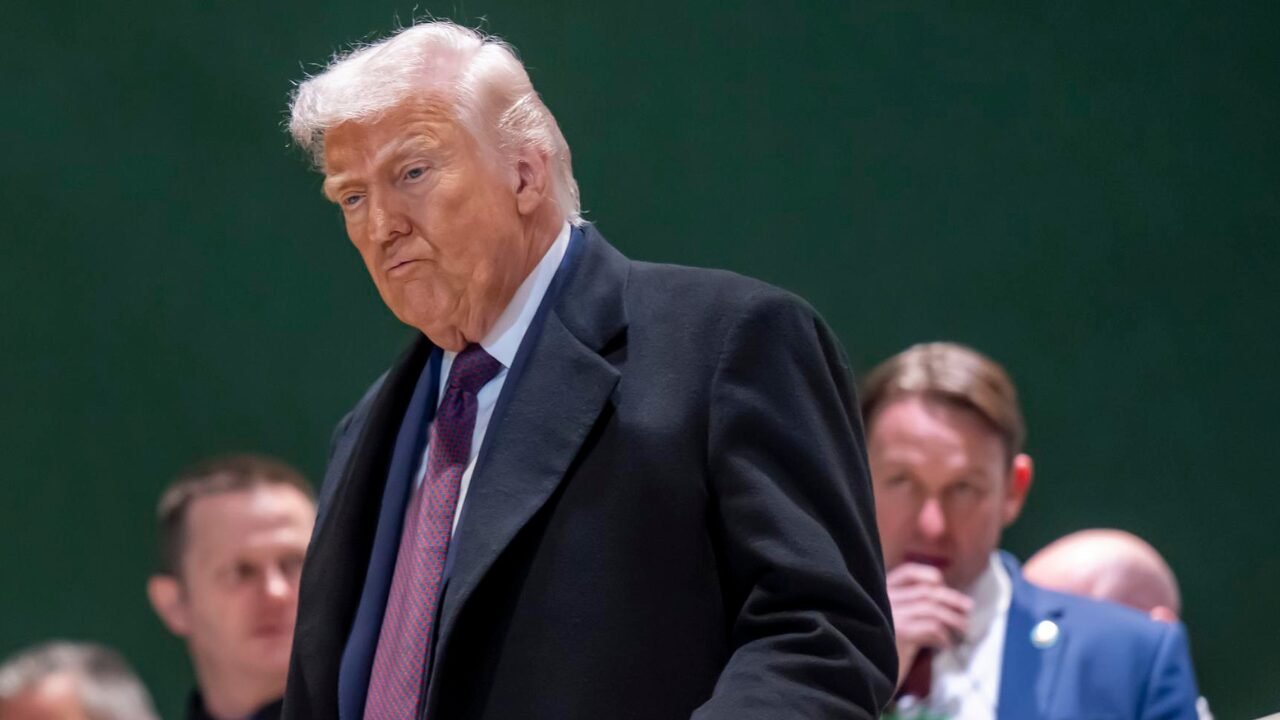
A division among conservative justices on the United States Supreme Court, exposed in last week’s President Donald Trump tariff trial, could prove to be a brake on the Republican’s measures on other issues awaiting analysis in courtsuch as layoffs in federal agencies and the granting of citizenship to children of immigrants.
In the case of tariffs, six ministers understood that Trump could not have used the International Emergency Economic Powers Act (IEEPA) to apply a series of import taxes to products from several countries, including Brazil. The president of the Court, conservative John Roberts, formed a majority with the three judges from the progressive wing, Sonia Sotomayor, Elena Kagan and Ketanji Brown Jackson, and with two other conservatives appointed by Trump in his first term: Neil Gorsuch and Amy Coney Barrett.
Three other conservative judges voted for the legality of the tariffs: Clarence Thomas, Samuel Alito and Brett Kavanaugh, the latter also appointed by the current president.
Why conservative ministers differed on the pricing case
The reason for the disagreement was the extent of presidential authority when the Executive invokes an emergency law, such as IEEPA, to act on foreign policy. For Roberts, Gorsuch and Barrett, Congress did not clearly delegate to the president the power to create a large-scale tariff regime based on this law. They highlighted that executive actions with extraordinary economic impact require explicit authorization from the Legislature and that using generic sections of the emergency law to impose tariffs would mean excessively expanding the delegation of power made by Congress to the Executive.
The group formed by Brett Kavanaugh, Clarence Thomas and Samuel Alito adopted a more expansive reading of presidential authority. They maintained that tariffs have historically always been a traditional instrument for regulating foreign trade and that, in the field of foreign policy and national security, Congress tends to grant greater flexibility to the president.
The divergence revealed two distinct currents within the conservative wing of the US Supreme Court: one that emphasizes structural limits and requires clear legislative authorization for far-reaching measures; and another that understands that the head of the Executive must have greater freedom to act when invoking a national emergency or acting on foreign policy.
Erwin Chemerinsky, dean of the University of California at Berkeley School of Law, wrote, in an analysis published on the SCOTUSblog website, that this divergence in the conservative wing of the Supreme Court shows “a clear divide among conservative justices on their willingness to impose limits on presidential power” and could have “significant importance in the future”especially in other Court trials that involve the breadth of White House power.
What cases can the division in the Court influence?
Resignations at the FED and antitrust agency
The discussion about how far the president’s authority goes also appears in other cases awaiting a decision from the Supreme Court. One of them involves the Federal Reserve (FED), the central bank of the United States, and the possibility of the president being able to fire members of the institution even when the law provides for a fixed term of 14 years and removal only for “just cause”.
The process arose after the Trump administration announced, in August last year, the dismissal of Lisa Cook, FED Governor. The president claimed “just cause”, accusing her of mortgage fraud that occurred before his appointment, during the government of Democrat Joe Biden.
Cook denies the accusations and has gone to court to keep his position. His lawyers maintain that the dismissal threatens the independence of the central bank, which makes decisions about US interest rates and monetary policy.
Trump has publicly criticized the FED for keeping interest rates higher than he would like and for rejecting significant cuts, saying they harm the US economy. Cook’s eventual departure would open space for a new presidential appointment, which could change the internal balance of the FED Board and influence interest rate decisions. In October, the Supreme Court authorized her to remain in office until the final judgment of the case. The final decision on the case is expected to be announced by the Court by the end of June.
Another action along these lines involves the Federal Trade Commission (FTC) — an independent federal agency responsible for monitoring antitrust practices and protecting consumers. The case under discussion in the Supreme Court was filed by Rebecca Slaughter, Democratic FTC Commissioner Fired by Trump last year. She had a term until 2029. The legislation that created the FTC establishes that its commissioners have a fixed term of seven years and can only be removed for “just cause”, such as negligence, inefficiency or misconduct.
Trump justified Slaughter’s dismissal by stating that, as head of the Executive, he has the constitutional authority to remove directors of federal agencies, even those considered independent such as the FTC, and that the restrictions imposed by Congress in the creation of the agency would be an undue limitation on presidential power.
Slaughter’s defense argues that there was no proof of “just cause” for the dismissal announced by Trump and that the measure violates the very law that created the FTC, approved by Congress, which guarantees a fixed term of office for commissioners and allows removal only in the cases already mentioned.
Both cases can define the extent of the US president’s authority to intervene in federal bodies whose autonomy was established by Congress.
Citizenship by birth
Another case involving the limits of presidential power concerns the Trump administration’s attempt to restrict birthright citizenship through executive action, reinterpreting the 14th Amendment to the Constitution. The text of the amendment states that “all persons born or naturalized in the United States and subject to the jurisdiction thereof are citizens of the United States and of the State in which they reside.”
Last year, Trump signed a decree determining that children of immigrants in an irregular situation or on a temporary visa would not have the automatic right to American citizenshipeven if they were born in United States territory.
Lower courts blocked the measure and it will now be up to the Supreme Court to decide whether the president can change, by decree, a constitutional interpretation consolidated decades ago by the Court itself in the case United States v. Wong Kim Ark (1898), which recognized the right to citizenship for practically all people born on American soil, regardless of their parents’ nationality or immigration status.
This case should have a decision announced by the end of June.
Automatic alignment of conservatives with Trump is discarded
The division observed among conservatives in the case of tariffs indicates that the government cannot assume automatic alignment between ministers appointed by Republican presidents when disputes over the expansion of presidential power are at stake.
Professor Jonathan Adler, from the College of Law William & Mary, stated, in an interview with the New York Times, that the decision reinforces “important and subtle differences in the way conservatives understand the contours of the Executive Branch and its relationship with Congress”.
In another article, published in the newspaper Los Angeles TimesProfessor Chemerinsky wrote that the decision on the tariff case sends a strong institutional message to the White House: that the Supreme Court “will not be a simple rubber stamp approving presidential actions.”
The outcome of these actions could directly influence Trump’s agenda, which has been testing the limits of presidential powers to advance his government’s measures.
This Tuesday (24), during the State of the Union speech in Congress – which was attended by judges who voted to overturn the tariffs –, Trump classified the court’s decision as “very unfortunate”. Before that, when reacting to the judgment, the president had been harsher when stating that the judges who voted against the tariffs were “a shame for their families”.
