
On a recent morning Eric Taylor, city manager for a small Georgia town of about 5,000 residents called Social Circle, was contacted by a staffer from Immigration and Customs Enforcement.
“They asked me to turn on the water,” he said of a 1m sq ft warehouse nearby that the federal government recently purchased for $128m, with plans to use it for locking up as many as 10,000 detainees as part of the Trump administration’s mass deportation plan.
“I told them I’m not going to do it,” Taylor said. “Not until they come and talk to me.”
The local official, together with the town’s mayor and police chief, have all publicly opposed the Department of Homeland Security’s plans to open what could become one of the largest immigration detention centers in the US – in a rural town with 19th-century buildings downtown, and horse and cattle farms and hay for sale on the outskirts.
ICE’s warehouse purchase in Social Circle is one of several dozen across the US in recent weeks. In a handful of locations – such as Ashland, Virginia and Kansas City, Kansas – local opposition appears to have thwarted such plans.
In the case of Social Circle, officials and residents alike only learned of the Trump administration’s plans to buy the empty warehouse from a 24 December Washington Post report – and since then have been clamoring for the federal government’s attention, to no avail. Taylor contacted Jon Ossoff, a Democratic senator who has also opposed ICE’s plans for the town, and Mike Collins, a Republican congressman who has told Taylor that the federal government will be in touch.
Neither Ossoff or Collins responded to queries from the Guardian.
Taylor’s concerns include: loss of property tax revenue and insufficient water, sewage, police, ambulance and hospital infrastructure, in a town that could soon triple in population. The city manager said the town’s sewage system dated to 1962, was built to handle 660,000 gallons a day, and was “already maxed out”. Social Circle had taken out a $65m bond to fix the system before ICE’s plans had materialized, he said. With thousands of detainees at the edge of town, “you’ll have poop on the ground over there”.
The town’s water system was also stretched, Taylor added. State permits allowed Social Circle to draw one million gallons a day from nearby Alcovy River, and its residents had come close to that figure last summer.
Not only that, the federal government pays no taxes on its property; former warehouse owners, PNK Group, paid about $300,000 in taxes last year, he said.
Despite these and other concerns, as of Thursday morning, not a single ICE or homeland security official had contacted Taylor or anyone else in the local government to talk about such details, even as plans appeared to be moving forward to transform the warehouse into a prison. “It’s frustrating,” the city manager said.
Town officials announced ICE’s $128m purchase 8 February on Social Circle’s Facebook page. The price paid was nearly five times the property’s assessed value of $29m last year, Taylor said. The Facebook post had nearly 1,000 comments as of Friday – more than any in recent history, said John Miller, a local business owner.
Meanwhile, despite being located in a county where nearly 75% voted for Donald Trump, a coalition of strange bedfellows appears to be as steadfast as Taylor, who for now at least controlled the water at the warehouse. “This is a close, tight-knit community,” Taylor said. “I can tell you there is unity around this issue.”
Residents who spoke to the Guardian downtown were informed and concerned.
“I would rather not have it here,” said Harriett Nunnally, a retired dental hygienist who has lived in Social Circle since 1988 and was out walking her dog. “I don’t see any pluses … nobody wants a prison in their backyard.”
Becca Moore, a 30-year-old interior designer who works in downtown Social Circle and lives nearby in Covington, said the warehouse plans were “awful”. She called herself “a blue dot in a red area”, and was concerned about reports elsewhere of members of Congress being stymied in attempts to visit detention centers, as well as conditions for detainees.
Nearby, in a coffee shop, a half-dozen middle school students had been following the issue. Chelsea Gordon, 13, said ICE’s plans were “horrible”, adding: “I feel like people wouldn’t want to live here” with the detention center in town. “I don’t know how they found it in our little town,” she added, referring to the vacant warehouse.
Daniya Locklin, 14, mentioned that she had friends from other countries. “I would hate to see them go,” she said.
The group was also aware that students across Georgia had recently protested against ICE. If such a protest happened in Social Circle, Locklin said: “I would definitely protest – but I’d be scared.”
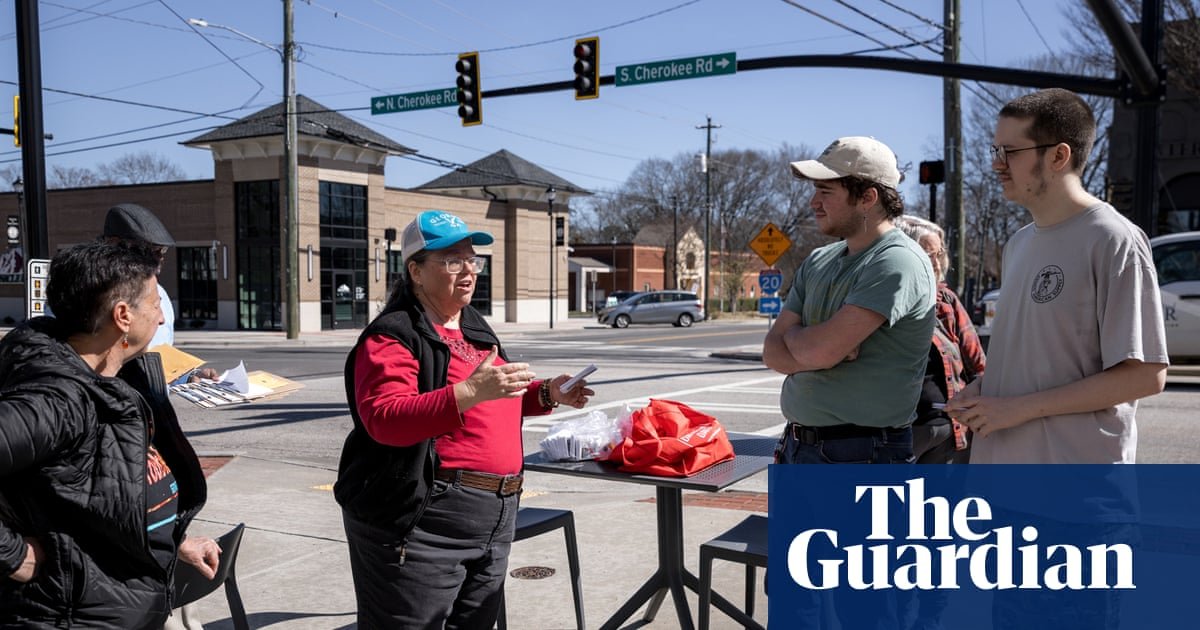
Gareth Finley was also downtown on Thursday, with a crew of 12 canvassers talking to people on the street. Founder of a group called Indivisible Boldly Blue, she said “a lot of Maga supporters … support ICE but don’t want these things next to a school, or don’t want two police officers dealing with protesters” – referring to the warehouse’s location, less than a mile from the town’s elementary school, as well as the size of the town’s on-duty police force.
At the end of the day, canvassers had spoken with about 50 residents, Finley said. About 80% were opposed to the detention center, but “most were very cautious about being identified with a political view,” she said.
John Miller’s building materials company is also downtown. He and others formed a group called One Circle Community Coalition last July with concerns about plans to bring datacenters to the area. The group of about 150 locals includes “liberal Democrats and staunch conservatives”, he said. The coalition held a public meeting 6 January on ICE’s plans, and sent a four-page letter to the homeland security department on 29 January.
“Social Circle prides itself on being ‘Georgia’s Greatest Little Town’,” the letter says. “Our identity is built on our small-scale, rural character – a character that is incompatible with a federal facility of this scale.”
The letter goes on to note the federal government’s lack of transparency and engagement with the town to date. “We are Americans after all,” it concludes. “Will we come first, or be left out completely?”
Miller told the Guardian on Friday that a Collins staffer had sent a text assuring him that someone at the federal agency had seen the letter, and would be in contact with city officials. “Honestly, I don’t know if I trust anyone in the government at this moment,” he said.
Mabel Standridge has a 50-year-old business with her husband, Bob, across the road from where the mammoth warehouse sits. Standridge Color employs 260 people, she said. The couple hosted the early January community meeting on ICE’s plans.
Standridge didn’t approve of “the secrecy”, or lack of communication from the federal government to date. She also was concerned about “what happened in Minnesota – it was scary. Two people were killed, and it wasn’t necessary. There’s always a chance such a tragedy could happen here.”
Standridge mentioned the detention center’s potential impact on emergency medical services, which have shown an increase in other areas. Social Circle has one ambulance. “If I have a heart attack, and Bob’s calling an ambulance, I’m dead!”
On Friday afternoon, Social Circle added some news on its Facebook page. A meeting had been called with the deputy chief of staff for US Citizenship and Immigration Services – and not homeland security, which oversees ICE.
But the meeting never happened.
“City staff and officials remained available for 45 minutes past the scheduled start time,” the post says. “[H]owever, the representative we were instructed to contact never returned our calls.”
