
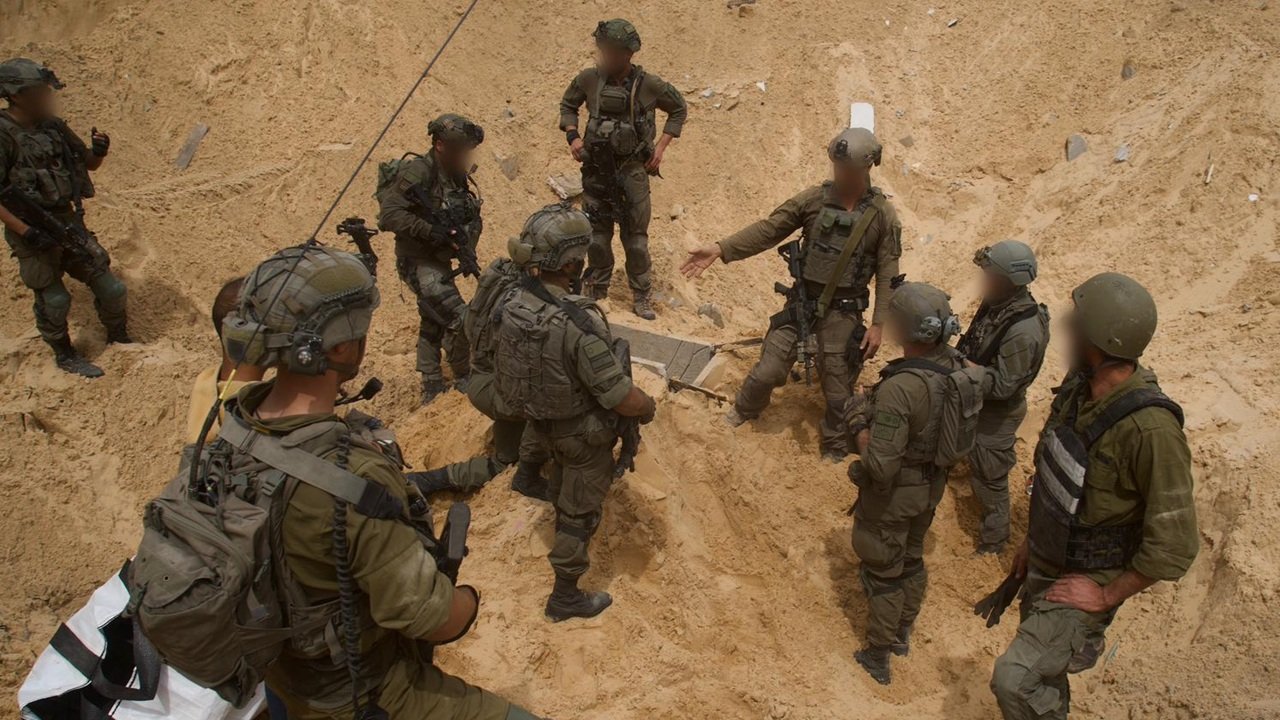
Hundreds of Brazilians served in the Israel Defense Forces (IDF) during the war against the terrorist group Hamas, a conflict currently in a ceasefire whose second phase depends on the Peace Council proposed by American President Donald Trump coming to fruition.
According to the British website Declassified UK, which obtained the data through a request for access to information sent to the IDF, last year there were 596 Brazilians in the Israeli armed forces.
Many of these serve as lone soldiers, as IDF soldiers who do not have in-person family support in the country are called. A report by The Times of Israel newspaper showed that the corporation had around 7,000 lone soldiers last year.
About half of them were native-born Israelis, who did not have family support due to personal situations, such as coming from broken or ultra-Orthodox homes, which are against military service, which creates family breakdowns. The other half were immigrants, who went to Israel alone to serve in the IDF.
Brazilian S. (for reasons of IDF protocol, his full name was not given) has been in the Israeli armed forces for two years and four months and is four months away from completing his mandatory military service.
In an interview with People’s Gazette Over the phone, the sergeant said that he serves in the Givati Brigade, which has the nickname “desert foxes” due to its training location.
S. will complete seven years of residence in Israel in September. “When I was 16, my parents came back from a trip to Israel and asked me if I wanted to go to the country to study, do high school. I kept thinking and decided to go. I thought: ‘I have nothing to lose, at most, I’ll go back home'”, he reported.
S. studied at a school where the majority of students were foreigners. After completing three years of high school, he was faced with the options of remaining in Israel, joining the IDF, or returning to Brazil.
“I really liked it here, it’s a very good country to live in. In the end, it’s very safe, the quality of life is very good. So, I decided to stay. But, before joining the army, I volunteered with children at a school for a year”, said S. At the end of that period, the Hamas attacks took place on October 7, 2023.
“I thought a lot to myself, whether I would go back to Brazil or not, what would happen, because it was very difficult. But something told me that I had to become a fighter. I had to go to the front line to give back what Israel already gave me”, said S.
At the FDI, the Brazilian, who was already attracted to technology, became interested in drones and took several courses in the area. In the war in the Gaza Strip, S. was in practically “the entire” enclave, on the front line, but acting in a “specialized in drones” way.
“It’s an experience that I will never regret having gone through, that’s for sure. Because you experience things you wouldn’t imagine. But I think the most important thing about it are the friendships you create, because at the end of the day everyone is there together, everyone is suffering in the same way, but also motivating each other, helping each other”, said the sergeant, who has people from different countries as colleagues in the IDF.
“You end up meeting people from all over the world who decided to come do this, decided to serve in the army for a greater cause. Everyone has their own reason, it’s really personal, but in the end everyone came to be able to protect Israel,” said S.
For the sergeant, the status of a lone soldier provides a special perspective from the Israeli military and population.
“They give you more opportunities, they give you a lot more help in the army. Because they know that it’s not easy to live alone, they know that, at the end of the day, you have to return home after being confined to the base for 20, 30 days, and you have to do everything: you have to cook, you have to wash, you live alone. You don’t have parents [ao seu lado]like everyone else here in the army”, he explained.
“It’s difficult to see your country turning against Israel”, says Brazilian
In the case of Brazilian lone soldiers, there is the specific situation that Brazil and Israel are experiencing a moment of diplomatic tension.
President Luiz Inácio Lula da Silva was declared persona non grata by the government of Prime Minister Benjamin Netanyahu after comparing the offensive in Gaza to the Holocaust. Furthermore, the PT government withdrew Brazil from the International Holocaust Remembrance Alliance (IHRA) and joined South Africa’s action at the International Court of Justice (ICJ) against Israel.
In response, the Netanyahu government accused Lula of anti-Semitism and placed relations between the two countries at a “lower diplomatic level”.
“I think the only thing I have to say about this is that it hurts me a lot. Knowing that Israel has already helped Brazil in several crises that happened, volunteering… And suddenly you see your country being against [Israel]is really an issue that is quite difficult to see. I’ve never been able to choose a side, because there’s no way. One is the place where I grew up, where I was born, and the other is the place that welcomed me”, said S.
“The Israelis really like Brazil. They really like Brazilians, they see a Brazilian and they are 100% excited. And when they see a Brazilian in the army and know that he is a lone soldier, without his parents, for them it is crazy that I am doing this, having left home to serve another country that is not my home country”, said the sergeant.
S. stated that, after completing the period of two years and eight months, he intends to stay a few more years in the IDF.
“In this battalion, in this team, I became a sergeant, drone sergeant. So, my whole part is specialized in fixing drones, teaching people how to fly, how the drone works and everything. And it ended up that I really liked it. So, I received [convites de] there are some places that want me to stay longer, so I can teach people who are going into the military how to get started with this,” he explained.
