
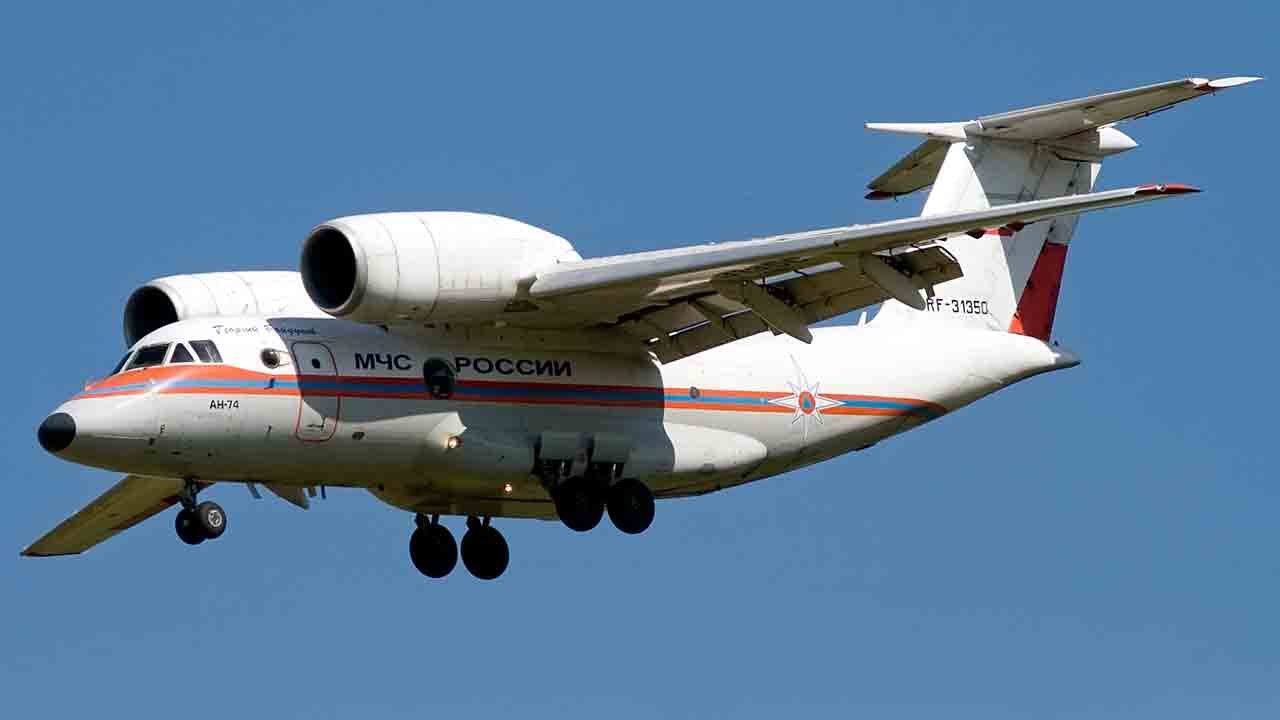
The Peruvian Ministry of the Interior canceled a tender valued at US$63 million for the acquisition of an An-74 transport aircraft after the discovery of a scheme involving falsified documents and the offer of a plane that, in practice, did not exist.
According to information released by the specialized portal Pucará Defensa and confirmed by Ukrainian authorities, intermediaries linked to the Russian Federation tried to facilitate the sale through the company Aero Express FZE, registered in the United Arab Emirates, which acted as a shell company.
The fraud was exposed thanks to the joint work of the Ukrainian Foreign Ministry and Antonov. Ukrainian Foreign Minister Andriy Sybiha stated that the company presented false information to prove its ability to supply the aircraft to the Peruvian government.
Forged documentation and lack of official license
The investigation conducted by Peruvian authorities found that the documentation presented by Aero Express FZE — including the manufacturer’s alleged representation rights — was forged. The company did not have any official license from Antonov, which is the sole legal holder of the rights to produce and sell the Antonov An-74.
Another warning factor identified during the process was the fact that serial production of new An-74 aircraft has been interrupted for more than a decade, which would make the delivery of a new or fully certified example even more unlikely.
In light of the evidence, the Peruvian Ministry of the Interior decided to immediately invalidate the results of the bidding, ending any possibility of continuing the contract.
C-27J Spartan emerges as an alternative
With the cancellation of the agreement, the Italian C-27J Spartan transport aircraft emerges as the main candidate to replace the An-74 in the Peruvian program. The model has been in operation in the Peruvian Air Force since 2015, being widely used in logistical support missions, tactical transport and operations in difficult-to-access regions.

The choice of the C-27J is seen as a low operational risk solution, since the plane is already integrated into the local fleet, has established logistical support and remains in active production, unlike the An-74.
The episode reinforces the challenges faced by countries seeking to modernize their airline fleets in a global scenario marked by international sanctions, fragmented industrial chains and attempts to circumvent them through intermediaries.
Source and images: Pucará Defense | Militarnyi | Wikimedia. This content was created with the help of AI and reviewed by the editorial team.
