
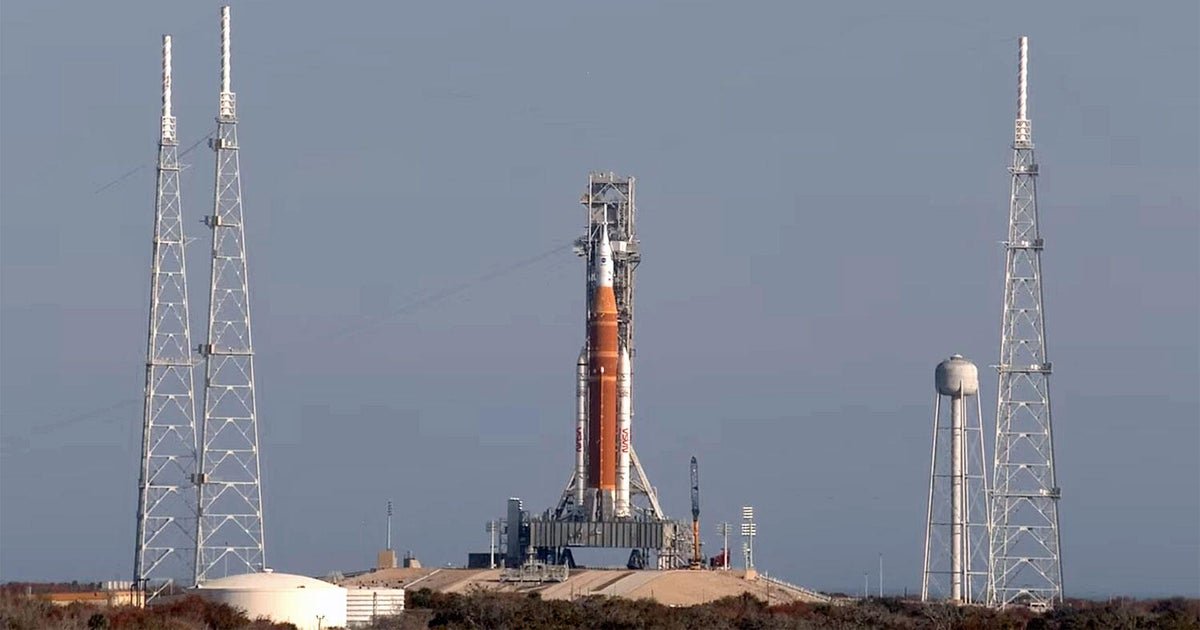
NASA and contractor engineers pumped more than 750,000 gallons of supercold propellants into the agency’s huge Space Launch System rocket Thursday without any signs of hydrogen leaks in a major step toward launching four astronauts on a flight around the moon as early as March 6.
The practice countdown began Tuesday night, kicking off a carefully choreographed series of steps to ready the world’s most powerful operational rocket for what amounted to a simulated launch Thursday at 8:30 p.m. EST. Controllers then carried out additional tests to make sure the team can recycle, hold and restart an actual launch countdown as needed to handle unexpected problems.
NASA
The initial stages of the rehearsal countdown went well and at 9:35 a.m. Thursday, launch director Charlie Blackwell-Thompson gave her “go” to begin the multi-hour process of pumping 196,000 gallons of liquid oxygen and 537,000 gallons of liquid hydrogen fuel into the SLS rocket’s first stage. The second stage was loaded with another 22,500 gallons of oxygen and hydrogen propellants.
Unlike the rocket’s first fueling test earlier this month, when hydrogen leaks forced the team to call off the countdown, sensors detected no significant leaks the second time around and the rocket’s tanks were topped off without incident.
For the remainder of the dress rehearsal, propellants were added as needed to make up for the relatively small amounts of hydrogen and oxygen that normally warm and “boil off” in their tanks. Another milestone presumably was reached in the final 10 minutes of the countdown when the propellant tanks were to be pressurized as they would be for an actual launch. Again, no problems were noted.
NASA 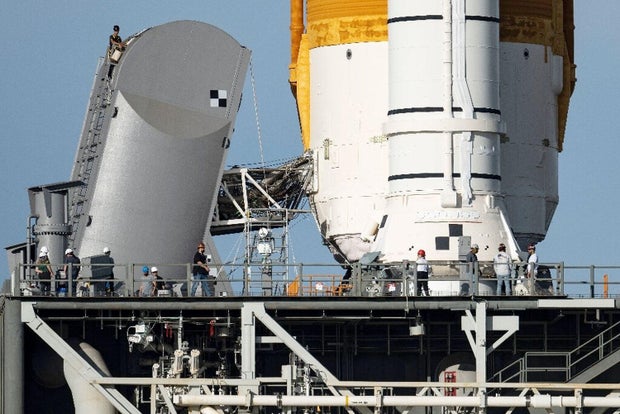
While detailed analysis remains to be completed, the preliminary results were a positive sign NASA Artemis II commander Reid Wiseman, Victor Glover, Christina Koch and Canadian astronaut Jeremy Hansen may, in fact, be cleared for launch in just two weeks. Hoping for the best, the crew planned to enter pre-flight medical quarantine Friday.
It will be the first piloted flight to the moon since the final Apollo landing in 1972, carrying the crew farther from Earth than any astronauts in history. Wiseman and his crewmates will also be the first to ride into space atop the 322-foot-tall Space Launch System rocket, making only its second flight, and the first to fly aboard an Orion deep space crew capsule.
More important, the flight will serve as a major step toward the follow-on Artemis III mission to land astronauts near the moon’s south pole in 2028.
NASA originally planned to launch the Artemis II mission early this month, but NASA engineers and contractors ran into problems during an initial dress rehearsal countdown when hydrogen leaks were detected near the base of the rocket.
Sensors in a cavity between umbilical plates where the fuel lines are attached to the SLS first stage began detecting hydrogen gas buildups when flow rates were increased after an initial “slow fill” period.
NASA 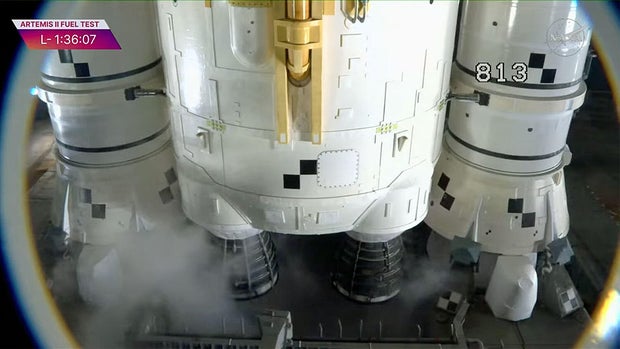
After troubleshooting, engineers were able to press ahead with the test, keeping leak rates within acceptable limits by varying flow rates and temperatures. That allowed them to safely fill the first and second stage propellant tanks and then to replenish them as needed.
But late in the countdown, when engineers began pressurizing the first stage as they would for an actual launch, the leak rate in the fueling umbilical suddenly shot up, climbing toward concentrations of 16% in the inert nitrogen gas flowing through the cavity. Beyond that, the risk of fire becomes a real threat.
The dress rehearsal was called off before the team could work through the planned countdown recycle options.
After studying test data, engineers decided to replace two seals that were thought to be responsible for the leak. A second “mini” tanking test was carried out last Thursday when a small amount of liquid hydrogen was pumped into the core stage to confirm a leak-free environment.
But a filter in the ground system apparently froze, reducing the flow rates. Even so, NASA said in a blog post, “the test provided enough data to allow engineers to plan toward a second wet dress rehearsal this week.” No other details were provided, but the seals apparently worked as required during the fueling exercise Thursday.
