
“The greatness of America,” wrote the 19th-century French diplomat, political philosopher and historian Alexis de Tocqueville, “lies not in her being more enlightened than any other nation, but rather in her ability to repair her faults.”
For a brief moment at the Munich Security Conference (MSC) last weekend, European leaders half-thought that their most heartfelt wish – the return of the old US, that believed in the EU ideal and backed a rules-based world order – had been granted.
The previous year on this same stage, US vice-president JD Vance had delivered a gut punch: a brutal ideological assault accusing Europe of abandoning “fundamental values”, and questioning whether the US and EU still had a common agenda.
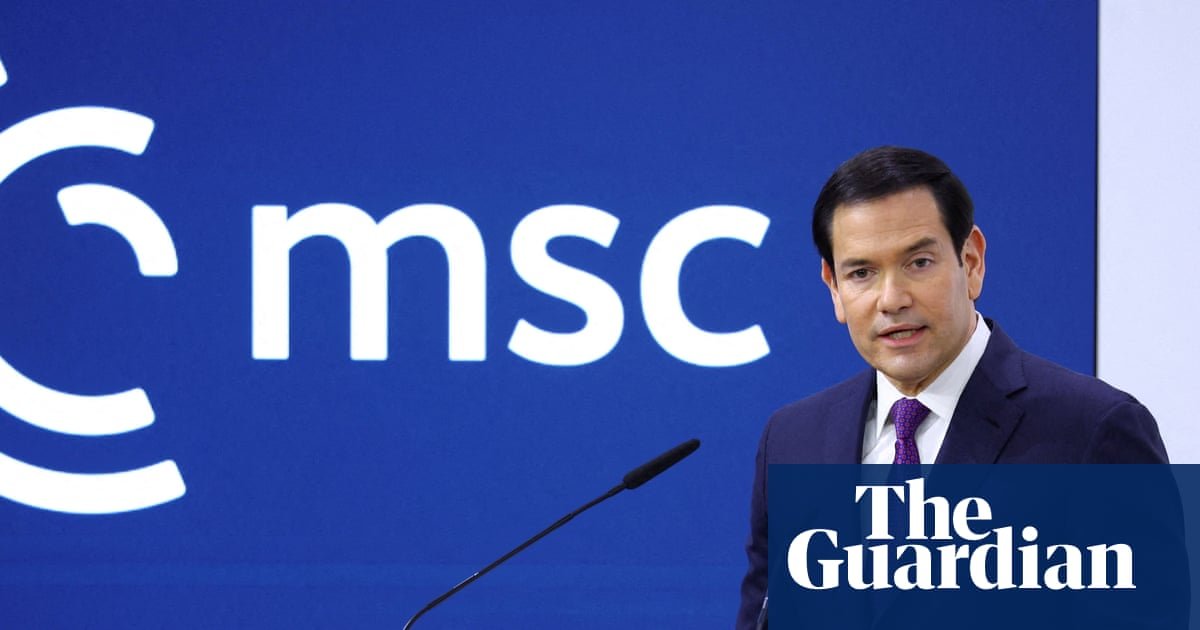
This year, secretary of state Marco Rubio gave a speech so markedly different in tone that the sheer relief at hearing something other than abuse saw the audience – led by Germany’s defence and foreign ministersplus 40-odd US officials – give him a standing ovation.
Rubio played a soothing tune. The US and Europe “belong together”, he said: if Americans came across as direct and urgent, it was because they know European and US destinies were forever intertwined. The US would “always be a child of Europe”.
Wolfgang Ischinger, the MSC president, exhaled “a sigh of relief”. Ursula von der Leyen, the European Commission president, said she was “very much reassured”. Kaja Kallas, the EU’s chief diplomat, said the bloc could work with that kind of US.
But it didn’t take long – about as long, in fact, as it took to reread Rubio’s speech – for European reactions to change. The US secretary of state, many realised, may have couched it in conciliatory terms, but his message was no different from Vance’s.
Maga’s familiar blood-and-soil obsessions were all there: mass migration; civilisational erasure; the demise of Christian culture; unfettered trade; outsized welfare states; weak militaries; “a climate cult”; worthless international institutions.
Lest there be any doubt, the White House summary was crystal clear, listing a further litany of Trumpian buzzwords: “sovereign nations”, “shared heritage”, “Christian foundations”, “outdated globalist structures” – and “defence of western civilisation”.
In short, as Claudia Major of the German Institute for International and Security Affairs put it, this was “an offer of friendship – but on white, Christian, Maga terms”. The US, Rubio explained, wanted allies “who are proud of their culture and their heritage”. Friends who see themselves as “heirs to the same great and noble civilisation”, and are “able and willing to defend it”. It was a chilling line, noted Mujtaba Rahman of the Eurasia Group, that echoed word-for-word the far-right Alternative for Germany (AfD).
As if to ram home Washington’s hostile stance, Rubio went on after the MSC to pay bilateral visits to, as Rahman put it, “the two most pro-Putin, anti-Brussels and Trump-loving leaders in the EU”: Robert Fico in Slovakia, and Viktor Orbán in Hungary.
In Budapest on Monday, Rubio hinted at financial help and said Trump was “deeply committed to the success” of the illiberal Hungarian prime minister, the EU’s disruptor-in-chief, who faces a serious challenge to his power in April’s elections.
That, too, was a massive “‘eff you’ to the EU,” one analyst told the Guardian’s global affairs correspondent, Andrew Roth, who said the visit was “guaranteed to reinforce fears that the US was seeking to promote chaos and disunity among its allies”.
Battle for meaning of ‘western civilisation’
So Rubio’s speech was no olive branch – still less a US attempt to “repair its faults”. The historian Phillips O’Brien was succinct: Rubio had “called for the end of a tolerant, democratic Europe and its break-up into a disparate group of smaller, Trumpist states”.
The speech “pronounced the death of the liberal, democratic system that has governed the European continent – and the US-led world – since 1945”, O’Brien said, and “a return to a world based on the primacy of national interests”, not values.
Some leaders showed few illusions. The German chancellor, Friedrich Merz, said Maga’s culture war was not Europe’s. In the EU, “freedom of speech ends … when it is directed against human dignity and basic law,” he said. “We do not believe in tariffs and protectionism, but in free trade. We stand by climate agreements and the WHO.”
The French president, Emmanuel Macron, told the audience that: “Europe has to become a geopolitical power. We have to accelerate, and deliver all the components of a geopolitical power: defence, technologies, and de-risking from all the big powers.”
Kallas, despite her initial welcome for Rubio’s sweetening of the pill, went on to sharply criticise “fashionable” US “Euro-bashing”. Contrary to what some may say, she insisted, “woke, decadent Europe is not facing civilisational erasure”.
There was even evidence of what the Guardian’s diplomatic editor, Patrick Wintour, called Europe’s newfound “steeliness”. Macron’s speech was rather overshadowed by Rubio’s, but referenced a hugely critical – and sensitive – topic.
The French president spoke of a “convergence” between the French and German strategic defence positions and the possibility, within Europe, of “placing nuclear dissuasion within a wholistic approach to defence and security”.
Merz, too, made a brief but deliberate reference to initial talks he had held with Macron on the subject, while the British prime minister, Keir Starmer, talked of “no British security without Europe, and no European security without Britain”.
Whether, and how, France and the UK could make their nuclear deterrents available to Europe, reducing the need for the US nuclear umbrella, will be the subject of long and fraught discussions in the months ahead, but the topic has been broached. That, and other contentious issues – think European digital sovereignty – will strain transatlantic ties further.
As ever, the EU’s member states will squabble: Germany this week told France it had to put its money where its mouth was on defence spending. But there are signs Europe is at least starting to push back. If Vance’s speech last year marked the moment “a transatlantic break-up started”, Wintour wrote, this MSC “was where the debate about the terms of the divorce settlement got under way”.
For as Le Monde put it in a powerful editorialif the US paints the EU as “a graveyard of ambition, identity and liberty”, the bloc “can in turn point to Washington’s climate denialism, abandonment of science, plutocratic drift and authoritarian tendencies”.
It has become clear, the French paper of record said, that the term “western civilisation” no longer has “the same definition on either side of the Atlantic – and Europeans have absolutely no reason to relinquish their own”.
Until next week.
To receive the complete version of This Is Europe in your inbox every Wednesday, please subscribe here.
