
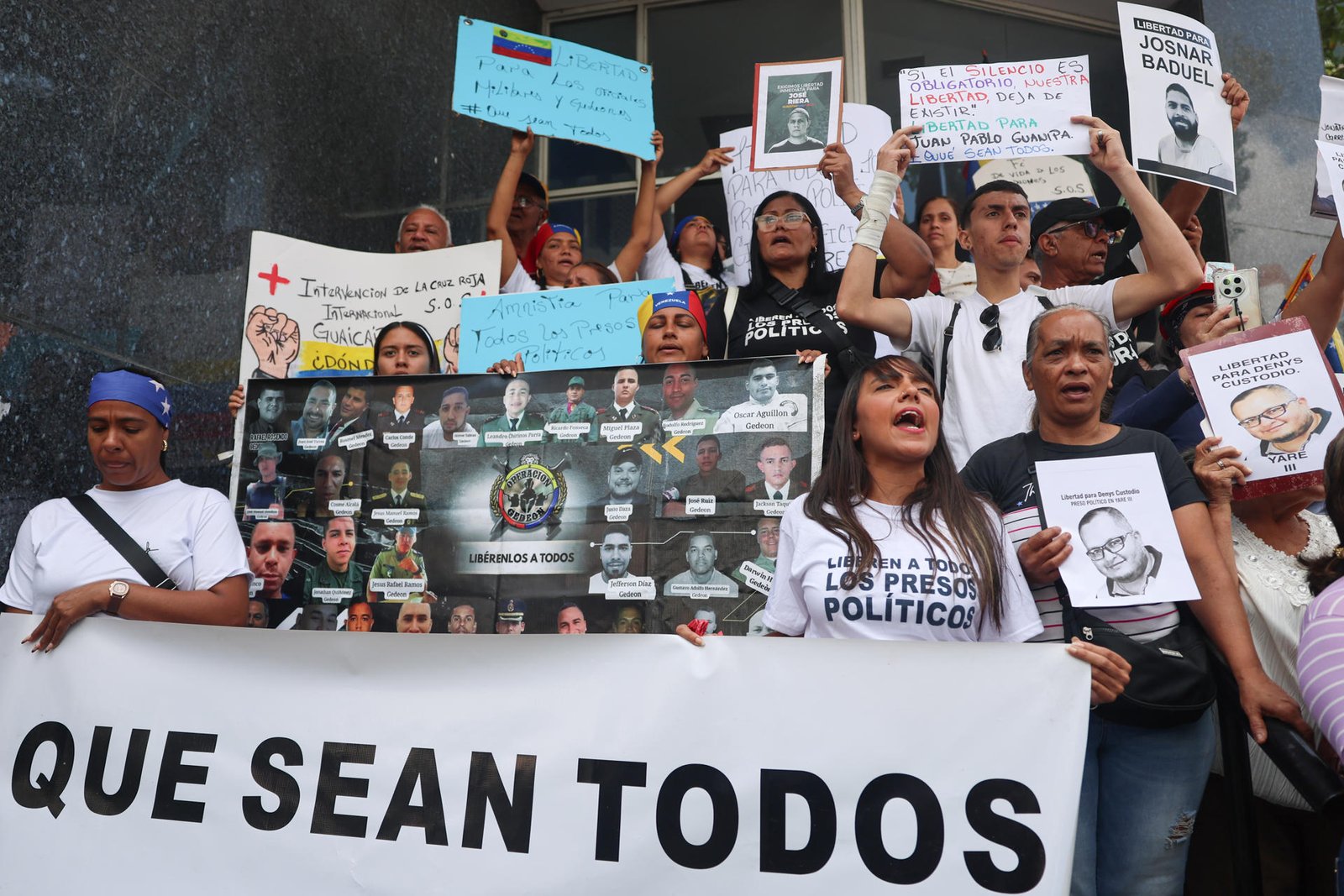
Family members of political prisoners held a protest this Tuesday (10) in the region of the National Assembly of Venezuela, in Caracas, to protest against the amnesty law proposed by Chavismo.
According to information from the EFE agency and the newspaper El País, the protesters claimed that the measure, approved by Parliament in the first discussion and in a public consultation process for its second debate and final approval, would not benefit more than 50% of the country’s political prisoners.
“The amnesty law, as currently drafted, would exclude more than half of political prisoners,” said Andreína Baduel, director of the NGO Committee for the Freedom of Political Prisoners (Clipp), who called for other mechanisms for the release of these detainees in addition to amnesty laws.
“We did not reach this point by choice. We have been calling on state institutions for years to establish dialogue tables with international observers, but they have chosen to continue violating human rights”, he denounced.
“There are several mechanisms in the law that can allow political prisoners to be released without having to continue prolonging the pain with bureaucratic actions,” added Baduel, who is the sister of political prisoner Josnar Baduel.
Other relatives of the activist who were targets of Chavismo’s political violence were another of her brothers, Raúl Emilio Baduel, who was released and later exiled, and her father, General Raúl Isaías Baduel, former Minister of Defense under Hugo Chávez and who died in prison in 2021.
Chavismo claims that he died as a result of Covid-19, but the family disputes this claim.
Andreína Baduel denounced this Tuesday that the bill proposed by the interim dictator of Venezuela, Delcy Rodríguez, does not cover arrests that occurred in years such as 2018, 2020, 2021, 2022 and 2023, when “more than half of the registered cases” occurred.
In the proposal, it is said that the amnesty is for cases from 1999 until January 2026, but in article 6 some specific years are detailed: 2002, 2003, 2004, 2007, 2013, 2014, 2017, 2019 and 2024.
Chavista deputies Jorge Arreaza, leader of the commission that discusses the law, and Pedro Infante, vice-president of Parliament, received family members, who appointed a commission that entered the Legislative headquarters to raise their questions and concerns about the text.
The NGO Foro Penal, which leads the legal defense of political prisoners, reported on Monday (9) that it has confirmed 426 releases since the release process was announced on January 8, while the interim regime says it has released 897 people since December, but without publishing an official list of names.
