
When new rules come into force in Formula 1, it’s natural to see many different interpretations across the grid, especially on those components that define the car’s overall concept. From tail to tip, from the sidepods to the suspension, all the way to the front wing, changes have swept the 2026 cars in line with the new philosophy this season.
The FIA has sought to limit the outwash effect that made it difficult for cars to follow each other through corners in previous eras, while at the same time introducing a major new feature: active aerodynamics on the front flaps. This latter element mitigates the effect aerodynamic drag would have on power demand from the engine’s hybrid system.
On this front, beyond a few hard points, the regulations grant teams a certain degree of freedom both in how the wing is interpreted and in the positioning of the actuators that control the rotation of the flaps — such as under the nose, or with two elements on the mainplane, as in the case of Racing Bulls.
Andrea Kimi Antonelli, Mercedes W17
Foto di: Mercedes AMG
The trend followed by most teams is to have two separate elements rotate – the maximum allowed by the regulations – in order to maximise drag reduction in the areas where active aerodynamics can be deployed.
But one team has taken a different path compared with its rivals: Mercedes.
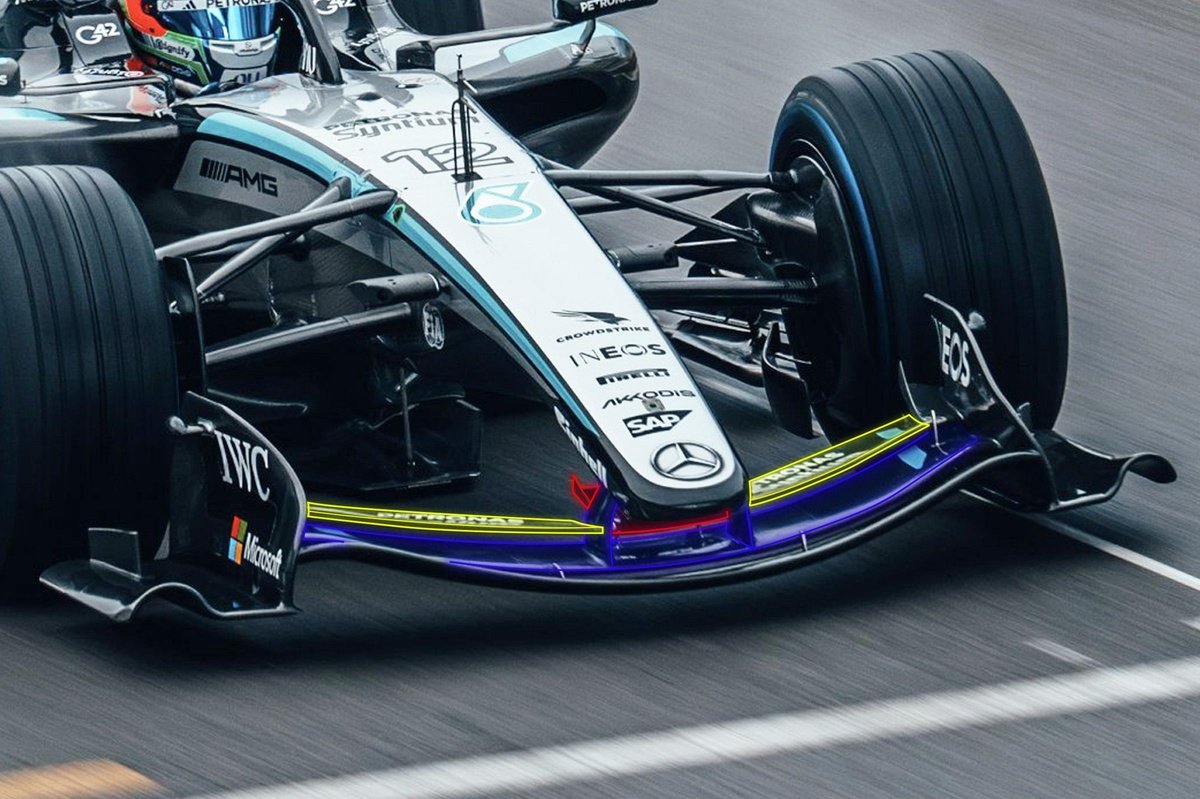
Where the W17 clearly differs from its rivals here is the choice of mounting point for the two pylons that connect the nose to the front wing. On all the other cars seen so far, this mounting point is on the main plane, whereas on the W17 the pylons are attached to the secondary plane (highlighted in blue in our images), so only the flaps on the third plane (highlighted in yellow) are free to move.
On this point, the regulations don’t impose particularly strict restrictions: the presence of one or two movable elements is left to the teams’ discretion, as is the choice of which flaps – defined as “primary” or “secondary” depending on their position on the wing – to make active. The main constraints are instead related to the axis around which the elements must rotate, the number of flaps allowed to do so, and the “deflection” relative to the standard position, which is 30mm for the primary flap and 60mm for the secondary one.
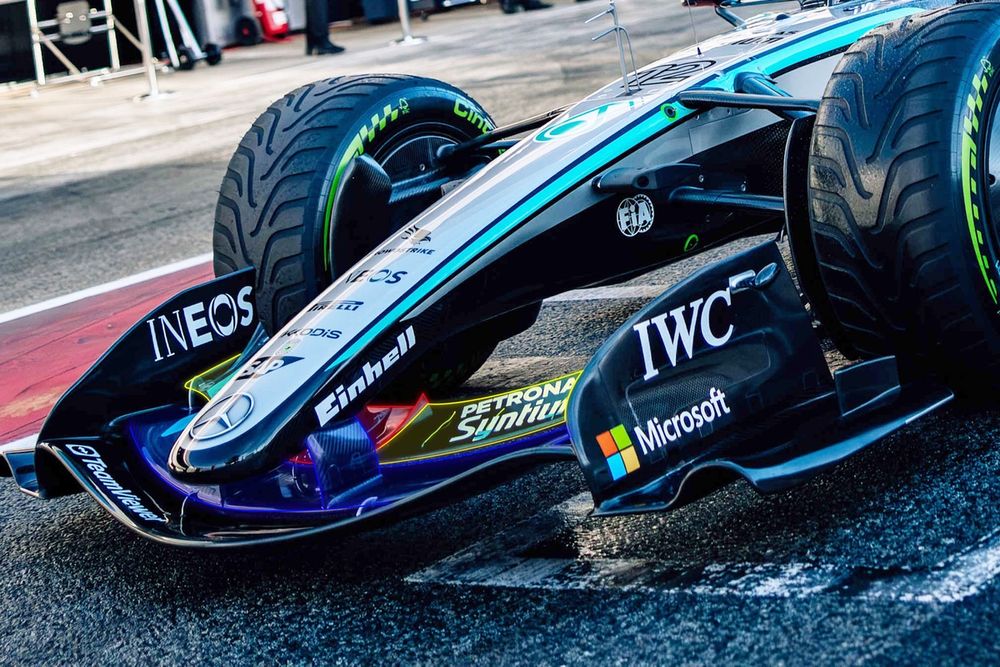
Front wing detail of Mercedes W17 with fixed secondary plane highlighted in blue and moveable tertiary planes highlighted in yellow
Photo by: Formula 1
At the core of this lies a different interpretation of how to exploit the wing elements. The only element capable of rotating would be the final one (highlighted in yellow in our images), while the fixed second flap would also have a different angle of incidence compared to its rivals. During Monday’s running, Mercedes paid particular attention to this area, even going ‘old school’ by applying wool tufts to analyse the behaviour of the airflow.
This approach inevitably raises some questions. Is this a solution intended to remain in place for the entire season, or will there be circuits where, based on track characteristics and downforce requirements, Mercedes chooses to modify the wing? For example, in recent years Silverstone has become one of those circuits where teams have begun to lean towards relatively low-downforce set-ups.
Insiders in several teams have said that the ideal level of downforce when the straightline mode is active will differ from track to track. It isn’t necessarily the case that they would want to shed as much as possible, so an element of tuneability is required.
Up until last year, we saw how teams could even make changes to nose length during the season without having to undergo a new crash test, since the internal structure remained unchanged and only the outer shell was modified. In theory, this margin would also allow for a revision of the position of the support pylons — but this is something that will certainly be answered over the course of the season.
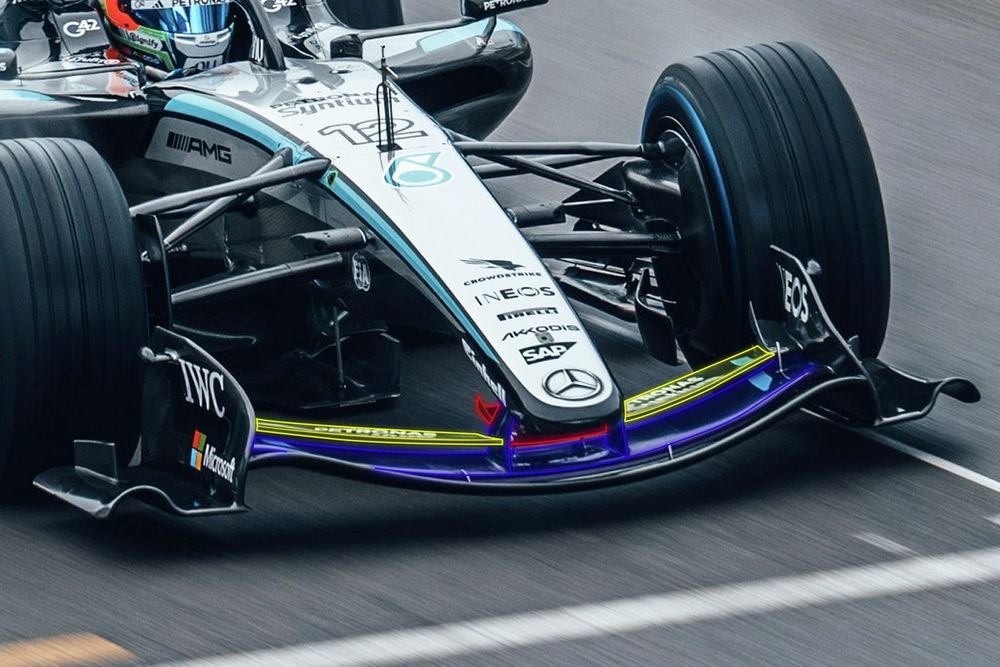
Mercedes W17 front wing detail with fixed secondary plane highlighted in blue, moveable tertiary flaps highlighted in yellow, and flow conditioners highlighted in red
Photo by: Mercedes AMG
There is another interesting element worth highlighting on the W17’s front wing. Through the choice of where certain components are positioned, Mercedes has created a channel in the lower part of the nose that directs airflow toward the underfloor, all the way to the T-tray area.
Unsurprisingly, this area features appendages (highlighted in red in our images) dedicated to managing and optimising the direction and quality of the airflow downstream.
In the images released during the Silverstone filming day, it appears that a portion of the final flap is actually fixed, while the metallic inserts positioned right at the end of that section are tasked with guiding the airflow and generating small vortices that are useful for flow management in that area.
We want to hear from you!
Let us know what you would like to see from us in the future.
– The Autosport.com Team
