
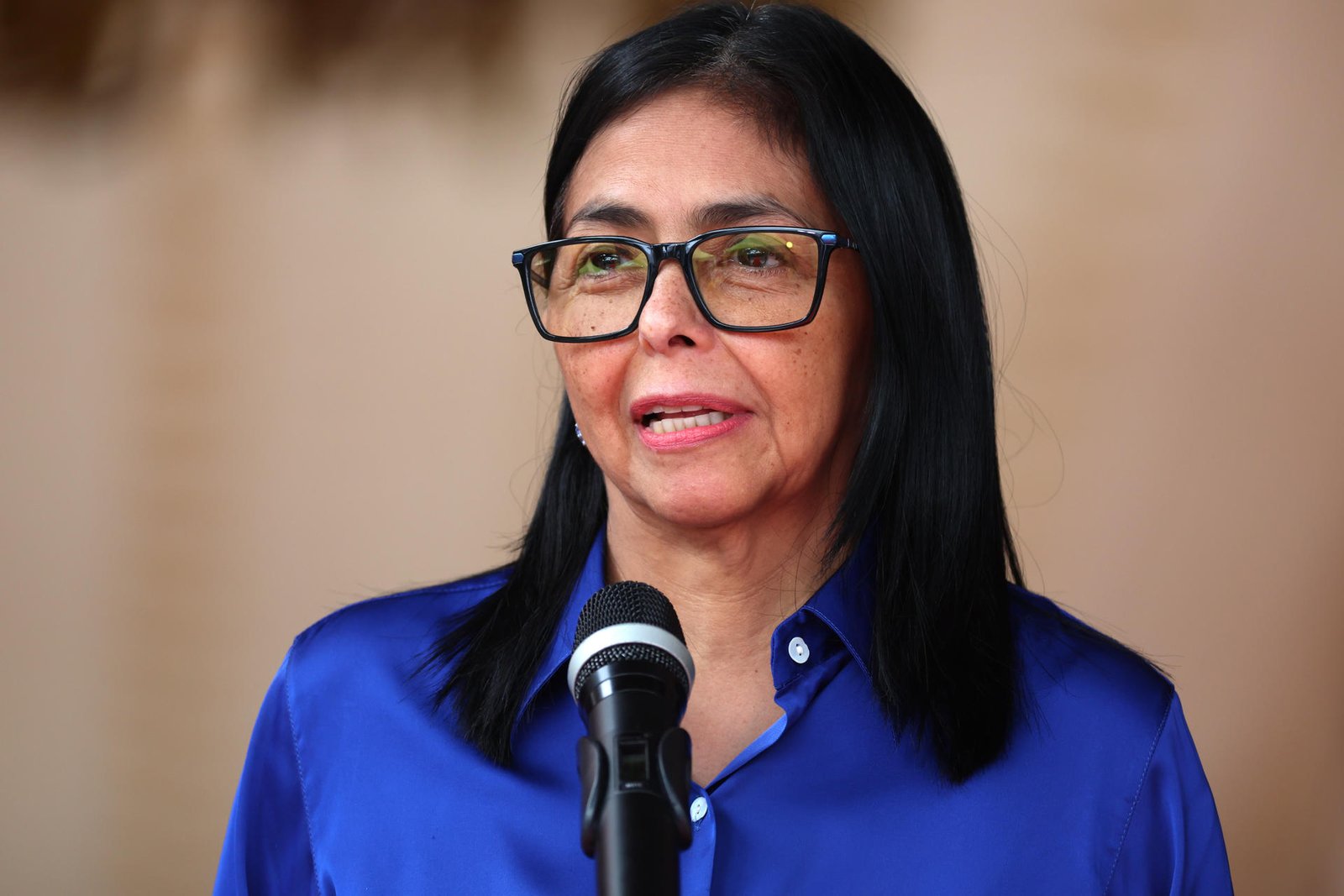
Venezuela’s interim dictator, Delcy Rodríguez, proposed an amnesty law that could result in the release of hundreds of political prisoners who have been detained from 1999 to the present, a period that covers the regimes of Hugo Chávez and Nicolás Maduro. Furthermore, she suggested the closure of the well-known Chavista torture center, El Helicoide.
In the announcement, made at the opening of the judicial year at the Supreme Court of Justice (TSJ), the successor to dictator Nicolás Maduro, captured by the US at the beginning of the month, excluded prisoners prosecuted for homicide, drug trafficking, corruption and human rights violations.
The Chavista leader instructed the Judicial Revolution Commission and the Program for Coexistence and Peace to present the bill to Parliament in the “next few hours” and asked for the “maximum collaboration” of parliamentarians for approval.
“Let it be a law that serves to repair the wounds that the political confrontation left, resulting from violence, extremism, that serves to redirect justice in our country and that serves to redirect coexistence among Venezuelans”, he defended in his speech.
In the same statement, Rodríguez announced that the regime has decided to close El Helicoide, the most feared prison in Venezuela, and transform it into a center of social and sports services for the community.
Announcement generates reaction from the opposition and family members of political prisoners
Venezuela’s largest opposition coalition, the Democratic Unitary Platform (PUD), reacted to Rodríguez’s announcement, arguing that the amnesty law proposed on Friday should include the full and unconditional freedom of all political prisoners, allow the return of leaders who are in exile and the annulment of their political disqualifications.
Furthermore, the opposition alliance called for the “full exercise of freedom of expression and information” and the “dismantling of irregular armed groups”.
The PUD reported that more than 800 civilians and military personnel remain behind bars, while the more than 300 released amid the release process announced on January 8th by the President of Parliament, Jorge Rodríguez, have, for the most part, “open legal proceedings with precautionary measures”.
The coalition also highlighted that progress must be made “in building a path for the restoration of human, civil, social and political rights, which aims to refound institutions and respect popular sovereignty.”
Family members of political prisoners in Venezuela told the EFE Agency who feel “hopeful” after the proposed amnesty law presented by the interim dictator, which should be sent in the “next few hours” to the National Assembly.
“First God, first God, and I know that many people, both in the National Assembly and outside it, want a change, a radical change both for society and for the political structure,” said Sandra Rosales, whose husband, Dionis Quintero, is detained in a cell in Zone 7 of the Bolivarian National Police (PNB) in eastern Caracas.
Rosales said that her husband is a police officer and has been detained for two months, but she celebrated Delcy Rodríguez’s decision on this law, as she considers that there are many prisoners detained unjustly.
Another relative of a detainee, Mariglys Guzmán, told EFE: “We will continue the fight until we can embrace our own, who were also victims of this terror.” She follows the situation of her brother Luis Daniel, detained since March 29, 2023, accused of participating in a corruption scheme related to the state oil company PDVSA.
US announces that all American citizens imprisoned in Venezuela have been released
The US Embassy for Venezuela confirmed on Friday that all American citizens who were imprisoned in the South American country were released in the midst of the release process in Caracas and approaches between the White House and the Miraflores Palace.
“We are pleased to confirm the release by interim authorities of all U.S. citizens known to be detained in Venezuela,” said the U.S. Foreign Office for Venezuela, which operates in Bogotá, Colombia, since the U.S. and Venezuelan governments closed their embassies in Washington and Caracas in 2019 as they severed diplomatic relations.
