
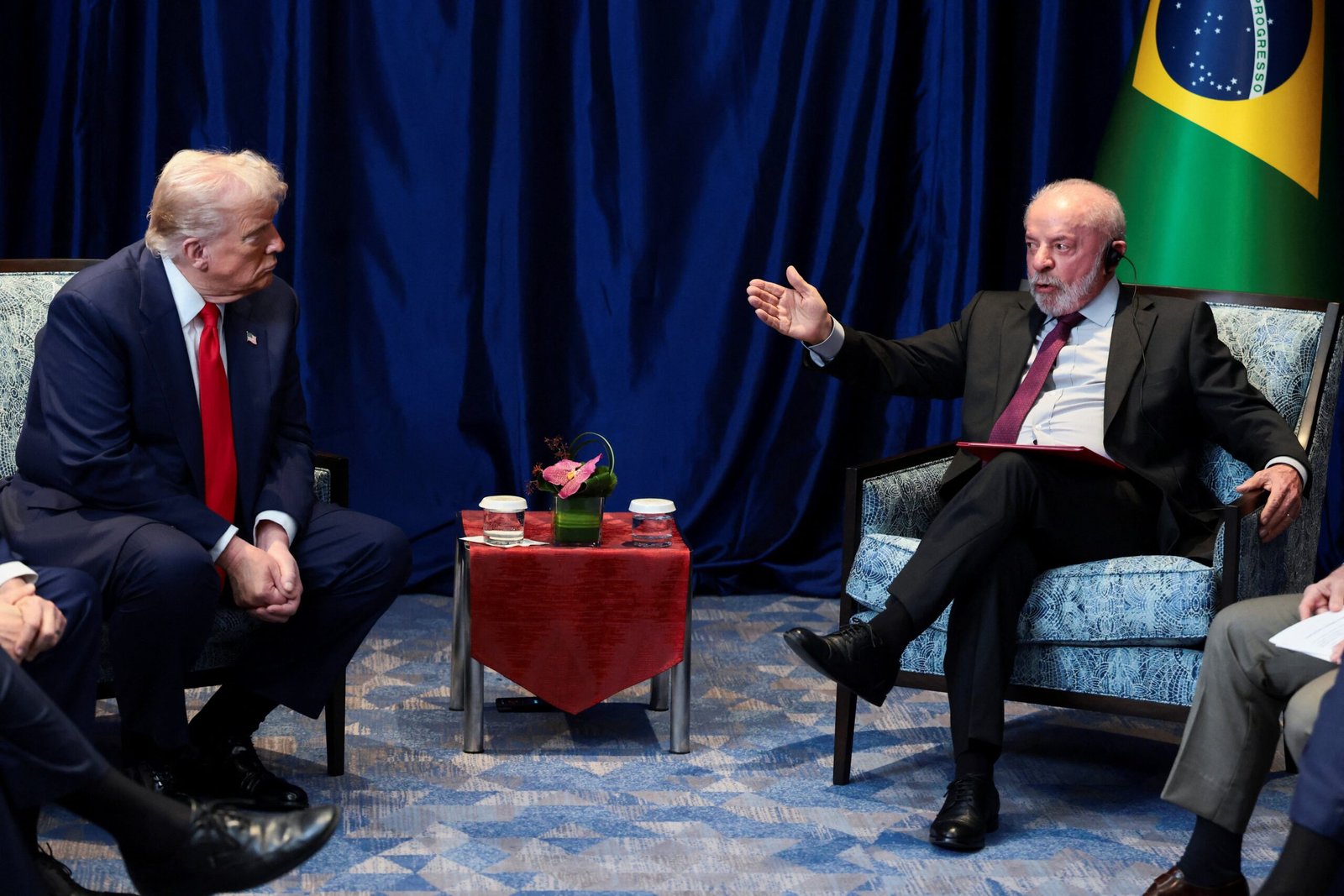
In conversation with Trump, Lula proposes that the ‘Peace Council’ be limited to the Gaza Strip President Luiz Inácio Lula da Silva (PT) began the year 2026 in dialogue with different heads of state about international politics, unstable amid tensions in Venezuela, the Gaza Strip, Greenland, as well as tariff threats. Lula spoke to 14 leaders. The conversations take place at a time of instability in the geopolitical scenario, marked by regional conflicts, trade disputes and uncertainty about the direction of the organization of countries. See which leaders Lula spoke with: 08/01 – Gustavo Petro (Colombia) 08/01 – Mark Carney (Canada) 08/01 – Claudia Sheinbaum (Mexico) 09/01 – Pedro Sanchez (Spain) 13/01 – Luís Montenegro (Portugal) 14/01 – Vladimir Putin (Russia) 15/01 – José Raul Mulino (Panama) 01/21 – Recep Tayyip Erdoğan (Turkey) 01/22 – Narendra Modi (India) 01/22 – Mahmoud Abbas (Palestinian National Authority) 01/22 – Xi Jinping (China) 01/26 – Donald Trump (USA) 01/27 – Emmanuel Macron (France) 01/27 – Gabriel Boric (Chile) Among the main Topics discussed in the conversations were: the agreement between Mercosur and the European Union; the proposal to create a Peace Council presented by the President of the United States, Donald Trump; and the situation of political tension in Venezuela. In addition, Lula also met with José Kast, president-elect of Chile, while participating in an economic event in Panama. The presidents of the United States, Donald Trump, and Brazil, Luiz Inácio Lula da Silva (PT) Evelyn Hockstein/Reuters The Brazilian government has sought to defend multilateralism and expand the country’s role in debates on peace, security and international trade. Brazil has already been highlighted by European leaders as a country capable of maintaining stability in Latin America. Lula has sought to defend the maintenance of countries’ sovereignty and respect for international law amid Trump’s territorial and tariff threats to Europe and the world, without, however, adopting a tone of direct confrontation with the North American government. Since the announcement of the “tariff”, the two presidents have maintained dialogue, despite differences in position. In this context, during a telephone conversation held this week, a meeting was agreed between Lula and Trump in Washington, scheduled for March. At this meeting, the Brazilian president must reinforce the bilateral relationship and trade between the two countries, and the expectation is also for an appeal for the prevalence of international law in relations between States. Capture of Maduro and situation in Venezuela The capture of Nicolás Maduro was carried out on January 3rd. The operation involved elite troops and direct confrontation with Venezuelan forces, but was completed without American casualties. Maduro and his wife were taken to a military ship and later to the US, where they face charges. Once in the country, they went through a hearing and declared themselves innocent. With the president’s dismissal, Delcy Rodríguez took over as leader of the country. The crisis generated strong international repercussions. Lula condemned US military action in Venezuela and stated that military action goes beyond the line of what is acceptable in relations between countries. Trump’s Peace Council Trump launched the so-called Peace Council during the World Economic Forum in Davos. The initiative was presented as an international body dedicated to resolving conflicts and rebuilding regions affected by wars, starting with the Gaza Strip. However, the proposal quickly generated strong international concern due to its similarity to a “parallel UN” and the concentration of powers in the hands of Trump himself. The structure of the new council provides for a lifetime mandate for Trump, who will hold the position of president of the organization and will have the authority to invite or remove countries, except in the case of a veto by two-thirds of the member states. 💰 The charter also determines that nations interested in permanent seats must pay US$1 billion, an amount administered by the White House — something that critics classify as a form of “commodified peace” and highly dependent on the interests of the North American government. Around 60 leaders were invited to join the council, although several European countries rejected participation, citing a lack of clarity and the risk of weakening the multilateral system. 🌍 The statute also gives the Peace Council a global reach, allowing intervention in any conflict that the US deems relevant, not just in Gaza. Lula discussed the invitation he received to participate in the body with Trump in a recent call, proposing that the council be limited to humanitarian issues in the Gaza Strip and include a seat for Palestine. Annexation of Greenland The dispute over Greenland took on the shape of an international crisis after the President of the United States, Donald Trump, publicly intensified his intention to annex the autonomous territory of Denmark. Trump stated that the island is indispensable to American national security, going so far as to threaten tariffs against countries that oppose his plans. “We need Greenland for national security,” declared the president, linking geopolitical interest to the development of the Golden Dome, an anti-missile system planned by the US. The escalation of tensions intensified when Trump accused Denmark of failing to protect the island against alleged Russian influence, arguing that only the US could ensure stability in the region. The president also stated that European countries that resist annexation could be targets of trade retaliation, which provoked a strong reaction from the European Union. In response to Trump’s speeches, several nations in the bloc — Germany, France, Sweden, Norway, Finland and the Netherlands — sent symbolic troops to Greenland, in an international demonstration of opposition to American intentions. 🔎 American interest in Greenland is linked to strategic factors: the island has large reserves of rare earths, essential for the technological industry, in addition to its crucial location in the Arctic — a region increasingly accessible due to the melting of the polar ice caps. 🔎 Control of the territory would allow the US to expand its military and economic influence in the north of the globe, especially in a scenario of direct competition with China and Russia. At the same time, the Trump administration stated that it was negotiating with Denmark and NATO on ways to expand the American military presence on the island, but denied that the annexation would be carried out exclusively by force. According to Trump, the US is discussing “full access” to the territory and possible transfer of strategic portions of the island for military bases. As the crisis evolves, analysts see the move as part of a broader pattern of Trump’s foreign policy: using economic pressure, aggressive rhetoric and exploiting internal divisions in Europe to impose American strategic objectives.
Source link
Lula speaks to 14 heads of state amid international uncertainty with Venezuela, Gaza and Greenland
40
