
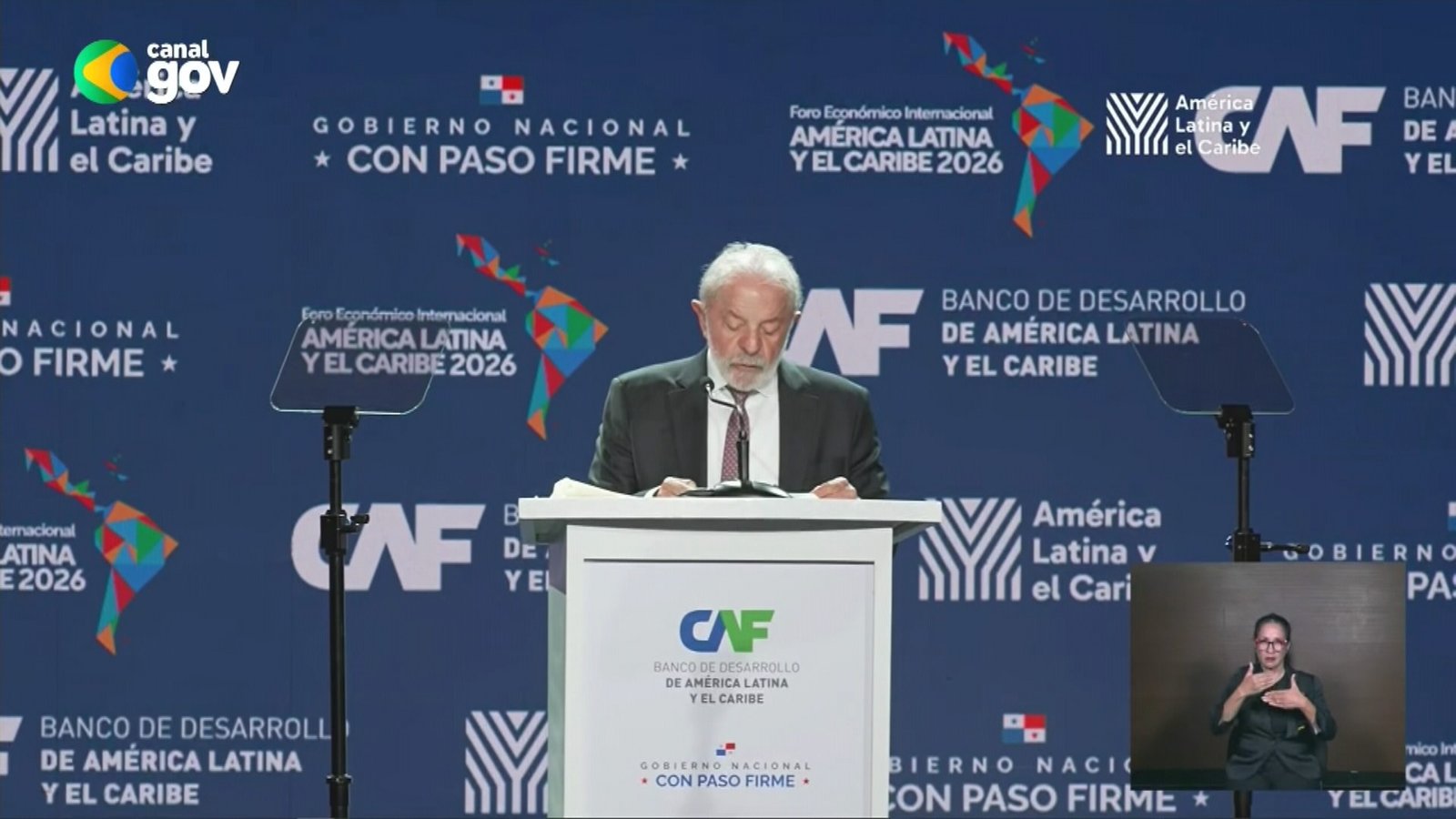
During the opening of the International Economic Forum – Latin America and the Caribbean 2026, held in Panama City, President Lula defended regional integration based on pragmatism, political plurality and economic cooperation, amid a global scenario marked by geopolitical instability, advances in protectionism and technological challenges.
When thanking the invitation of the executive president of the CAF, Sergio Díaz-Granados, and the hospitality of the Panamanian president José Raúl Mulino, the head of state highlighted the historical symbolism of Panama as a link between the Atlantic and the Pacific and recalled the Amphictyonic Congress of 1826, which laid the foundations for principles now enshrined in international law, such as the peaceful resolution of disputes and equality between States.
Despite the historical legacy, the president assessed that Latin America and the Caribbean are experiencing one of the greatest setbacks in terms of regional integration. According to him, recent initiatives have failed due to political intolerance, while the region remains divided, vulnerable to external ideological disputes and unable to respond in a coordinated way to challenges such as the Covid-19 pandemic, transnational organized crime and global warming.
The speech also criticized the paralysis of the Community of Latin American and Caribbean States (CELAC), which, according to the president, has not even managed to produce minimal consensus in the face of illegal military interventions in the region.
Faced with this scenario, Brazil defended a new model of possible regionalism, far from rigid ideological paradigms and adapted to local realities. The president highlighted that Latin America and the Caribbean have relevant strategic assets, such as vast energy potential, agricultural capacity, large reserves of fresh water, biodiversity, critical minerals, a consumer market of 660 million people and the predominance of democratic regimes.
When addressing Brazilian foreign policy, the president stated that the country has invested in democracy, multilateralism and regional integration as pillars of its international insertion. He highlighted economic growth above the global average since 2023, the reduction in unemployment, the control of inflation, the appreciation of the minimum wage and Brazil’s exit from the FAO Hunger Map.
In the commercial area, he highlighted that the country achieved, in 2025, a trade flow of 629 billion dollars, driven by the diversification of partners. Among the advances mentioned are the conclusion of Mercosur agreements with Singapore and EFTA, in addition to the signing of the Mercosur–European Union agreement, after 26 years of negotiations.
The president also highlighted investments in regional infrastructure through the South American Integration Routes program, with logistical and energy works that could double intra-regional trade in the coming years. He also defended the neutrality of the Panama Canal and greater mobilization of multilateral banks, such as CAF, the IDB and the New BRICS Development Bank.
In the social field, he drew attention to inequality and violence in the region, especially the high number of feminicides, defending public policies of inclusion, combating misinformation and strengthening security as bases for democratic stability and economic growth.
In closing, the president stated that the use of force and neocolonial disputes represent historical setbacks and argued that the only war to be fought in the region is against hunger and inequality, through investments, technology transfer and fair trade.
According to him, regional integration will only be viable if it respects political diversity and is guided by democratic coexistence, ensuring that Latin America and the Caribbean remain a zone of peace, cooperation and sovereignty on the international stage.
