
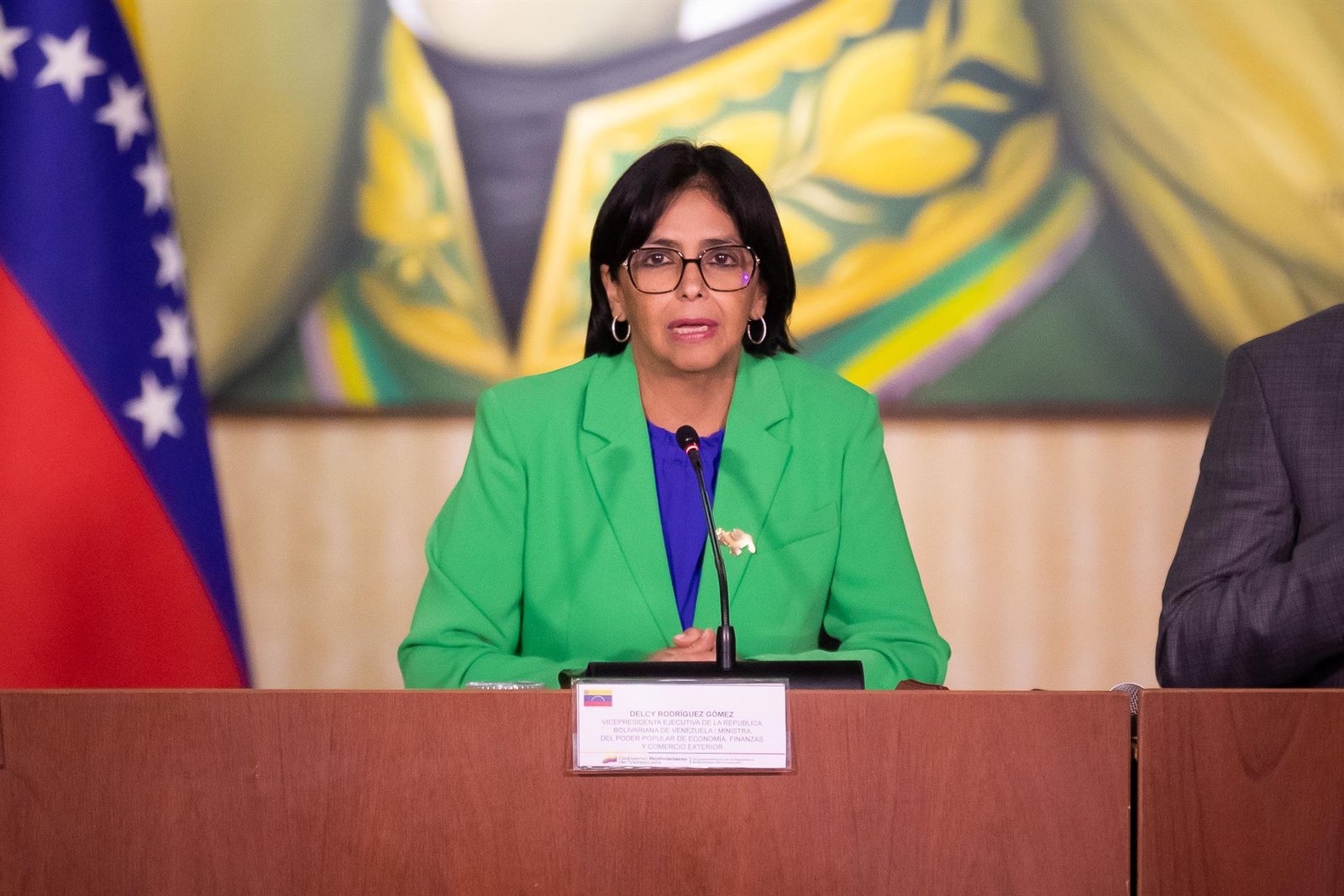
The interim dictator of Venezuela, Delcy Rodríguez, signaled this Thursday (15) a diplomatic opening to the USA, defending cooperation with several countries. She even indicated that she is willing to travel to Washington if necessary.
The Chavista leadership alternated the tone in several passages of the speech, sometimes adopting a more provocative speech. When presenting the accounts for the first year of the questioned third term of dictator Nicolás Maduro – detained in the USA -, Rodríguez reiterated that she is willing to “confront” Washington diplomatically.
“It’s not that the interim president is afraid because she is being threatened. No. All of Venezuela is under threat (…). If one day I, as interim president, have to go to Washington, I will go standing, walking, not crawling. I will go with the tricolor flag”, declared the Chavista, whose interim regime has already announced that it is exploring ways to reopen embassies with the US after the 2019 diplomatic rupture.
And while she accused the U.S. of limiting the South American country’s ability to sell its petroleum products abroad following the naval blockade that she said occurred before Maduro’s Jan. 3 arrest, Rodríguez emphasized that amid “aggression” and “ferocious threat,” the country is “building what should be an energy cooperation based on decency, dignity and independence.”
Hydrocarbons and Funds Law
He also presented a proposal to reform the hydrocarbons law to seek investments in oil infrastructure, at a time when crude oil is at the center of the debate between the US and Venezuela.
The dictator presented the proposal to Parliament, but did not give details.
“We present the bill for the partial reform of the organic hydrocarbons law, in order to incorporate production models” that allow “investment flows to be incorporated in new fields, in fields where there has never been investment and in fields where there is no infrastructure”, he stated.
She also announced the creation of two funds that, according to the regime, will be administered with “any” currency that enters the South American country, to “improve” workers’ income, and another destined for the development of hospitals, schools, housing, as well as public services such as water, electricity and roads.
“There are two sovereign wealth funds, and I also requested the creation of a technological platform that makes the use of these resources transparent and free from bureaucracy, corruption and indolence,” he added.
Rodríguez also highlighted a bill to “streamline procedures” and thus “revoke any rule” that is “preventing the arrival of investments.”
US Surveillance
Following the capture of Maduro on January 3, along with his wife Cilia Flores, by US troops in an attack on Venezuelan soil, US President Donald Trump said he would govern Venezuela until there was a transition and warned Rodríguez that if she did not do the right thing, she could end up worse off than the Venezuelan dictator.
A day later, US Secretary of State Marco Rubio indicated in an interview with ABC News that they were “managing” the “direction that Venezuela will take in the future.”
On January 7, US Energy Secretary Chris Wright stated that his country would indefinitely control Venezuela’s oil sales and deposit the proceeds from these transactions in accounts managed by Washington.
At a conference in Miami, the secretary said he was “working in direct cooperation with the Venezuelans”, following Trump’s previous announcement that Venezuela would deliver between 30 and 50 million barrels of oil to the US for sale.
Trump said this week that he spoke with Rodriguez by phone and described her as a “fantastic” person.
