
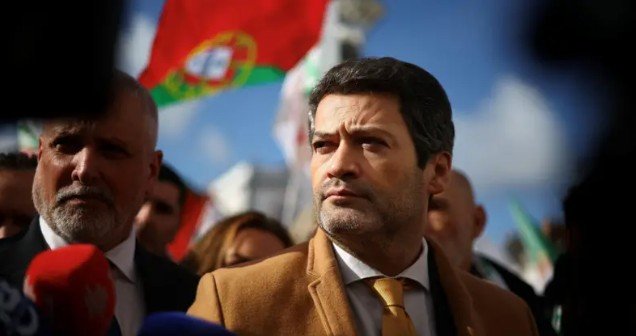
André Ventura, candidate of the radical right and with an anti-immigration speech, appears at the front of the polls Reuters The Brazilian community in Portugal follows with apprehension the final stretch of the country’s presidential election, scheduled for this Sunday (18). With a record 11 candidates, this is the most fragmented dispute since the redemocratization of Portugal in 1974. At one point in the campaign, there was a technical tie between five candidates for president and, even in the final stretch, half of the voters admit that they can change their vote. For sociologist Ana Paula Costa, president of Casa do Brasil in Lisbon — the oldest association of Brazilian immigrants in the country — the main concern is the risk of the results of the polls giving even more strength to the anti-immigration discourse of the radical right, led by candidate André Ventura, from the Chega party. “A large part of the Brazilian community is apprehensive — even afraid — of what might come out of this election,” says Costa. “We are living in a time of changes in immigration policy and the risk is an even greater tightening. Furthermore, there is fear of an increase in discrimination and xenophobia with the normalization of speech against foreigners in the public sphere.” Ventura took the lead in the electoral dispute in the last days of the campaign, promising to put “the Portuguese first” on the country’s political agenda. According to the electoral poll aggregator of the digital newspaper Observador, 22.5% of voters intend to vote for him. In second place, with 20.9% of the votes, comes António José Seguro, former general secretary of the Socialist Party (PS), who presents himself as a moderate and calls for a “useful vote” from the left. João Cotrim de Figueiredo, MEP from the Liberal Initiative, has 18.4% of voting intentions defending a leaner State and fewer taxes. The trio is followed by Admiral Henrique Gouveia e Melo, an independent who gained notoriety for coordinating the national vaccination campaign against Covid-19 (15.1%), and by Luís Marques Mendes, supported by the ruling center-right Social Democratic Party (PSD) (14.9%). Political analysts interviewed by BBC News Brasil consider it very likely that Ventura will contest the second round, which takes place on February 8, but assess his chances of victory as remote, given his rejection rate, which exceeds 60%. “Still, reaching 30% or 35% of the votes in the second round would be a great political victory for Ventura and would help legitimize the party’s agenda and the idea that it is on the rise”, says political scientist António Costa Pinto, from Universidade Lusófona de Lisboa. Founded in 2019, Chega has increased its vote from 1.3% to more than 20% in recent years, with a speech denouncing the corruption of political “elites” and in favor of tightening security policies and controlling what it considers “uncontrolled” immigration. In the 2025 legislative elections, it won 60 seats in Parliament, becoming the second largest political force in the country, behind the center-right coalition Democratic Alliance (AD), led by the PSD. “Ventura never showed great interest in being president. His strategic objective is the position of prime minister”, says Riccardo Marchi, researcher at the Lisbon University Institute. “But he couldn’t stay out of the presidential debate — and now he can emerge stronger.” The former general secretary of the Socialist Party (PS), António José Seguro, appears in second place EPA Portugal has a semi-presidential regime with a parliamentary matrix. Although the president is elected by direct vote, executive power is exercised by the prime minister, appointed after legislative elections and who depends on minimum support in Parliament. The role of the president, however, is far from protocol. “It exercises a kind of moderating power and is crucial for institutional balance”, explains professor Joana Ricarte, from the University of Coimbra. The president can veto laws, returning them to Parliament, and has the prerogative to swear in the prime minister. In extreme cases, it can also dissolve Parliament and call early elections — a measure known as the “atomic bomb.” “All these actions obviously need to be based on the Constitution, although the way each president interprets and applies constitutional provisions varies”, comments Ricarte. For this reason, presidential campaigns tend to emphasize the personal characteristics of candidates, who run as individuals, not party representatives. The 2026 presidential elections are still taking place amidst a scenario of rising costs of living in Portugal, with inflation rising to 2.3% in 2025, with food putting pressure on prices. In this context, three points help explain what is at stake in this election — and how its developments could affect the Brazilian community. Check out what they are. Political instability To begin with, the election takes place amidst great instability in the Portuguese government. Since 2022, Portugal has had three legislative elections, two of them early. And each new election seems to confirm the trend of political fragmentation and a crisis of confidence in traditional parties. The current government, led by the PSD, does not have a parliamentary majority and, to approve its projects, depends on the support, or at least the abstention, of other parties — sometimes radical right, sometimes center-left. In November, for example, its budget passed with the abstention of the PS, which avoids direct opposition at critical moments to avoid causing the government to fall. In this scenario, Sunday’s presidential election is crucial for two reasons. First, as political scientist Marco Lisi, from Universidade Nova de Lisboa, explains, “in a context of fragile government, without a majority and with uncertain alliances, the president can play a decisive role in political stability, influencing the duration of the government itself.” Furthermore, if Chega feels strengthened by the electoral result, it can intensify pressure to end the government — for example, by presenting motions of censure for voting in Parliament. Rules on immigration and nationality As noted by Costa, from Casa do Brasil in Lisbon, Portugal is in the midst of a process of tightening its migration policy. Last year, the government coalition, the Liberal Initiative and Chega came together to approve changes to the Foreigners Law. Among other measures, the new law restricted work visas to qualified professionals, eliminated the possibility for immigrants to apply for residency after entering the country as tourists and tightened the rules on family reunification (which establish when relatives of regularized foreigners can live in Portugal). Demonstration of immigrants in Portugal after the approval of a new immigration law in 2025 Getty Images Parliament also approved a new Nationality Law that increased the minimum period of residence required of Brazilians to apply for nationality from five to seven years. The law, however, ended up being vetoed by the current president, former PSD leader Marcelo Rebelo de Sousa (prevented from running in the current election due to having already served two terms). The veto occurred after the Constitutional Court identified signs of unconstitutionality in some of the provisions of the new law, which returned to Parliament and must now be reformulated. “Clearly, immigration and nationality rules will continue to be on Parliament’s agenda this year, and a strengthened Chega would try to push for further tightening,” says Lisi. It will be up to the new president to veto laws if he understands that they violate fundamental principles of the Portuguese Constitution. “But it is worth highlighting that the political veto is usually used with great caution, especially in the first presidential terms. The president tends to be more active in this area in the second term, when he no longer needs to worry about re-election,” explains Luis Aguiar-Conraria, professor at the University of Minho. Xenophobia and discrimination Demonstration by Brazilian students against xenophobia in Portugal Getty Images Another question is whether a possible strengthening of Chega in the elections could lead to an increase in xenophobic attacks against Brazilians. As some analysts point out, Ventura has not directly attacked the Brazilian community which, with more than 500 thousand people, is the largest among immigrants in Portugal. He says that Brazilians who “contribute” to Portuguese society are welcome, and that the big problem is immigration from South Asia, especially from Muslim countries, with cultures that would be very different from the Portuguese. There are even Brazilians among Chega’s supporters and members: Ventura is especially popular among supporters of former president Jair Bolsonaro, who identify with the anti-left agenda, conservative in customs and defending “law and order” policies. “But from the moment that the discourse of exclusion and discrimination against certain groups becomes politicized and normalized in public debate, people feel authorized to adopt behaviors that were previously socially unthinkable and xenophobic and racist attacks become more frequent — against everyone”, says Costa. “In recent years we have already registered not only an escalation of attacks against the Brazilian community, but also an increase in the violence of these episodes, such as the case of the Brazilian child who had his fingers cut off at school.” Ventura’s presidential campaign included episodes and strategies that generated public controversy, such as billboards with the phrase “This is not Bangladesh” aimed at Asian immigrants. Pieces with negative comments about the gypsy community were also removed by court decision. “You can’t think that just because there isn’t a billboard saying ‘This is not Brazil’ we are more protected,” says Costa.
Source link
Elections in Portugal: 3 factors at play in the dispute — and why many Brazilians are apprehensive
27
