
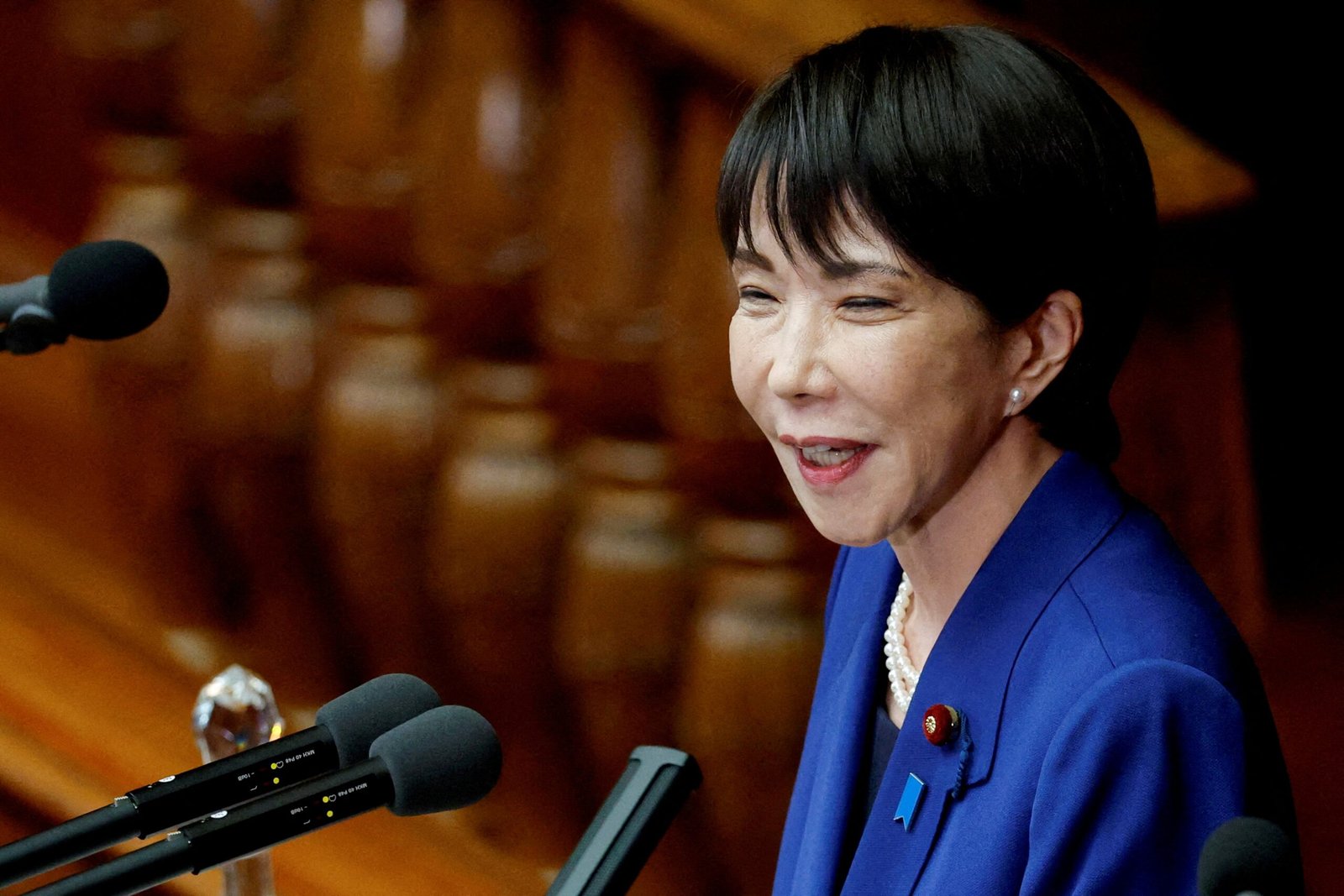
Who is Sanae Takaichi, the first woman to hold the position of prime minister in Japan The Prime Minister of Japan, Sanae Takaichi, has expressed, more than once, her admiration for Margaret Thatcher. The former British prime minister, who held the position for several years, was a staunch conservative with strong views on economic policy, national security, immigration and several other center-right positions that are now shared by Takaichi. Thatcher also built a reputation around her workaholic spirit. The British woman used to say that she only needed four hours of sleep a night. Similarly, Takaichi has expressed the same disdain for rest and has already indicated that he expects the same level of commitment from his ministers and the Japanese population itself. The attitude, however, has raised alarms in some sectors of the country. After being named prime minister in October, Takaichi said she intended to rule out “work-life balance” for herself. “I’m going to work, work, work and work”, declared the Japanese woman at the time. Prime Minister of Japan, Sanae Takaichi. REUTERS/Kim Kyung-Hoon/File Photo Meetings in the early hours of the morning The Japanese prime minister kept her word. At the beginning of this month, the prime minister called a meeting at 3 am in her office, before another meeting, of the Budget committee, which would start at 9 am that day. She admitted that she sleeps “about two hours a night now, four hours tops.” “It’s probably bad for my skin,” he joked. Takaichi also asked the Minister of Labor to analyze the possibility of easing restrictions on overtime – set at a maximum of 720 hours per year – in order to encourage economic growth. Tomoko Yoshino, the first woman to head Rengo, Japan’s largest union, highlighted that the number is already close to the limit that increases the risk of karoshi, a Japanese term that means death from overwork. Japan recorded a record 1,304 cases of deaths and health problems related to overwork in 2024 Yoshikazu Tsuno/AFP Excessive working hours “We cannot allow the maximum limit to be relaxed,” Yoshino told reporters in Tokyo. “We are still only halfway to reducing karoshi to zero and promoting reforms in the style of work,” said the union leader. A group of lawyers representing the families of people who died from karoshi expressed a position along the same lines. The group issued a statement saying the prime minister’s comments were “unhelpful” in a country that has long been notorious for its culture of excessive working hours. The statement from the National Council for the Defense of Karoshi Victims called on Takaichi to halt efforts to reverse recent progress in creating a healthier work-life balance and to stop his more “exalted” comments. According to Japanese government statistics, a record 1,304 cases of deaths and health problems related to overwork were recorded in fiscal year 2024 in Japan – an increase of 196 cases from the previous year. Of the total, 1,057 were work-related mental health disorders, including “abuse of power by superiors or other people” and “harassment by customers”. Toxic work culture The concern was even shared by some members of Takaichi’s government. Health Minister Takamaro Fukuoka stated that the ministry “believes that losing one’s life or health due to overwork should not happen.” The problem is also a human rights issue, highlighted Teppei Kasai, representative of Human Rights Watch in Tokyo. “I don’t believe this is a particularly Japanese phenomenon. There are workplaces with toxic cultures and rules in many other countries,” he said. “That said, Japanese corporate culture tends to overemphasize attendance over productivity, which can lead workers to feel obligated to show up to work even if they are sick or know they won’t be productive for some other reason,” Kasai told DW. While there has been some progress in Japan’s work culture since the Covid-19 pandemic in 2020, there are concerns that pressures on workers could increase once again, leading to a further rise in cases of karoshi, depression or suicides related to excessive workload. International rules According to Kasai, Japan should follow the 2016 UN guidelines on working conditions. These rules define that States must “establish minimum standards that must be respected and cannot be denied or reduced based on economic or productivity arguments.” “It is important to keep in mind that everyone has the right to rest every week as part of fair and favorable working conditions, which means that no worker should be able to ‘choose’ to work 90 hours a week,” Kasai highlighted. “It is also essential to understand that flexible working hours can increase the risk of labor exploitation for people in certain sectors.” Prime Minister Takaichi once again highlighted long working hours in Japan, but the debate became even more urgent after several professionals shared 18-hour workdays on social media. Hiro is the author of the Japanese channel “Typical Salaryman” on YouTube and Instagram. He publishes publications such as “No Money Before Payday”, “A Week of Corporate Despair” and “65-Hour Weeks in Japan”. In a video published on YouTube titled “Every Day is Hell”, Hiro describes how lonely and exhausted he feels from working in the Japanese city of Osaka and how he finds solace in food. Comments from profiles around the world on the video are revealing. “I hope one day you get a better job and stay healthy for a long time,” says one. Another viewer says: “You’re an amazing guy. I’ve been watching your videos since yesterday. I wish you all the best. Keep producing your content and leave this life.” Excessive hours Issei, 27, hoped to find a stable job right after graduating. Instead, he worked at a series of companies that required a lot of overtime and where the culture was “challenging” for anyone expecting a reasonable work-life balance. “They’re called ‘Black kigyō’ and it was very difficult,” says Issei, who worked in the sales sector and asked not to reveal his last name, as he is currently unemployed and applying for new positions. “I accumulated some debt after college and it was difficult to survive, even working full time,” he explains. “There were days when I was very depressed, but I read about people who died of karoshi from working too much or who committed suicide.” “For me, it’s never been that bad, because I would rather give up, but I can understand how some people don’t feel like they can do it and just keep going until it’s too late.” Others, however, are cautiously in favor of allowing anyone who wants to work overtime to do so without breaking the law, especially in a time of economic challenges. “The issue is complicated,” says Makoto Watanabe, professor of Communication and Media. “Some people want to work long hours because they can earn a good salary and there is legislation to protect those who don’t want to work unlimited overtime. There is a problem with suicides, illnesses and karoshi related to overwork, but I think things have improved in recent years.” “I believe that if the laws are not relaxed to the point where employers can abuse them, people should be able to work as much as they want,” argues Watanabe. What are the updates to NR-1, which presents occupational health guidelines
Source link
Early morning meetings and only 2 hours of sleep: who is the new ‘workaholic’ prime minister that scares Japanese people
21
