
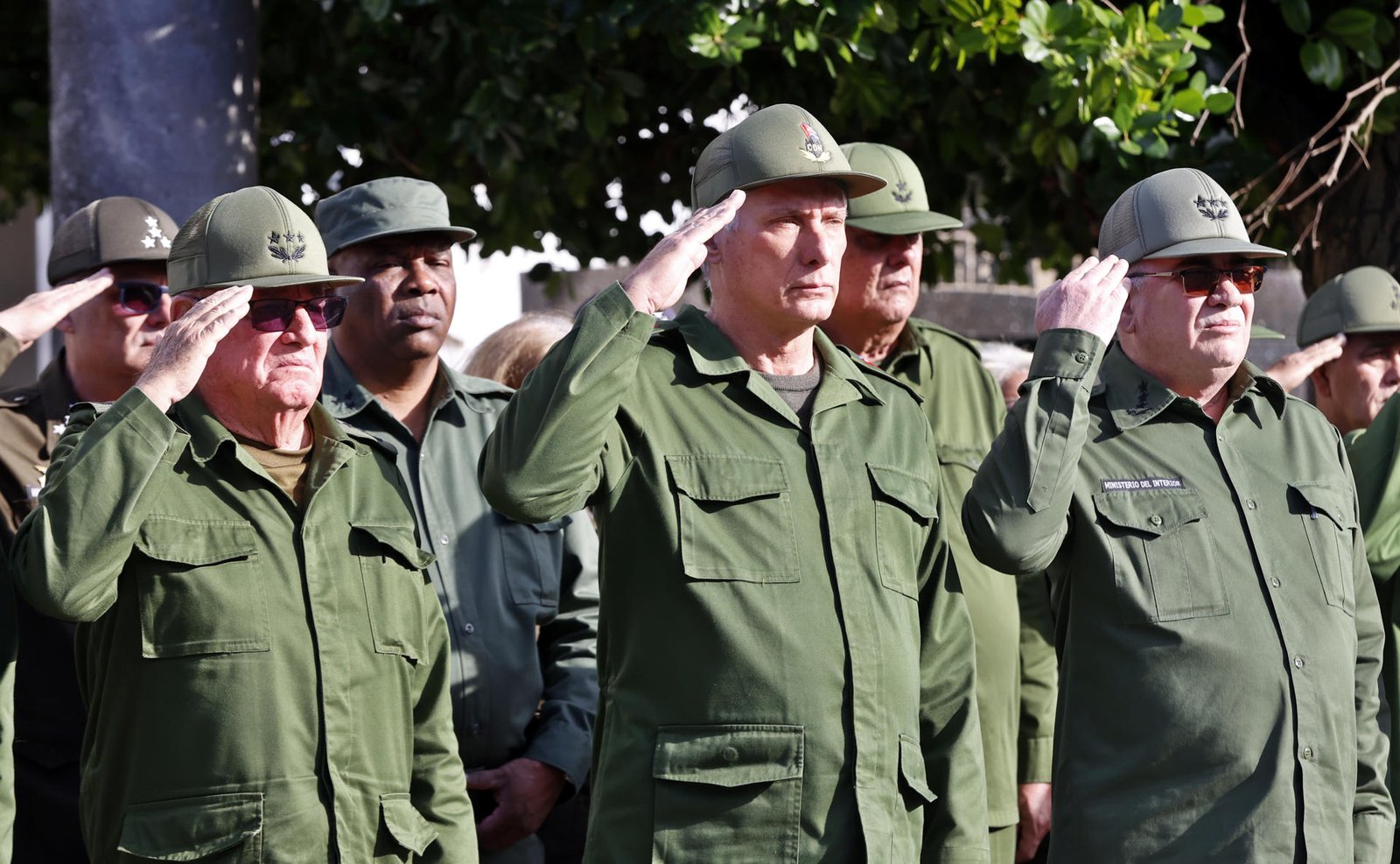
Cuba’s National Defense Council approved over the weekend “plans and measures” to implement a “state of war” amid tensions with the United States.
The official press of the Castro dictatorship published the information on Sunday (18), although the measures were not detailed.
The EFE agency reported that such plans are based on the concept of War of the Whole People, a strategy promoted in the 1980s by then dictator Fidel Castro that envisages the general mobilization of the Cuban population to face possible external aggression.
The Cuban state press reported that the plan was approved on Saturday (17), during a meeting of the National Defense Council – the body responsible for taking command of the country during natural disasters or armed conflicts – “in compliance with the activities planned for Defense Day”, with the aim of “increasing and improving the level of readiness and cohesion of leadership and personnel”.
On Saturday, the Castro regime once again held a day dedicated to defense activities, with exercises that included ambush simulations, training in laying mines and protecting the population and joint classes in areas such as military health, defense against weapons of mass destruction, handling the AKM rifle and camouflage techniques, according to state press reports.
Since the capture of Venezuelan dictator Nicolás Maduro, an ally of the Cuban regime, in a US military operation on January 3, tension between Havana and Washington has increased.
Although President Donald Trump said shortly after the Chavista’s capture that he did not plan an intervention in Cuba, because, according to him, the communist regime allied with Venezuela was “about to fall”, Secretary of State Marco Rubio suggested in an interview with NBC that this hypothesis has not been ruled out.
“I’m not going to talk about what our next steps will be and what our policies will be at this point in this regard,” Rubio said. “But I think it’s no secret that we’re not big fans of the Cuban regime, which, by the way, was the one that supported Maduro.”
Shortly after the press conference in which Trump detailed the operation in which Maduro was captured, the secretary had been more explicit. “If I lived in Havana and were part of the government, I would be at least a little worried,” he threatened.
Days later, The New York Times reported that the United States Armed Forces, after carrying out the operation to capture Maduro, reduced the volume of the fleet that has been positioned in the Caribbean since the end of August and transferred two amphibious transport ships to waters north of Cuba as part of this reorganization.
Trump later said on social media that the island would not receive “any more oil or money” from Venezuela and suggested that the Cuban regime reach “an agreement before it is too late.”
The Cuban dictator, Miguel Díaz-Canel, also responded on social media, saying that “there are no conversations with the United States government”.
“As history demonstrates, for U.S.-Cuban relations to move forward, they must be based on international law rather than hostility, threats and economic coercion,” wrote Díaz-Canel.
The dictator added that the Cuban regime is willing to “maintain a serious and responsible dialogue” with the American government “based on sovereign equality, mutual respect, the principles of international law, reciprocal benefit, without interference in internal affairs and with full respect for our independence.”
