
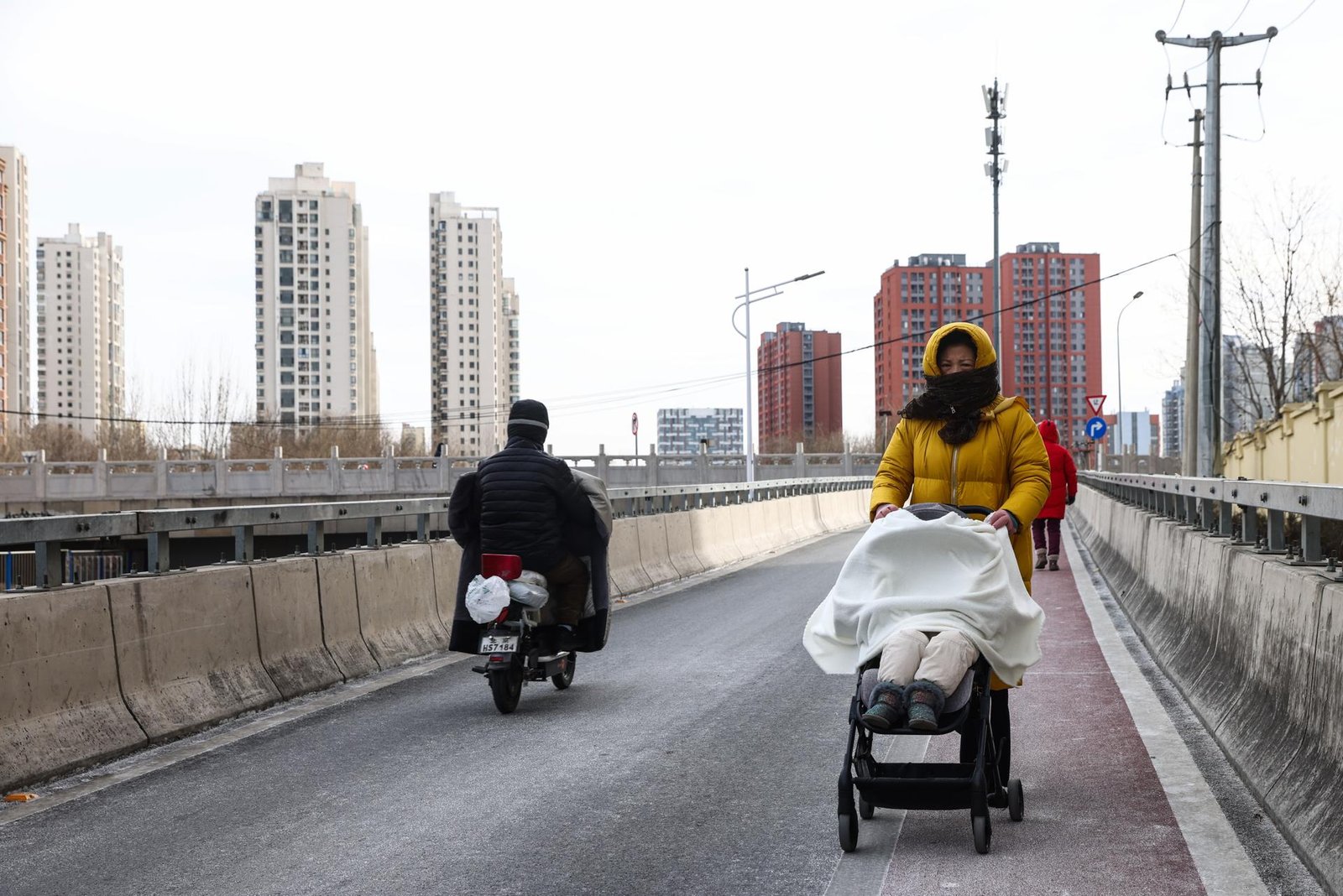
The number of inhabitants in China, the second most populous country in the world, suffered a further decline, falling by around 3.39 million in 2025, following a new negative record in birth rates and population aging, according to official data published this Monday (19) by the National Statistics Office (ONE).
This is the fourth consecutive year of contraction, after the Chinese population lost 850,000 people in 2022 – the first decline since 1961, when the number of inhabitants contracted as a consequence of hunger resulting from the failed industrialization policy of the Great Leap Forward -, 2.08 million in 2023 and 1.39 million in 2024.
The country registered 7.92 million births last year, a considerable reduction compared to the 9.54 million in 2024 and a new negative record since the year the People’s Republic of China was founded, in 1949, even below the 9.02 million in 2023.
Despite numerous policies announced by authorities, both locally and nationally, to try to create a “child-friendly society”, the birth rate has also fallen to historic lows, at 5.63 per 1,000 people.
Since 2021, the Asian giant has allowed its citizens to have a third child, although the decision was not received with great enthusiasm by the population, due both to the economic burden that creation represents and the priority given to a professional career.
During his 20th Congress in 2022, the Communist Party leader emphasized that the country needs a system that “increases birth rates and reduces the costs of pregnancy, childbirth, schooling and upbringing.” Furthermore, Chinese dictator Xi Jinping classified the demographic crisis as a “vital issue”.
In 2025, China recorded around 11.31 million deaths, with a rate of 8.04 per 1,000 inhabitants, higher than the 7.76 in the previous year.
Thus, the Asian giant ended the year with 1.404 billion inhabitants, which contrasts with the 1.408 billion there were in the country at the end of the previous year.
China is currently the second most populous country in the world, behind only India, which surpassed the country in number of inhabitants in 2023 and whose population continues to grow, according to data from the United Nations.
In recent months, Beijing has implemented measures to try to reverse the decline in births, such as direct subsidies of 3,600 yuan per year (about R$2,700) for each child under the age of three and plans for births to be covered by national maternity insurance before 2026.
Likewise, the regime announced at the end of 2025 a complete review of the daycare pricing policy to reduce the costs of pre-school education and reinforce birth support.
Furthermore, other ways of trying to contain negative birth rates were to make childbirth a patriotic act and to tax condoms.
The demographic context also coincides with the increase in the population living alone, which exceeds 92 million people and could reach between 150 million and 200 million in 2030, according to data from the Ministry of Civil Affairs and estimates from the Beike Research Institute.
Another important obstacle is the gender imbalance caused by decades of the “one child policy”, in which the search for sons predominated, which means that, at the moment, there is an approximate ratio of 104.34 men for every 100 women in China.
