
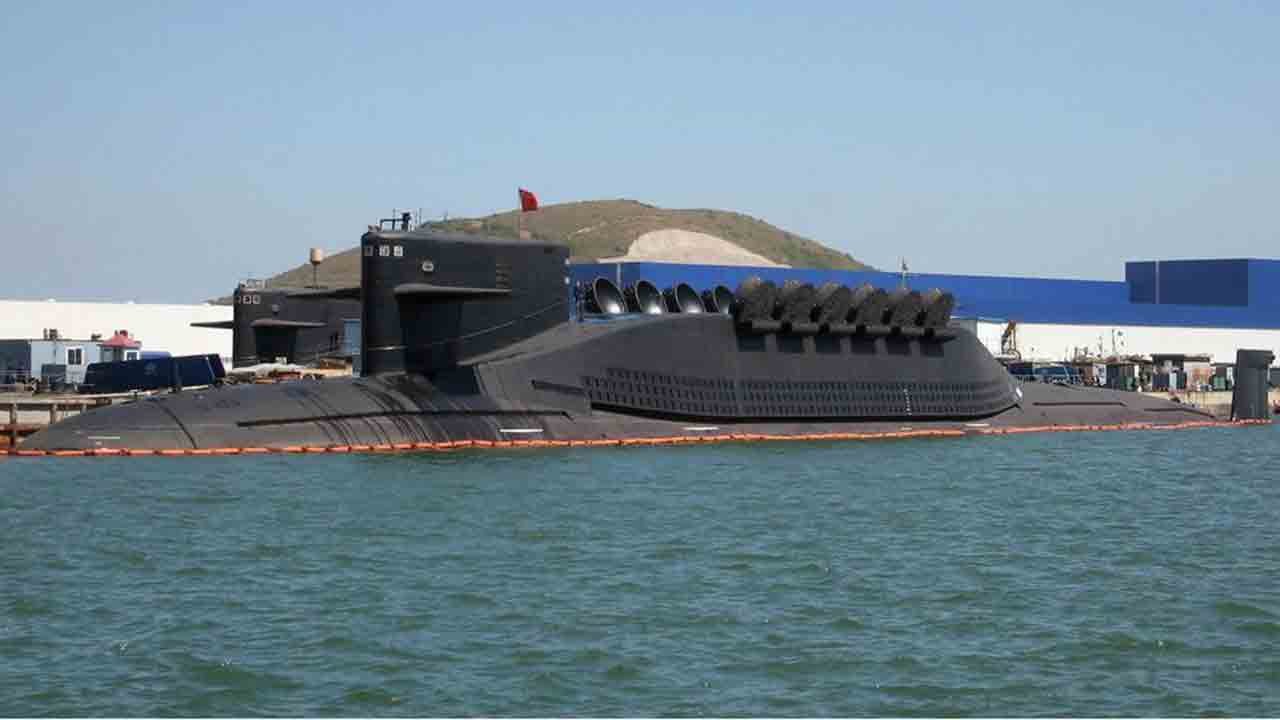
China has surpassed Russia in the number of nuclear-powered submarines and has moved up to second place globally in this strategic segment. Thus, the country is approaching the United States and changing the balance of submarine deterrence in the Indo-Pacific region.
The information was published by the specialized media Defense Security Asia.
According to the survey, the People’s Liberation Army Navy (PLAN) currently has around 32 active nuclear submarines, while the Russian fleet has between 25 and 28 units in service. The United States remains the sovereign leader, with about 71 nuclear submarines in operational service by the end of 2025.
Chinese submarine fleet growing

By the start of 2026, the Chinese Navy is operating multi-role nuclear-powered attack submarines of the classes Type 093 and the Type 093A, developed for anti-submarine and anti-surface missions with torpedoes and missiles. An important further development is the Type 093B project, which includes 24 vertical launch cells for YJ-12 or YJ-18 sea-targeting missiles, in addition to six 533 mm torpedo tubes in the bow.
In the strategic area, the PLAN has at least nine ballistic missile submarines of the Type 094 and Type 094A classes, armed with JL-2 and JL-3 submarine-launched ballistic missiles.
The next generation and the shipbuilding industry
China is also making progress on two next-generation projects. The hull of a Type 095 attack submarine is in the early stages of assembly, while the first strategic submarine in the Type 096 project is already under construction. These programs strengthen China’s maritime industrial capacity and signal continuity in both the qualitative and quantitative expansion of the fleet.
+ Iraq negotiates purchase of 250 K2 tanks in billion-dollar deal with South Korea
Russia falls to third place, but without a capacity collapse

According to the analysis, Russia’s decline to third place is not due to a sudden loss of capacity, but the cumulative effect of industrial stagnation, budget constraints and competing strategic priorities. These factors have limited fleet renewal and operational readiness.
Sources and images: China Military Online | Defense Security Asia | Wikimedia. This content is created with the help of AI and reviewed by the editors.
