
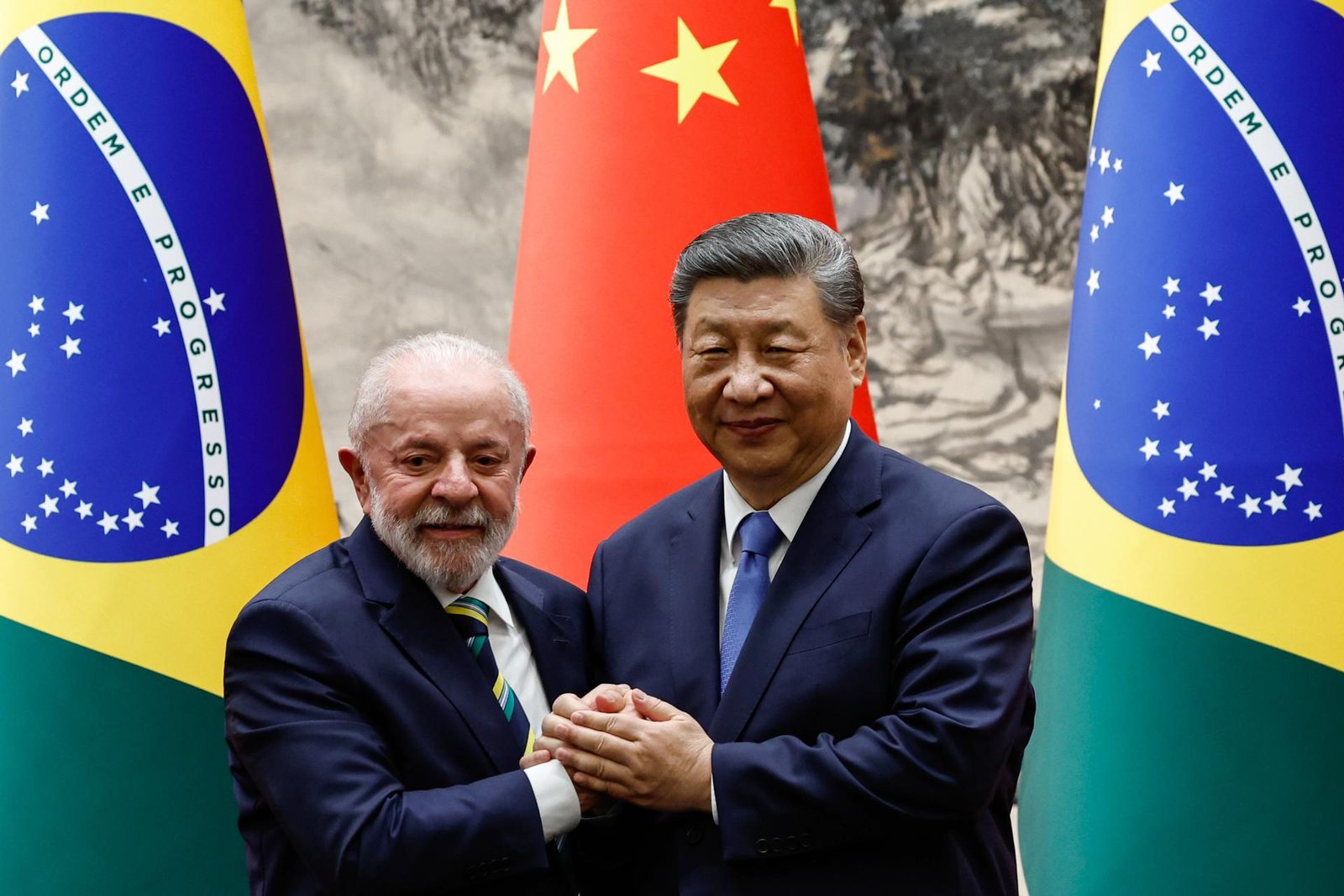
President Luiz Inácio Lula da Silva received a call on Thursday night (22) from China’s dictator, Xi Jinping, who asked him for his countries to remain “on the correct side of history” and denied that Beijing is a “threat”, shortly after US President Donald Trump’s appearance at the Davos World Economic Forum.
As reported this Friday (23) by the Chinese Ministry of Foreign Affairs in a statement, Xi highlighted that, faced with a “turbulent” international context, China and Brazil, as prominent members of the so-called Global South, must act as “constructive” forces to safeguard international peace and stability and contribute to the reform of the global governance system.
Xi also rejected external accusations against Beijing and claimed that the supposed “Chinese threat” is “totally unfounded”.
In this way, he criticized the “baseless accusations” and the practice of “fabricating pretexts” to “seek selfish benefits”, in an indirect reference to recent statements by Western leaders, including Trump, about Chinese expansion in the Arctic region and Greenland.
Xi also defended the need to protect the “common interests” of developing countries and preserve the central role of the UN, urging it to “defend international equity and justice”, according to the statement released by the Chinese Foreign Ministry.
On a bilateral level, the Chinese leader recalled that, in 2024, both countries raised their relations to the level of a “community with a shared future”, aimed at promoting “a fairer world and a more sustainable planet”, and stated that, since then, cooperation between China and Brazil has advanced in a “solid and pragmatic” way.
Xi added that the start of China’s 15th Five-Year Plan (2026-2030), released this year, opens up new opportunities to deepen economic, trade and technological cooperation, and expressed China’s willingness to expand “integral and mutually beneficial” collaboration with the Brazilian government.
In turn, Lula declared that Xi’s visit to Brazil in 2024 represented a decisive boost for bilateral relations and that cooperation in various areas recorded “significant advances”.
The Brazilian president agreed to highlight the role of China and Brazil as defenders of multilateralism and free trade, and defended greater coordination to “strengthen the authority of the United Nations”, strengthen cooperation within the BRICS and contribute to regional and global stability, according to the official Chinese note.
The conversation comes at a time of rising international tensions, after Trump announced this week at the World Economic Forum in Davos a pre-agreement with NATO on Greenland and defended a change in Washington’s foreign policy that generated unrest among European partners and emerging economies.
In recent months, China and Brazil have intensified their diplomatic contacts in a context of trade frictions with the US and bilateral economic adjustments, such as recent Chinese restrictions on imports of Brazilian beef, which led Lula’s government to announce an agreement with Beijing to “mitigate the impact” of the measure on the sector.
