
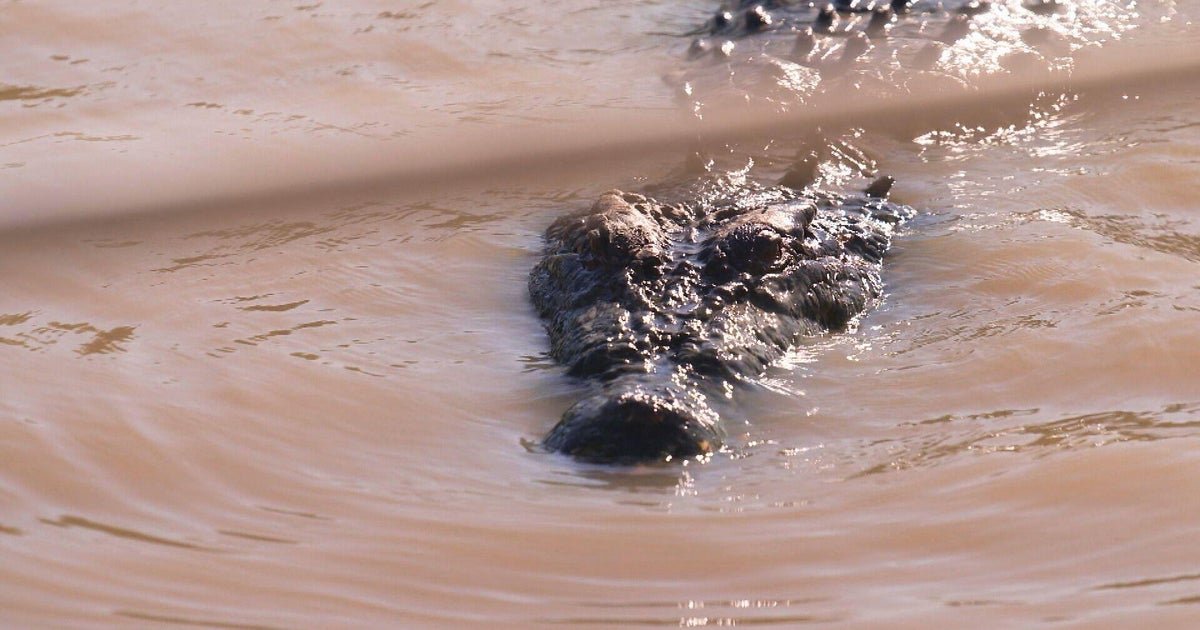
Australia’s infamous for the variety of ways its wildlife can kill you — deadly snakes, spiders, and jellyfish. But when it comes to inspiring fear, Australia’s saltwater crocodiles are in a category of their own.
They can grow to more than 20 feet, weigh over a ton, and have a bite force strong enough to crush a human skull.
Salties, as Australians call the apex predators, live across swathes of the country’s north. They’re protected by law, and because of that their numbers have surged in recent years, creating friction with another species: humans.
In the tropical city of Darwin, the sunsets on the beach are spectacular, though most people stay well away from the water.
Darwin’s surrounded by crocodile habitat – and salties are known for being territorial. A quick dip in the sea would be over in a flash if you ran into this creature.
Holly Williams: So it’s just luck…
Tom Nichols: Yeah, luck.
Holly Williams: You could go for a swim here, and be fine.
Tom Nichols: I wouldn’t – I wouldn’t go for a swim, no.
Holly Williams: Okay.
On the shores of Darwin’s idyllic harbor, crocodiles sometimes show up in backyards. Anywhere they get too close to humans, Tom Nichols and his team of government rangers have the job of removing them.
They’re known as problem crocodiles, though catching them is fairly easy, in cages baited with wild boar meat. It’s getting an angry salty out of a floating trap — with a rope, and a zip tie — that’s an art form.
Nichols told us this 6-footer wasn’t fully grown yet – but could easily kill a human.
60 Minutes
Tom Nichols: Now this size crocodile, he wouldn’t kill you by biting, unless he bit you in a certain place. But he would drown you quite easily.
Tom Nichols: He’ll take you down and under– under water. And then he– then he’ll come back up and then start spinning around.
Holly Williams: And that’s what– what they call the death roll.
Tom Nichols: The death roll. That’s correct.
That’s how a crocodile took off half of Nichols’ left hand, just over 20 years ago… in this exact spot.
Tom Nichols: With the crocodile, if he didn’t spin, I would’ve been all right. But trouble is he’s spinning. And he spun all my hand around.
Holly Williams: You operate just fine with three fingers on your left hand. Is there anything you can’t do?
Tom Nichols: Yeah. Pick my nose with my left.
All joking aside, salties are the largest reptiles on the planet — much bigger than alligators. And according to some scientists, the Australian crocs are the world’s most aggressive.
But that didn’t protect them from hunters.
By the 1970s they were so close to extinction, with just a few thousand left, that Australian officials banned nearly all crocodile hunting.
Since then, the population’s bounced back to over 150,000 and counting. That’s a conservation success story to some, a menace to others.
Trevor Sullivan: Crocodiles are way misunderstood. They’ve survived the times of the dinosaurs. And that is a question of respect.
Holly Williams: They’re also pretty scary.
Trevor Sullivan: Not really. Humans are far more scary. We kill each other for a lot less, for money. And– crocodiles only kill for food.
Trevor Sullivan keeps 10 saltwater crocodiles in his back yard, behind patched up chain link fencing.
Holly Williams: Can I stand up on the back here? Oh my god!
Trevor Sullivan: Shah, Shah!
60 Minutes 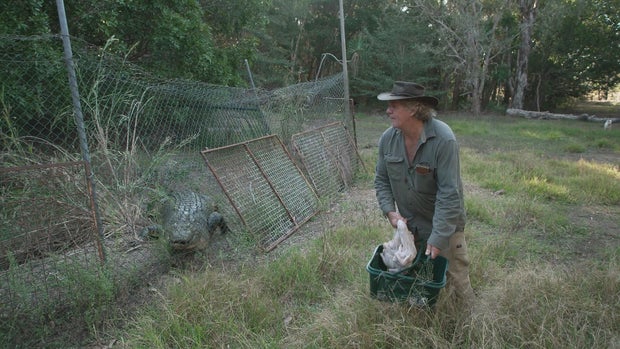
He feeds them whole chickens, by hand. He rescued most of them from crocodile farms and research facilities, including the biggest one, Shah, who’s over 120 years old, and missing part of his jaw.
Holly Williams: Trevor, what would happen if this fence wasn’t here?
Trevor Sullivan: Nothing.
Holly Williams: What do you mean, nothing?
Trevor Sullivan: I’ve fed him in there — I’ve gone in there and fed him.
Holly Williams: You go over the fence?
Trevor Sullivan: Yeah.
Holly Williams: With a 16-foot crocodile?
Trevor Sullivan: He’s not a problem – THAT one is!
Trevor Sullivan: It’s alright. It’s alright, Shah.
Sullivan’s a self-described conservationist – and told us he keeps crocodiles to prove they can co-exist safely with humans.
Trevor Sullivan: They answer to their name. They come when– you teach them. You can train them. Get them into a routine. They’re not just pets. They’re family.
Holly Williams: I’m sorry. They’re family?
Trevor Sullivan: They’re family.
Holly Williams: So just for the sake of clarity, they don’t see you as food?
Trevor Sullivan: No. I bring food.
Holly Williams: You’re also– a big chunk of protein.
Trevor Sullivan: Yes. Dogs eat meat. They– they– they don’t generally see you as food.
60 Minutes 
The truth is that crocodiles do kill people, though we were surprised to learn that only around 50 deaths have been reported in Australia since hunting was banned half a century ago.
That might be because of public education campaigns, warning people to keep a distance. Many of those who’ve been killed by salties misjudged where it was safe to swim or go fishing.
But there’s also anger in Australia that the law protects crocodiles, instead of people.
Bob Katter is a member of Australia’s parliament, with a reputation as a combative lawmaker.
Holly Williams: You’re a very popular man in these parts.
One of Katter’s most controversial positions is that he wants the crocodile hunting ban repealed.
Bob Katter: Yes, yes.
His electorate is about 1,000 miles southeast of Darwin. Much of it’s farmland, where cattle are sometimes eaten by salties.
Holly Williams: When you were growing up in Northern Australia, did you use to go swimming in– in the rivers here?
Bob Katter: Oh. Absolutely. You know, every Saturday, Sunday, you’d be down the river.
Holly Williams: Can the children do that now? Can they go swimming in the river?
Bob Katter: No. No way. No way. You would risk your life if you went near any of these waterways.
He told us he’s tempted to risk arrest by shooting a crocodile himself.
Holly Williams: You think the law is evil?
Bob Katter: Yes. Absolutely. A law that puts the value of a crocodile over a human being, that is the definition of evil.
60 Minutes 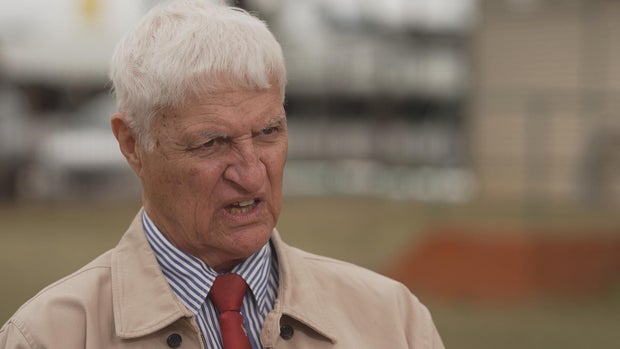
Bob Katter believes that legalizing crocodile hunting would make waterways safe again – and turn a profit by attracting big game hunters.
Other Australians disagree with his science – and his economics. They say salties are worth more alive than dead. Darwin’s roaring tourism trade relies in large part on crocodiles.
Just outside the city, you can pay for a close encounter with some cold-blooded killers.
Humans and crocodiles have shared this land for around 50,000 years. We drove to Kakadu National Park to meet some of Australia’s indigenous people. Kakadu is bigger than Connecticut: home to a few hundred people, and around 10,000 crocodiles.
Gleeson Nabulwad is an indigenous Australian who works as a river guide. Like other traditional owners, he’s permitted by law to hunt crocodiles for food.
Holly Williams: How do you hunt it?
Gleeson Nabulwad: Spear.
Holly Williams: With a spear. Is it good eating?
Gleeson Nabulwad: Yeah. They– they– they taste like fish.
Holly Williams: Like fish.
Nabulwad and his friend Robert Namarnyilk told us indigenous Australians disagree about salties just like other Australians: some favor commercial hunting, others prize them as a totem, or spiritual emblem, that should be left alone.
Robert Namarnyilk: It’s like a crocodile and us, we’ve been together for very long time.
Holly Williams: You have a special connection.
Robert Namarnyilk: Yes.
Trevor Sullivan is also of indigenous ancestry. He believes living with saltwater crocodiles is not just possible, but a privilege.
Trevor Sullivan: It’s the best fun. Being able to coexist with saltwater crocodiles, the most dangerous predator on Earth, and we– you– croc attacks are almost non-existent.
Holly Williams: But isn’t one fatal attack of a human being too many attacks?
Trevor Sullivan: Y– well, what are we supposed to die from?
Millions of years before people ever set foot on this wild land, Australia was croc country. As humans debate their future, the crocodiles are a lesson in survival.
Produced by Erin Lyall. Associate producer, Mimi Lamarre. Edited by Matthew Danowski.
